ILO marks centenary with hope for the future







The International Labour Organization was established in 1919 by the Peace Conference, which ended World War I, as an autonomous organization associated with the League of Nations, the predecessor of the United Nations. The aim of the founding members, among them China, was to promote and achieve global peace. They were of the view that peace and prosperity were the two sides of the same coin with no lasting peace possible without shared prosperity. This is reflected in the ILO Constitution which states that poverty anywhere is a threat to prosperity everywhere.
Additionally, the founding members were convinced that in order to achieve the double objective of peace and prosperity, international cooperation was essential. It is striking to note how relevant their vision still is today, 100 years later.
The ILO was entrusted with the mandate of promoting social justice, improving the working conditions of the global workforce, and supporting workers' rights and interests through international labor standards negotiated in tripartite cooperation between representatives of employers, workers and governments.
ILO is unique among global organizations
The Peace Conference created the ILO in which labor unions, employers and governments were to be represented on an equal footing. As so constituted, the ILO was, and still is, unique among international governmental organizations. It is the only one in which representatives of workers and of employers have the same status as governments.
From the start, the ILO has been an ambitious and bold organization. It was part of the League of Nations, but it started immediately a vigorous life of its own. In 1945, when the United Nations was created, the ILO became the specialized agency of the UN system for the world of work, but it kept its tripartite structure and its normative function.
In 1969, the ILO was awarded the Nobel Prize for Peace for its contribution to global peace and prosperity. Over time, while remaining true to its values, the ILO which now counts 187 member states, has adjusted its actions in response to profound political, economic, social, technological and environmental changes.
China one of the first to embrace ILO
China embraced the ILO's mandate right from the beginning, and it established its first ILO Office in May 1930 in Nanjing, Jiangsu province. The office closed in 1952 and re-opened in 1985 in Beijing. Since then, the ILO has been working with the Chinese government and social partners on a number of important issues ranging from labor legislation, labor market development, and youth entrepreneurship to social protection and occupational safety and health.
Of course, the world of work has dramatically changed in the past 100 years, not least in China. Profound transformations have, and still are, taking place under the influence of a number of factors including the advance of globalization, the spread of new technology and major demographic shifts. Today, public employment policies must cope with very rapid changes in labor markets and the private sector with young people's new professional ambitions and expectations.
In order to better understand these changes and their implications for workers and employers, Guy Ryder, ILO director-general, decided to dedicate the 100-year anniversary of the organization to the future of work. The ILO Future of Work Centenary Initiative is an invitation to all governments, workers' and employers' organizations to engage in a constructive dialogue on how to shape the future of work they want. The underlying assumption is that the future is not pre-determined by technology or any other factors. It is up to the people and their government to build it.
New technologies are a top topic of debate
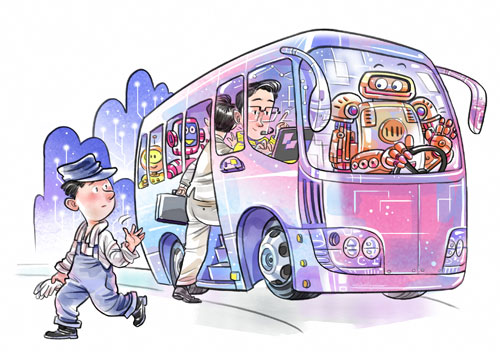
Yet if technology should not decide the future, it is likely to influence it. In fact, the impact of new technologies on the world of work is probably the topic that has generated most heated debates over recent years. How many jobs can technology create in the future? Will robots take our jobs? What do I do when my occupation no longer exists in five years' time? These are some of the legitimate questions expressing both fears and hopes because of the rapid changes.
There is no doubt that new technologies will continue to create jobs. In China for example, a third of the new jobs created over the past few years were directly linked to the introduction of new technologies. According to the 2019 report by the Sharing Economy Research Center of the State Information Center of China, the sharing economy drew 760 million participants in the country in 2018, among which service providers stood at 75 million and the number of employees hired by platforms reached 5.98 million, a 7.1 percent and 7.5 percent increase, respectively, over 2017.
But there is no doubt either that some jobs and occupations will disappear, that some skills will become obsolete more quickly than before, and that some workers will be made redundant. It is also true that not all the jobs created by new technologies are decent per definition. New forms of employment directly linked to technological innovation can indeed be temporary, insecure and unsafe, low paid and unprotected.
Report calls for a new human-centred agenda
In order to guide the global debate on the future of work launched by the ILO director-general, a global commission co-chaired by the South African President Cyril Ramaphosa and Swedish Prime Minister Stefan Lofven was established. At the end of January, the commission issued its "Work for a Brighter Future" report which calls for a new human-centred agenda.
The report intends to close the gap between the optimists who embrace innovation as a source of improvement for the world of work with more and better jobs being created, and those who fear artificial intelligence (AI), robotics or the digital economy could benefit only a few lucky ones. The report provides recommendations on how to create inclusive economic growth and decent jobs, leaving no one behind as foreseen in the UN 2030 Agenda for Sustainable Development. The first set of recommendations invites stakeholders to invest in people's capabilities, while taking measures to close the gender gaps and ensuring universal access to social protection. The establishment of universal and effective lifelong learning system is identified as a priority so as to enable workers to acquire the skills that are in demand in the labor markets.
A human-in-command approach to AI proposed
Second, the report recommends further investments in the institutions of work, including wage setting mechanisms and insists on revitalizing collective representation of workers and employers organizations. It proposes a "human-in-command" approach to AI and a global governance of digital labor platforms. Interestingly, a proposal is made for the establishment of a "universal labor guarantee" that would ensure that all workers, regardless of their form of employment, enjoy their fundamental rights, an adequate living wage, limits on their working hours and safe and healthy workplaces.
And third, the report stresses the urgent need to invest in and boost the green and rural economies. It also suggests reshaping private sector incentive structures to enable a long-term, human-centered approach to doing business. The social and environmental impact of investment ought to be better accounted for.
These proposals and many others will be discussed throughout the year in China and in many other countries. On April 11-100 years after the adoption of the ILO Constitution to the day-a high-level tripartite forum on "Joint Efforts for a Shared Future of Work" will be organized under the auspices of the Chinese Ministry of Human Resources and Social Security in Beijing. This high-level conference will mark the beginning of a series of events to be organized throughout the year as part of the ILO Centenary Initiative on the Future of Work.
Given the importance of the Chinese economy in the world and the size of China's labor force, the future of work at the global level will be strongly influenced by the future of work in China. It is with renewed energy, focus and vision that the ILO enters its second century, fully committed to working with China and its other member states for a bright future for peace, social justice and decent work for all.
The author is director of the ILO Country Office for China and Mongolia. The views don't necessarily represent those of China Daily.