Summit may yield results







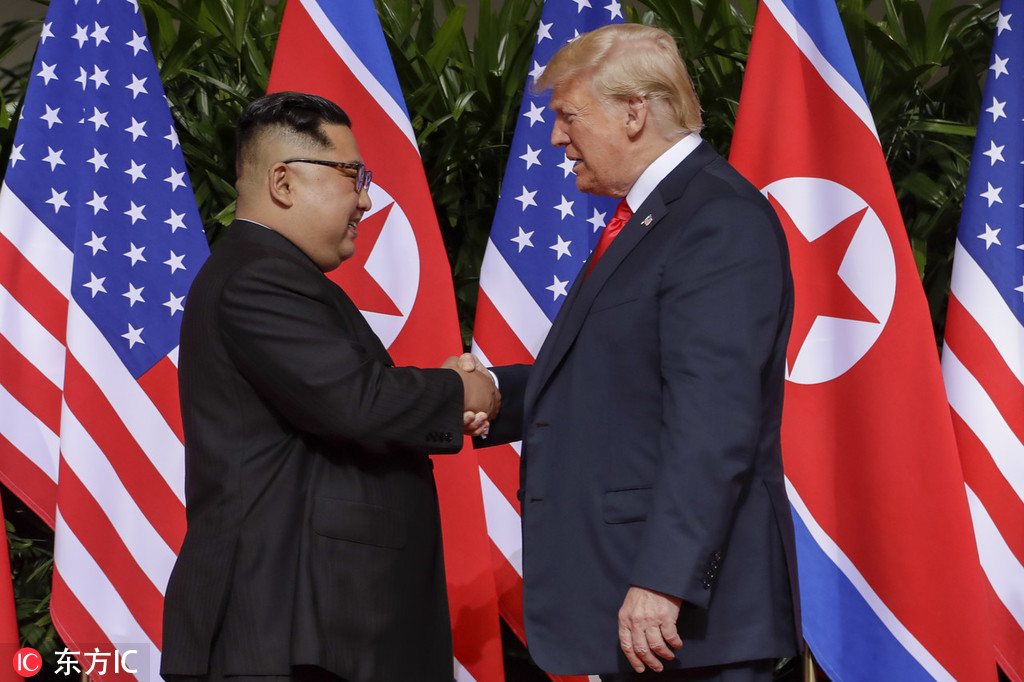
Editor's note: The international community expects the second summit between US President Donald Trump and the Democratic People's Republic of Korea top leader Kim Jong-un, to be held in Hanoi, Vietnam, on Feb 27-28, to take the Korean Peninsula peace process further forward. But will the summit fulfill people's expectations? Two experts share their views on the issue with China Daily's Pan Yixuan. Excerpts follow:
A lot at stake in second US-DPRK summit
Although the first Trump-Kim summit in Singapore in June 2018 concluded without any specific agreement on the Korean Peninsula denuclearization process, it was still a milestone for US-DPRK relations and the peninsula peace process.
But the second summit between Trump and Kim will be an exercise in futility if it ends without any specific agreement on the denuclearization process.
To propel the peninsula denuclearization process, Washington and Pyongyang should take corresponding actions to encourage each other to meet half way. Otherwise, it will be hard to break the impasse created by Washington's insistence on continuing the sanctions until Pyongyang implements "complete, verifiable, irreversible denuclearization" and Pyongyang insisting the sanctions ought to be eased in exchange for further denuclearization.
It is uncertain to what extent the US and the DPRK are willing to compromise on their rigid stances, but it appears they do have a positive attitude when it comes to denuclearizing the peninsula.
In fact, US Special Representative for the DPRK Stephen Biegun has said Washington has strived to map out "a set of concrete deliverables" for the second summit. And Trump has said Biegun had a productive meeting with DPRK officials during his visit to Pyongyang earlier this month.
Thus, Pyongyang may agree to further denuclearization, for example, by dismantling its plutonium and uranium enrichment facilities, which was one of Pompeo's demands during his October visit to Pyongyang.
And Washington could take "corresponding measures", such as agreeing to wider inter-Korean economic cooperation because, unlike the United Nations, it is not that difficult for the US and the Republic of Korea to ease unilateral sanctions against the DPRK.
But will Trump be severely criticized by US officials and politicians if he agrees at the second summit to change the US' denuclearization stance and give Pyongyang more development space? Trump will always be criticized, but if the step-by-step progress can lead to the complete denuclearization of the Korean Peninsula, the pressures on Trump could turn into praise. After all, as Trump said in his State of the Union address on Feb 5, his efforts helped avoid a US-DPRK war and eased bilateral relations.
Yang Mian, a professor at the Institute of International Relations, Communication University of China
Political trust key to peninsula peace
By deciding to hold the second summit in Vietnam, the US and the DPRK have showed their willingness to advance the negotiations. And the US' attitude is likely to make Kim feel more strategically secure, as well as promote US-Vietnam relations.
But there is little time to prepare a detailed denuclearization pact for the summit, which many expect Trump and Kim to sign.
The specifics to the framework agreement of the first summit need to be highlighted. But will the DPRK submit detailed information on its nuclear program and nuclear materials? How will Washington reciprocate? Will it ease the sanctions on Pyongyang? Will the US and the DPRK issue a joint Hanoi statement, which could form the basis for improvement of US-DPRK ties, and a Korean Peninsula peace accord based on the Korean Armistice Agreement of 1953?
The major difficulty in the US-DPRK talks is the lack of mutual political trust, which has created a security dilemma that impeded the progress of the denuclearization negotiations. Besides, positive interactions between Trump and Kim alone cannot promote overall bilateral political trust.
The mutual political mistrust casts a doubt on whether Pyongyang and Washington can find a balance of interests, especially on security issues. The two countries hold different views and stances on almost every issue. Plus, Washington has to consider the interests of its East Asian allies, the ROK and Japan in particular, when negotiating the peninsula peace process with the DPRK.
With internal and external forces wrestling for security interests, the question is whether Trump and Kim can make a substantially promising statement. For instance, will the US Congress agree to such an agreement? And after ROK President Moon Jae-in leaves office, will the next ROK president attach as much importance to inter-Korean relations as Moon does?
The lack of political trust could also cause economic disputes. Who should pay for Pyongyang's denuclearization? The DPRK's neighboring countries and the US? And how will they share the payment?
The international community should realize that with different interests involved, the deeper the peninsula denuclearization goes, the harder it will be for the parties to reach an agreement. But no efforts should be spared to restore permanent peace on the Korean Peninsula, because it is an issue concerning long-term regional development.
Ba Dianjun, head of the Institute of International Politics at and deputy director of the Northeast Asia Research Center of Jilin University