Festival consumption defies doomsayers







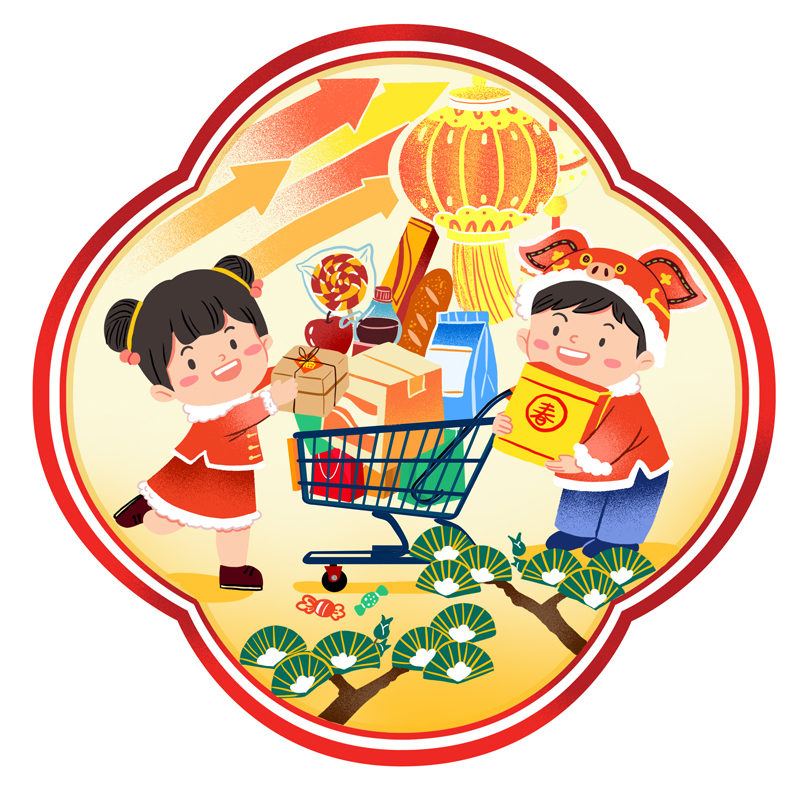
According to some international observers, the Lunar New Year sales figures indicate a plunge in Chinese consumption. Economic realities tell a different story.
The Lunar New Year can be seen as a barometer of Chinese private consumption, because of the practice of gift-giving and family reunions. Consequently, both holiday data and their international coverage are of great interest.
Record retail and catering earnings
Here's the bottom line: During the Spring Festival holiday this month, Chinese retail and catering businesses generated more than 1 trillion yuan ($148 billion), setting a new record. And sales by retail businesses increased 8.5 percent from a year earlier.
Here's how the data has been reported internationally: "the slowest increase since at least 2011" (Bloomberg), "Cooler pace of (sales) growth added to evidence the economy is slowing" (Reuters), "China's lunar new-year spending growth slowest since 2005" (Financial Times).
A dramatic plunge in Lunar New Year sales would indicate that China's ongoing rebalancing is failing-and yet, that's not the case.
One of the key reasons for retail pessimism in the international media is that holiday spending appears to have hit the profits of foreign high-end companies, such as Apple, Swatch Group and luxury carmakers.
But what's so surprising about that?
Good times drive durable and nondurable consumer goods, while uncertainty undercuts the sales of relatively more expensive consumer durables (for example, cars, appliances and furniture), and over time even cheaper nondurables (for instance, clothing, food and clothing).
Other observers have lamented that auto purchases are contracting for the first time in almost three decades. Inevitably, the United States administration's unilateral tariffs on US car imports are weighing on Chinese consumers. Last year GM's car sales were down 10 percent, Ford's fell 37 percent, Tesla had to cut prices for Model 3 in China and Jaguar Land Rover temporarily closed a factory.
US policies boost sales of homemade car models
The US' trade protectionism and tariff policies have contributed to the gains of China's domestically manufactured models, which grew about 3.9 percent last year and made up more than nine of 10 cars sold in January. And in the absence of tariffs, Japanese Toyota is expanding in China-as sales of the Japanese carmaker's vehicles surged 14 percent, while Volkswagen held its ground.
In the 1970s and 1980s, Japanese carmakers gained over US auto giants because the Japanese companies offered smaller, more fuel-efficient and affordable models. Today, Japanese and European car-makers are pushing attractive hybrid vehicles. Why? Because, unlike the US administration, the governments of China, Japan and European countries take climate change seriously.
Until spring 2018, global prospects looked positive and expansion in the US and Europe maintained momentum. It was the White House's new protectionist measures that undermined the promising future, as evidenced by the Baltic Dry Index, which rose to almost 1,800 by July 2018. But after the US administration began making good its threat to impose high tariffs on Chinese imports, the index plunged to less than 600-lower than that during the 2008 global financial crisis.
Rebalancing toward consumption on track
Like their counterparts in the West, Chinese consumers are now more cost-conscious as they should be, thanks to the tariff war. But it does not follow that China's rebalancing toward consumption and innovation is not progressing.
Despite the international negative hoopla, China's GDP growth in 2018 was broadly in line with expectations since the beginning of the year, as even the World Bank has acknowledged.
Much of the international media mistake secular, long-term trends with cyclical, short-term fluctuations. So the deceleration of Chinese growth is portrayed as a secular slowdown. In reality, deceleration reflects the eclipse of the intensive phase of industrialization, which heralds a shift to postindustrial society, and deleveraging, which will make that transition more resilient.
In the early 19th century, the United Kingdom experienced its "growth miracle". In the late 19th century, US growth accelerated. As these countries began to move toward postindustrial services, growth acceleration gave way to deceleration. That's the norm with industrializing economies. Similarly, until a decade ago, China enjoyed double-digit economic growth. But today its growth is slowing relative to its past performance.
Chinese consumption is a different story, however. In 2018, it contributed 76 percent to GDP growth. Retail sales, the key component of consumption, rose 9 percent from one year earlier, down from 10.2 percent in 2017. Yet both figures were 2 to 3 percent higher relative to overall GDP growth.
In other words, China's structural rebalancing toward consumption and innovation remains on track. That's why most analysts see consumption as the largest driver of the Chinese economy in the 2020s.
The Chinese economy has accounted for some 30 to 40 percent of global growth in recent years thanks to Chinese consumption. If and when the US-induced tariff war penalizes that consumption more, global growth prospects will be undermined accordingly.
That's the not-so-secret secret of the ongoing tariff war. Due to its importance to the global economy, China fuels growth prospects of many other economies. Consequently, unilaterally imposing tariffs on Chinese goods will penalize global economic prospects.
The author is the founder of Difference Group and has served at the India, China and America Institute (US), Shanghai Institute for International Studies (China) and the EU Centre (Singapore).