Nursing leave for only child a necessity







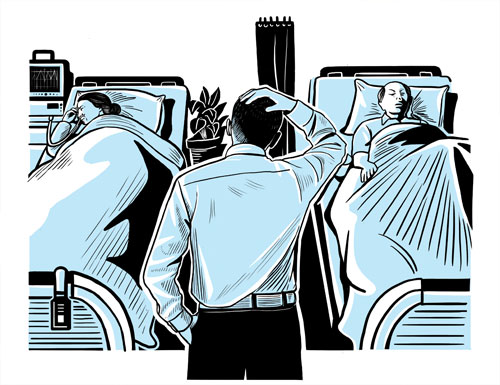
In 2016, Henan became the first province to introduce nursing leave for the only child, providing a maximum of 20 days of nursing leave per year to enable people to take care of their ailing parents. In 2018, Henan included the nursing leave for the only child into the province's ordinance on the protection of senior citizens' rights and interests.
Consecutively, more than 10 provinces, including Fujian and Heilongjiang, and major cities such as Guangzhou have introduced nursing leave-ranging from 10 to 20 days-for the only child. And Hubei and Heilongjiang provinces grant nursing leave to even non-only child for 10 days every year.
Although the public has welcomed this policy, many employees still face difficulties in getting this special leave, prompting some people to suggest that supervision and punishment for employers denying their staff of this special leave be enhanced to ensure the nursing leave policy is properly implemented. Fujian, for example, has stipulated that human resources and social security departments, along with other relevant departments, should take appropriate measures to enable the only child to enjoy paid nursing leave, and warned companies that they will be fined and listed as dishonest enterprises if they violate the regulation on nursing leave.
Why firms are denying employees their due?
It is important to analyze why many employers are denying their staff the nursing leave. Given the economic downturn, many employers have to face the pressure of rising labor cost and excessive tax and social security burden. As a result, they seem reluctant to implement any policy that could increase their labor and other costs. Therefore, the key to ensure all eligible employees enjoy the nursing leave is to distribute the cost of the leave across society rather than forcing the enterprises to bear it alone.
First, the government should include the nursing leave for the only child in its overall strategy to cope with the aging population problem. National Bureau of Statistics data show that by the end of 2018, China had more than 249.5 million people aged 60 or above, which accounted for 17.9 percent of the country's total population.
Since China's aging population is rising fast, the government should devise a foolproof plan to deal with the aging problem. For instance, the government can provide nursing subsidy for family members who take care of the aged in the family as an innovative method of public welfare.
Family nursing subsidy policy need of the hour
It would be an active and cost-efficient fiscal policy, and could save a huge amount of nursing cost for the country. Germany, Sweden, Switzerland, the United Kingdom and Japan have all introduced such family nursing subsidy policies.
Second, the entire society should share the cost of taking care of the aged. By purchasing services for the aged and providing nursing subsidy, the government could encourage various social organizations and individuals to take part in home-based eldercare. It could also launch a community registration system for the aged and volunteers, and a long-term pilot nursing insurance system to share the cost of eldercare.
Japan's Long-term Care Insurance implemented in 2000 requires all citizens above 40 to pay nursing insurance premium. Governments at various levels provide fiscal subsidy for 50 percent of the premium, and the enterprises and employees jointly pay the rest.
In Germany, multiple channels including individuals, employers, and financial and other funds are used to finance long-term nursing insurance. For those people who cannot afford to pay the premium, the government pays the entire amount of premium.
Pilot for nursing insurance
In 2016, the Ministry of Human Resources and Social Security issued a guiding document on launching pilot programs for long-term nursing insurance, earmarking 15 pilot cities as the first batch of experimenters.
Jingmen, Hubei province, one of the pilot cities, stipulated that long-term nursing insurance premium will be 0.4 percent of the local residents' per capita disposable income. Individuals will pay 37.5 percent of the premium, medical insurance funds will allocate 25 percent, and local financial funds will pay the rest. People who receive minimum living cost allowance, or are physically disabled and so cannot work and the most needy people will get full subsidy for the premium. Qualified insurers will get full time home care expenditure of up to 80 yuan ($11.91) a day or part-time home care expenditure of up to 40 yuan from the long-term nursing insurance fund.
Establishing a reasonable social cost-sharing mechanism would be an effective way of implementing the nursing leave for the only child policy. In this context, the authorities should help enterprises bear the cost of granting paid nursing leave to eligible employees using the nursing insurance fund or ease the enterprises' costs by implementing fiscal and taxation measures, in order to ensure all eligible employees get nursing leave.
The author is a professor of law at China Women's University.