Equity market outlook this year is positive







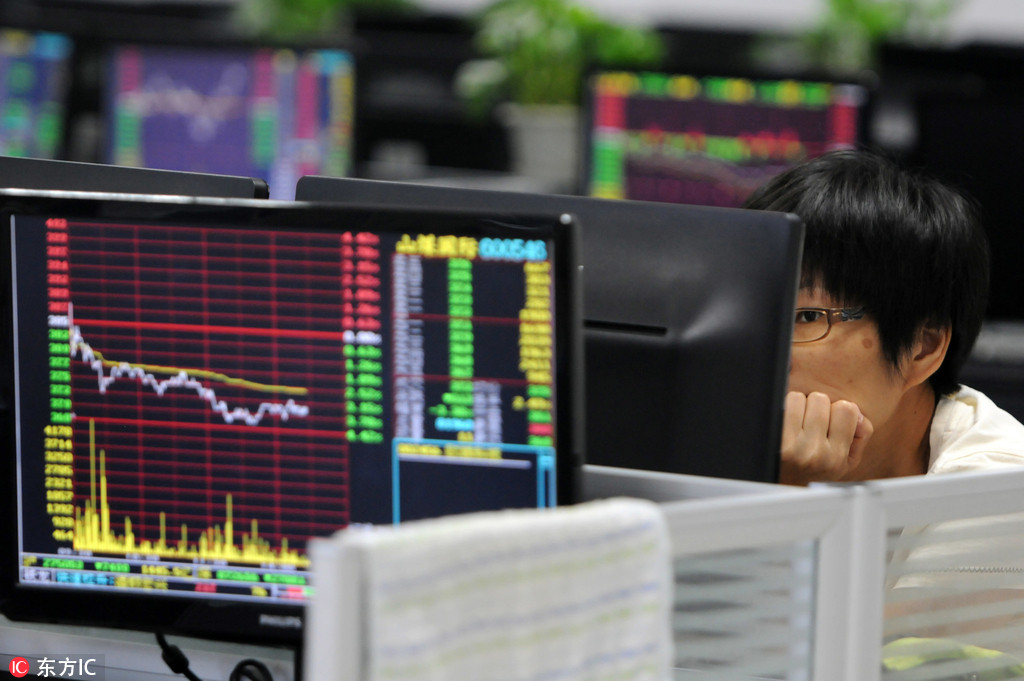
Deutsche Bank's equity market outlook for China in 2019 estimates that MSCI Inc.'s proposed increase of A-share weighting and FTSE Emerging Index's A-share inclusion could result in an inflow of $90 billion, and recommends GARP-themed investment. (GARP refers to growth at a reasonable price based on greening, advancing manufacturing, reforming State-owned enterprises and promoting consumption.)
The bank is positive about China's equity market in 2019 and has set the year-end index targets for MSCI China/CSI300 at 82/3,608, or 16 percent upside for MSCI China and 20 percent upside for CSI300 Index from the level at the end of 2018.
The spike in equity risk premium in 2018 appears to have been overdone. MSCI China's price-to-earning-ratio de-rating (or PE-de-rating) in 2018 was the third worst since 2006, next to only 2008 when the global financial crisis broke out, and 2011 when the European debt crisis happened.
The current low valuation and high-risk premium largely reflect the lowered market confidence. History shows a high probability of positive returns when PE dips below 10x. PE 10 ratio is calculated by taking the annual EPS of an equity index, such as Standard and Poor's 500, for the past 10 years, adjusting the earnings for inflation using the consumer price index, calculating the average of these real EPS figures over the 10-year period and dividing the current S&P 500 level by the 10-year average EPS number. So we expect the equity market to bottom out in the first quarter of 2019.
We believe the growth of MSCI China/CSI300 2019 earnings per share (EPS) will be between 9.0 percent and 10.2 percent, and expect the downside to the current consensus estimates are less of a concern, as actual market estimates may have already been cut. As a reminder, MSCI China gained 19 percent in 2012 on flat EPS after rounds of cuts, thanks to higher PE after a preemptive de-rating in 2011.
Besides, this year should be better than 2018 in terms of market risks and volatility since the government is using expansionary fiscal and monetary policies to counter the slowdown, which include tax cuts, boosting fixed asset investment (FAI), injecting liquidity, and improving credit transmission.
For the equity market, two important catalysts will be recovery in total social financing and a trade deal between China and the United States. Externally, a less strong US dollar, an end to the US Federal Reserve's rate hike cycle, along with the absence of divergent growth momentum between China and the US, could be of some help.
China is relying more on the fiscal side to bolster the economy and implement further tax cuts in 2019. The extent of further tax cuts will depend on the results of trade negotiations with the US, though.
We expect the FAI growth rate in the infrastructure sector to advance from low single digit in 2018 to high single digit, or even low teens in 2019. And even if the growth is not as big as before, the recovery from rapid deceleration in 2017-18 can offset potentially weakening real estate investment. The main contributor to the growth should be increasing bank loans and State budget fiscal spending, with the rally becoming more apparent after the first quarter owing to the time lag in policy shift.
We recommend four GARP-themed investments, which will continue to help China to pursue better quality of growth, although thematic basket performance could be volatile in the short term.
We have formulated top-down sector preferences after considering macro exposures, absolute and relative valuation metrics, sector analysts' bottom-up views and relative fund positions. On balance, we have a preference for new growth sectors and recommend overweight on sectors such as media and entertainment, healthcare, insurance, retailing, real estate and diversified financial, and advocate underweight on sectors such as telecom, staples, energy and information technology.
The author is equity strategist at Deutsche Bank.