More births won't solve aging problem







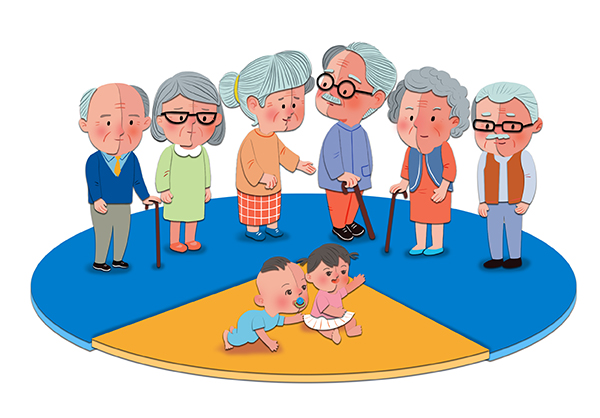
A popular view is that the one-child policy in the past acted like a huge dam on a river, holding back desired fertility. So, many people expected that as soon as the dam gates were opened, a baby boom would follow thereby greatly increasing the number of births and helping China to meet the associated challenges of an aging population and shrinking labor force.
Hence the surprise among many over a "green book" released last week by the Chinese Academy of Social Sciences that said China's population will show negative growth from 2028 if the country's fertility rate remains, as some predict, at its current low level.
Upon closer inspection of the most recent available data, it seems there was an increase in the number of second births in China, even if it was much lower than anticipated. However, this was offset by a relatively large decrease in the number of first births. In short, the impact of the two-child policy appears muted.
Policies alone don't shape birth patterns
The surprise at the relatively modest effect is grounded in the assumption that policy was (and is) the only thing that shaped patterns of childbearing in recent times in China. But this ignores the other seismic economic and social changes of the past three decades. Like elsewhere in East Asia, the direct costs of childbearing in China are often astronomical. As importantly, the indirect costs to careers-especially those of women-are often higher, affecting people's financial well-being as well as dignity.
These were all bound to have an impact both on couples' decision to have a second child and the starting of families in the first place. More fundamentally, marriage (and first births) in China generally occurs earlier than in other low-fertility settings. In common with the experience of almost all other industrial countries, then, we can expect these ages of marriage and first birth to increase somewhat.
In this context, even if policies are introduced to support childbearing, we can anticipate that total fertility rates (and total number of births) are likely to stay low in China in the foreseeable future purely because of the expected increase in the age of marriage.
So far, so little surprise.
Quite a radical conclusion
However, in response to the CASS "green book", there was a widely published quote from Yi Fuxian of the University of Madison-Wisconsin and Su Jian, an economist at Peking University which read: "A great nation, which once upon a time accounted for nearly a third of the world's total population, is gradually degenerating into a small group of the old and the weak thanks to wrong demographic policies."
Well, it is quite a leap to go from a few million fewer births than expected to such a conclusion. Looking at projected data for 2030, China will have a population of 1.22 billion aged below 70 compared with 151 million aged above 70. Is this really a country "degenerating into a small group of the old"?
And what about being "weak"? China's life expectancy has almost doubled since 1950 and is forecast to add another four years by mid-century. While concerns about smoking, diet and the effects of pollution exist, there is little doubt that China's population is getting healthier at least as measured by mortality.
So much of the writing on China-and, indeed, elsewhere in Pacific Asia-is based upon a kind of demographic determinism, of a two-dimensional view of the world. Aging is seen to be a problem; aging is "caused" by low fertility. Unless we increase fertility, we are trapped in this existential struggle against a "silver tsunami".
Yet this "balance sheet" view of the world is profoundly unhelpful. Having more babies is a very inefficient way to "fix" the aging problem. Rather, reforming the institutions which we are concerned about-pensions, healthcare and so on-and increasing both labor force participation and productivity are much more effective "cures" which can deliver immediate returns. China is, in fact, in a strong position to take this institutional "route".
More effective way of securing growth
As far as technology and innovation go, there is still much to do in terms of moving up the value chain of innovation by investing in fixed capital. In terms of human capital, China's younger population is better educated and better skilled than ever before, yet graduate unemployment and underemployment remains high. Squeezing as much as possible out of the existing human capital, not least through activating this under-used pool of young talent, is a much more effective way of securing growth and offsetting the aging problem than just creating new babies.
Lastly, I think the last few words of the quote from Yi and Su above about "wrong demographic policies" tell something about the motivation of the authors. It often seems like there is a certain schaden-freude about China's demographic travails-uniting both China's (economic) enemies and critics of the country's birth control policies. For the former, I would argue that what is good for China is probably also good for our interconnected world-or at least the region. For the latter, I too have long argued that birth control restrictions should be changed and further relaxed, if not dismantled altogether.
However, I also realize the past is the past. Whatever we might think of the decisions of our forefathers, we cannot change them now. All we can do is learn from them and respond to their consequences.
The author is an associate professor of social science and public policy, The Hong Kong University of Science and Technology.