Global pork prices in flux due to ASF







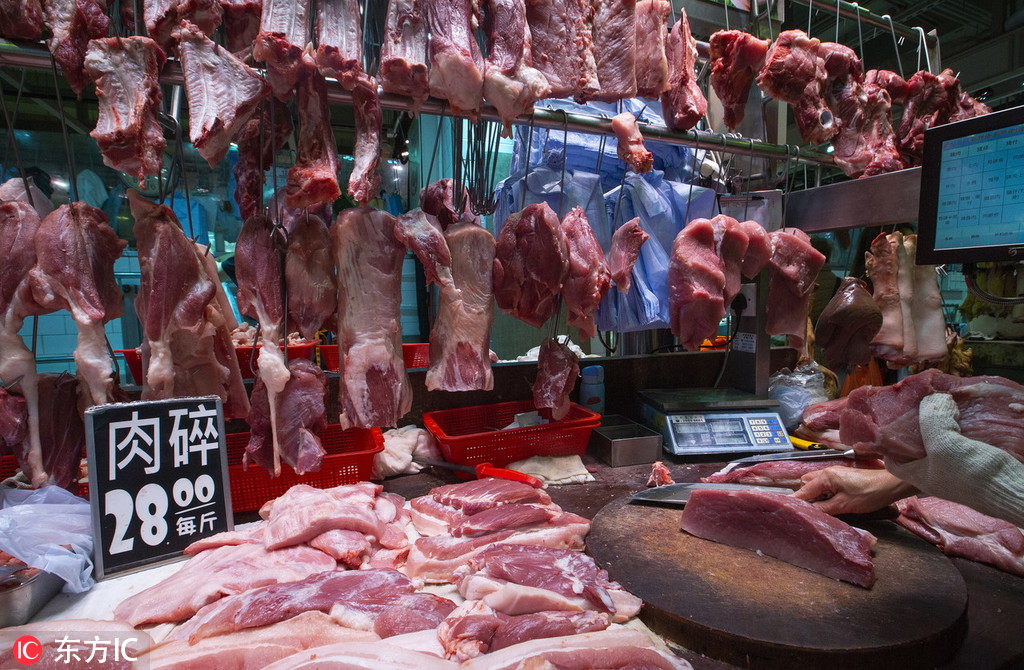
China's pork supply will determine trading trends for meat and oilseeds
China is entering the year of the pig on an apt note - its huge pork industry is sending ripples across the global commodities chain.
Traders, analysts, farmers and other stakeholders are closely monitoring how China is managing the African swine fever cases. China is the world's biggest pork producer and consumer, and ASF's impact on its pork supply and demand will determine price trends in the global meat and oilseeds trade.
According to analysts interviewed by China Daily, prices of soybeans - the main ingredient in livestock feed - may soften owing to slower demand as China culls thousands of pigs to bring the disease under control.
International hog prices, however, are expected to go up as China is seen to import pork to fill the potential shortfall in domestic supply.
"It's possible that demand for animal feed would decline (because of the ASF outbreaks). It could (also encourage China) to import more pork," said Caroline Bain, chief commodities economist of the London-based research firm Capital Economics.
"With China having the world's largest hog herd, the impact of African swine fever is significant from a global perspective," said Charles Clack, commodities analyst at the Amsterdam-based Rabobank.
China has 500 million pigs, accounting for about half of the global swine population, according to the United Nations Food and Agriculture Organization (FAO).
"The African swine fever outbreak could see a significant reduction in (China's) pork production, resulting in less demand for soymeal," said Chong Hoe Leong, commodities analyst at the Kuala Lumpur-based Public Investment Bank.
He said China is the world largest soybean buyer and the country's soybean imports affect prices of soybeans and other oilseeds. As such, the ASF situation in China is one of the key factors that will move soybean prices in the coming months.
According to data from the US Department of Agriculture, China buys for more than half of the over 150,000 metric tons of soybeans traded each year.
The USDA forecasts that China's soybean imports will slide to 90 million tons in 2019, from the previous year's 94.12 million tons. The department cited the ASF as one of the factors that will dent China's demand for soybeans.
The USDA also cited the ASF as one of the factors that will support the global pork trade. It expects pork exports to rise by 3 percent, thanks mainly to higher demand from China.
"Demand for imported pork in China is expected to increase in 2019 as end-users react to lower global pork prices and market disruptions and spot shortages caused by ASF," the USDA said in its latest report on world livestock and poultry trade.
The USDA sees China importing 1.88 million tons of pork in 2019, up 7 percent from last year. This also accounts for about 20 percent of the over 8 million tons of pork that will be traded on the global market this year.
"Ongoing outbreaks of ASF in China will further tighten the domestic supply situation," Rabobank's Clack said, noting that this will likely increase China's pork imports.
The African swine fever is one of the most devastating animal diseases and was first discovered in Kenya in 1921. The FAO said the virus can spread through direct or indirect contact, can survive for long periods in very cold and extremely hot weather, and can even be found in processed pork products.
While the virus won't affect humans, it's highly-contagious and deadly to pigs. What makes it difficult to control is the fact that there's no vaccine that can cure the disease, according to Howard Wong Kai-hay, director for professional development at the College of Veterinary Medicine and Life Sciences at City University of Hong Kong.
"There's no treatment to this virus. There's no vaccine. If you got an infected herd, the only solution is to cull the pigs. This virus is very resistant and it can last (for a long time)," Wong told China Daily. He said culled pigs have to be disposed properly as the virus can even survive in a pig carcass.
The first ASF case in China was reported in Shenyang, in the northeastern province of Liaoning, on Aug 1. Several outbreaks in over 20 provinces have been reported since then. The latest incident was reported in Jan 2, with over 4,000 pigs confirmed infected at a farm in the northeast province of Heilongjiang.
It's not yet clear how ASF came into China, but agricultural officials have repeatedly assured that the situation is under control. Yu Kangzhen, vice minister of agriculture and rural affairs, said over 600,000 pigs have been culled across the country, according to a report by Xinhua News Agency.
Local authorities have to report any outbreaks immediately and take measures to prevent the spreading of the disease. The transportation and slaughtering of pigs were also strictly monitored, while farmers were discouraged from using kitchen leftovers as hog feed to eliminate the risk of the virus being transmitted from human food to pigs.
Lean hog futures traded on the Chicago Mercantile Exchange posted record-highs. The actively traded February contract rose to a nearly two-week high of 63.425 cents per pound on Jan 2 on speculation that ASF will boost US pork exports to China, according to Reuters.
Apart from the US, key pork exporters like the European Union and Brazil are also expected to ship more meat to China this year as the ASF outbreaks curb production, according to Rabobank.