Global security faces severe challenges








The international security situation this year has been as complicated as ever. The rise of unilateralism and protectionism along with nationalism and populism, the resurgence of strong-arm politics, intensified geopolitical competitions, and incessant regional turbulence and conflicts all pose serious challenges to the global security order and rules.
Compared with previous years, the highlight of international security this year is China's warmer relations with neighbors, with the turmoil in the Middle East being the hotspot issue and the Sino-US trade conflict the biggest challenge.
First, the consensus on managing a crisis to avoid a head-on confrontation remains even though the competition between major countries has intensified. The geopolitical competition among major countries has always been an important barometer of the changes in the international landscape. But now the competition has developed new trends.
Concern over expanding geopolitical competition
The geopolitical competition has extended to multiple fields, shifting from coordination and cooperation to confrontation and rivalry. But despite the contradictions between China and the US, and between Russia and the US being the major contradictions, non-confrontation and non-conflict continue to be the bottom line in major country relations. Second, even though major countries are focusing more on traditional security, an all-out military confrontation is not likely to happen. The continuous growth in major countries' military budgets, adjustments and arrangements in their military strategies, rapid development of information technology and intelligent weapons, and the United States' withdrawal from the Intermediate-Range Nuclear Forces (INF) Treaty all show major countries have renewed their focus on traditional security. Which in turn has triggered a new arms race that lays emphasis on winning the information war. But unlike the Cold War, the impact of this arms race can still be managed.
Third, there is a notable change in the situation in the usual global hotspots. With the fierce competition among the major powers in key regions more profoundly influencing the developments in hotspot issues, regional situations seem to be swaying from one end to the other. For instance, the US' withdrawal from the Iran nuclear deal and re-imposition of comprehensive sanctions on Iran have caused much upheaval in the Middle East.
In addition, the unresolved regional and global conflicts are constantly releasing their destructive energy. For example, the European migrant crisis has had a chain reaction on Europe's political, economic and societal development, giving rise to nationalism and populism in a number of European countries, and increasing hate crimes, even turmoil.
Also, as the security situation on the Korean Peninsula improves, the Middle East and South Asia face a more complicated and turbulent situation.
Fundamental changes in Sino-US relations
Fourth, some fundamental changes have occurred in China-US relations, but the possibility of a new Cold War is low. The US has made strategic changes to its China policy, mainly in its understanding of interests, threats and attitude. It has listed China as a major competitor, a revisionist country, a neo-imperialist, a nurturer of State capitalism and an unfair trader. The US also sees China's rise as a structural challenge to its global leadership.
Accordingly, US strategies focus on dealing with so-called threats from China and Russia. Which signifies a radical change in the US' policy on China. How to reshape bilateral ties is a challenge both sides have to take up.
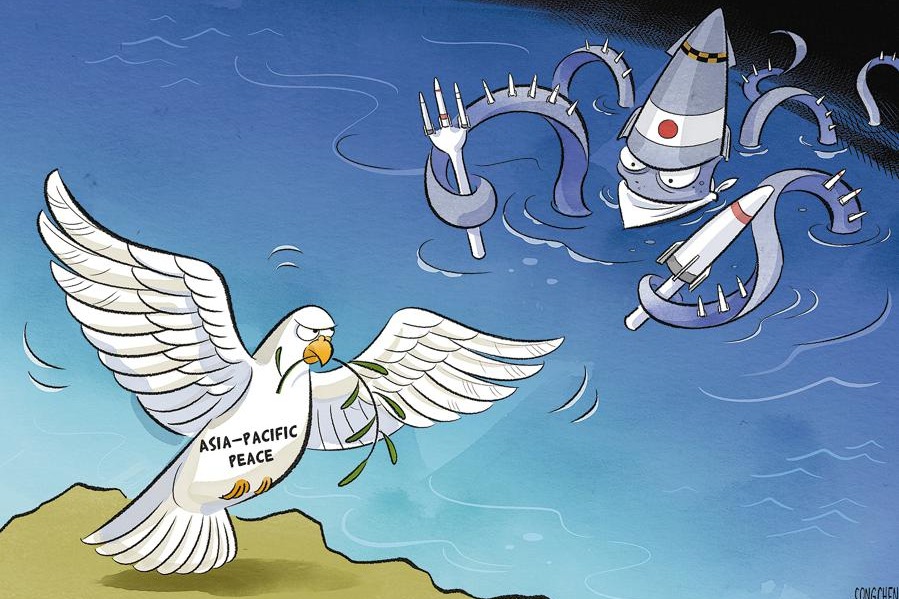
Fifth, China's relations with neighbors, including India, Japan and member states of the Association of Southeast Asian Nations, have greatly improved, although some hotspot issues could recur such as the Diaoyu Islands dispute, the South China Sea issue and the boundary dispute between China and India.
Sixth, the rapid developments in the field of science and technology have had notable beneficial effects as well as adverse impacts on societies. The rapid creation and application of new technologies including artificial intelligence, biotechnology, big data and cloud computing have brought about changes in production methods, and people's thought process and lifestyles. Still, the international community is worried about the negative impact of new technologies-for instance, they could lead to a spiritual, ethical or moral crisis, even political or economic crisis.
Nationalism a threat to global security
But despite the international order and landscape not undergoing any fundamental or qualitative changes, the pace of quantitative change appears to have gathered speed. Given such a complicated and uncertain international security situation, the international community should attempt to build a consensus on and strengthen global security governance. But since rising nationalism is threatening to shake the foundation of global security governance, giving rise to multiple new challenges, such a consensus seems a distant dream.
To begin with, the security governance system is under siege. The US withdrawal from the Iran nuclear deal and the INF Treaty has had a big impact on regional and global strategic stability and cast a shadow on the nuclear nonproliferation regime and global nonproliferation efforts.
Besides, global security governance has suffered a setback due to major countries expanding their defense budgets and attaching increasing importance to traditional security. In particular, the US administration's "America first" policy has weakened the global security governance system and violated the common security values.
And to meet their domestic political requirements, some major countries are undermining the global security governance system. For instance, when dealing with nontraditional security threats such as climate change and migrant crisis, some major countries, to fulfill their domestic agenda, have failed to honor their global commitments and thus weakened global security governance.
To address the new security challenges, President Xi Jinping has proposed the concept of common, comprehensive, cooperative and sustainable security and a path of security featuring consultation, joint contribution and shared benefits, and thus provided a practical and feasible way of maintaining world peace and security. This philosophy, if incorporated in global security governance, will make the world a secure and better place for all countries and peoples.
The author is a professor at the Institute of Strategic Studies, National Defense University.