Creating GM babies against medical ethics







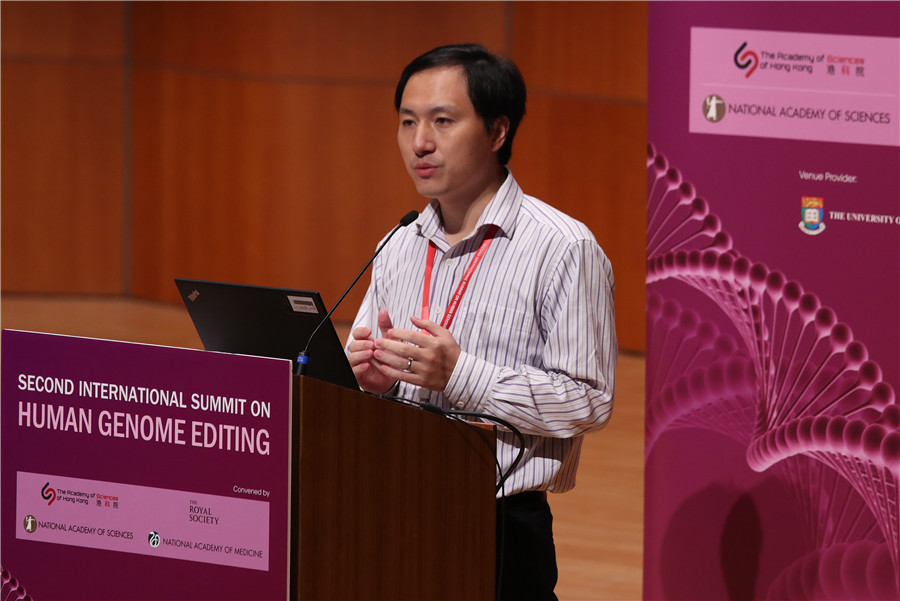
Chinese Researcher He Jiankui's claim to have used the gene-editing tool CRISPR-Cas9 to modify the CCR5 gene of twin female embryos has been met with shock and outrage across the world of science.
The reason: He flouted global conventions and ignored the risks and ethics in modifying a human gene before birth. His "experiment" even prompted the Chinese government agencies to launch an investigation into his work.
Since germline genome editing occurs in a germ cell or embryo the changes could also potentially be passed on, which could lead to risky consequences, such as off-target mutation, unintended changes in targeted cells, development of cancer and other side effects, genomic editing of human embryos-even for therapeutic purposes-should be completely suspended until thorough research proves it is safe for humans and their future generations. Otherwise, it would constitute a tremendously risky human experiment.
In the case of He, who reportedly used the CRISPR-Cas9 genome-editing tool to seek to disable a gene called CCR5-a protein doorway that allows HIV to enter a cell-the experiment was irresponsible and meaningless, because many other therapies and treatments are available to prevent HIV transmission from a parent to child, and he did not address necessary medical needs. In fact, Paula Cannon of the University of Southern California says strains of HIV do not even use the protein CCR5 to enter a cell or cells; instead, they use another protein called CXCR4.
In summary, it is unethical to expose healthy embryos to so many known and unknown risks for unknown benefits.
Germline genome editing could not only lead to many risks for children and future generations, it gives rise to a series of common ethical issues facing humans.
First, with genome editing techniques still full of so many known and unknown risks, and benefits being so uncertain, if the gene-editing tool CRISPR-Cas9 is used to modify the genes of human embryos to achieve medically "curative" results, it would certainly be detrimental to ethics and principles of medical and scientific beneficence.
Second, using genetically modified reproduction techniques would sacrifice another ethical principle of autonomy, and would be against the process of natural reproduction. Also, genome editing of human embryos even for therapeutic purposes will compromise free choice, since it will leave the future generations who can afford it no choice but to opt for it. Accordingly, the dilemma would be who should decide and whether that decision is justified.
Worse, germline genome editing even for therapeutic purposes, will eventually push humans toward a slippery slope of choosing to have "customized" children, which would create disastrous ethical problems for human society.
Once genome editing is used in reproduction, wealthy families would obviously opt for it to essentially have "designer" children", such as by enhancing their yet-to-be-born children's IQ, athletic ability, or even changing the color of their eyes and/or hair, which will lead to a resurgence of eugenics that as a movement emerged in the early 20th century. Under such circumstances, poor families will face even more unfavorable situations, and discrimination against the disabled would worsen and inequality exacerbate.
As such, how to address justice and equitability will become both legally and ethically challenging.
Finally, natural mutation, as a process of genetic variation essential for natural selection, is a recognized and accepted process in biology. In total contrast, artificial mutation, facilitated by germline genome editing, which could pass down to future generations, is an unnatural process.
Will the people created through artificial mutation enjoy as much dignity as the others who are naturally born? Or will a new class of genetically edited people emerge, disrupting the natural progress of human society? This is another important ethical issue worth considering.
Given that germline genome editing applied in clinical reproduction involves so many social and ethical issues, we should strengthen international governance of genome editing research and experiment. It's heartening to see that the concluding statements issued by both the first and second International Summit on Human Gene Editing constitute basic scientific ethical norms for genetic scientists. Nevertheless, to establish good governance in this field, international dialogue and cooperation among countries and international medical institutions, such as the World Health Organization, UNESCO and UN General Assembly, should be regularly held to spread awareness about the dangers of germline genome editing.
In the light of uncertainties in the field of gene editing, before a comprehensive international treaty is agreed to by all the countries to govern genome editing research and experiment, international soft laws such as international declarations and codes of conduct issued by international organizations should be followed so that scientists and researchers do not flout scientific and medical ethics and principles.
While basic research on CRISPR in cell lines or in somatic cells should be supported, germline genome editing for clinical uses should be subject to moratorium until it is proved to be safe and effective, and a broad global societal consensus is reached on its use. After all, germline genome editing could affect the development of humans and human society as a whole.
The author is director of the Center for Global Governance and Law, Xiamen University of Technology.