At the forefront of the Fourth Industrial Revolution







High-tech and innovations may not come up as the most intuitive or relevant topics to China, since China has been branded a "copycat" for decades. Some Western media outlets and pundits paint a picture that China's industrial regulations represent forced technology transfer, confer unfair advantages on domestic companies, penalize foreign participants and cheat on the country's commitments to the World Trade Organization.
But China has gradually moved away from its "copycat" image, especially in the past 10 years, and emerged as a global innovation hub. Grassroots innovations have proliferated. In 2017, the growth in the internet and technology sector-from ride-hailing to e-commerce, and robotics to artificial intelligence-was 18 percent, substantially outpacing the overall economy which grew 6.9 percent, according to Xinhua.
In the same year, a report by Deloitte and China Venture said China accounts for more than a third of the total number of "unicorns" globally, becoming the world's second-largest birthplace of companies valuing more than $1 billion. Internet giants such as Alibaba and Tencent, benefiting from the scale and speed of China's market as well as the prevalence of technology, are rapidly scaling up and have already created extensive sophisticated and lucrative business ecosystems. Today, Alibaba and Tencent are two of the world's 10 most valuable companies, according to Kantar and WPP's 2018 BrandZ? Top 100 Most Valuable Global Brands.
Nascent technologies hold key to the future
With plans and programs in mind, China upped the ante in nascent technologies that would, if properly captured, enable yet another age of growth and opportunities.
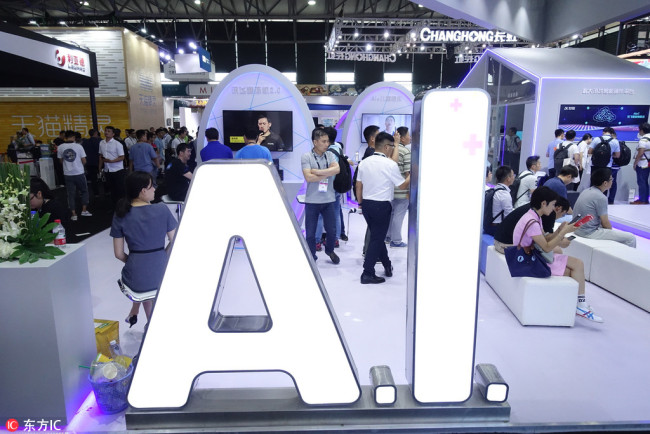
China aims to become a global AI powerhouse by 2030 with a domestic AI industry worth $150 billion. In December 2017, the Ministry of Industry and Information Technology released a three-year action plan calling for "major breakthroughs in a series of landmark AI products", focusing on such "core competencies" as the production of intelligent sensors and neural network chips. The plan is matched by governments of all levels, most notable that of Beijing and Shanghai, and Zhejiang province.
Domestic technology giants and startups alike will be the integral players in this endeavor. For example, Baidu, Alibaba, Tencent and iFlytek formed the "national AI squad", respectively backing the development of autonomous vehicles, cloud-empowered smart cities, medical imaging and voice recognition.
Up to now, two-thirds of the world's investments in this sector have flown into China and have enabled a 67 percent growth in the industry in the past year, according to recent research conducted by Tsinghua University. Chinese companies also filed the largest number of domestic AI-related patents, trumping Silicon Valley by as much as seven times, according to CB Insights, a tech market intelligence platform that analyzes millions of data points on venture capital, startups, patents and partnerships.
New value chains for use of blockchain
In China, new value chains for the use of blockchain in different industry sectors have emerged. About 450 blockchain technology companies have been registered in the country, according to the Ministry of Industry and Information Technology. The regulatory attitude toward blockchain turned from skepticism to acceptance, and now to support. Throughout 2018, the Chinese government has funded multi-billion-dollar initiatives to develop blockchain-based networks, with the Hangzhou city government investing $1.6 billion in the Global Blockchain Innovation Fund this April.
In the automotive sector, China is poised to be at the world's forefront by going through a four-phase evolution-car ownership, on-demand mobility, smart car ownership, and lastly personalized "automobility"-by 2030 or thereabouts. Traditional carmakers, foreign and domestic, are trying to reposition themselves as future electric vehicle makers, while collaborating and competing with more than a dozen of newer, non-State-owned new-energy vehicle players such as NIO, which went public at the New York Stock Exchange recently.
China will be in the front seat witnessing the turning point in the Fourth Industrial Revolution, perhaps ahead of most of, but not all, the other countries. Many foreign companies and their lobbyists have complained for long about the lack of market access to China, demanding "reciprocity". While they remain fixated on such issues, they have largely ignored the major shift in China's innovation policy and have become like observers on the sidelines.
Larger and more capable innovative economy
Innovation has become, and will continue to be, a global and prevailing theme, and a country's future well-being hinges upon its willingness and ability to embrace this trend.
The United States and its trade war against its trading partners including China notwithstanding, China will emerge as a larger and a more capable innovative economy. China's path will inevitably be marked by many ups and downs, and some of the experiments may not work out as planned while some resources may be wasted.
True, the lack of core technologies such as cutting-edge microchips has exposed China's weakness, but it has also given China the impetus to catch up.
Many startups would fail, but some will certainly succeed. Thus it would be foolhardily for anyone to discount China's will and ability to achieve its goals.
The author is founder and CEO of Gao Feng Advisory Company.