World at a crossroad on climate action







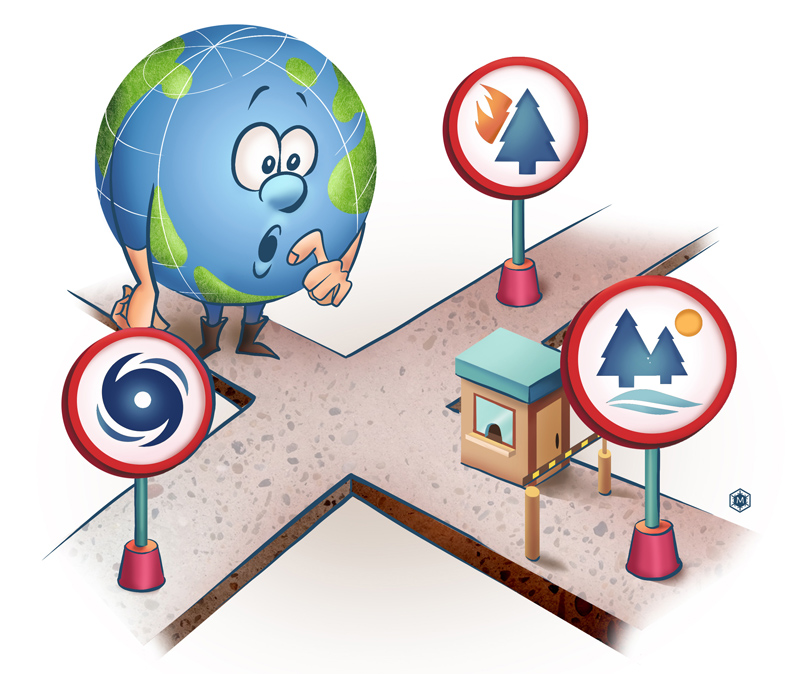
As negotiators prepare for the 24th Conference of the Parties to the UN Framework Convention on Climate Change in Katowice, Poland, the world is at an existential crossroad: it can continue on a path of gradual, but insufficient, progress on climate change, or shift to high gear to avoid the worst effects of rising global temperatures.
Fortunately, our understanding of the economic benefits of climate action is greater than ever. The world must wake up to seize these opportunities or face rising consequences of inaction. Decisions we take today will make the difference to the generations to come.
We know from the Intergovernmental Panel on Climate Change's special report, released last month, that the window to keep the world temperature from rising above 1.5 degrees Celsius is closing. We need major, immediate transformation across economic sectors, including how we generate and use energy, how we plan and live in cities, how we produce and consume food, and how we use and protect forests. We know that every additional fraction of a degree of warming can have a negative impact on economic growth, prosperity and quality of life.
The Paris Agreement, forged in 2015, brought the world together around the goal of limiting emissions below 2 C. Today, many national governments are moving forward, though not at the pace that is necessary. More encouragingly, we are seeing businesses, provinces and states, and cities making progress.
Many businesses are moving faster than governments to adopt low-carbon strategies. Nearly 500 companies have committed to set science-based targets to reduce climate-warming emissions in line with the Paris climate pact. More than 150 major companies, with a combined annual revenue of $2.75 trillion have joined the RE100 initiative, committing to power their operations entirely with renewable energy.
In the financial sector, more than 500 companies and organizations with combined market capitalization of more than $7.9 trillion have publicly committed to support recommendations of the Task Force on Climate-Related Financial Disclosures, which recognizes the need for voluntary, consistent disclosures of climate-related financial risk to investors, lenders, insurers and others.
In the United States, too, there are signs of momentum despite the Donald Trump administration's opposition. For example, a new law in California-which has the fifth largest economy in the world-requires all of its electricity must be generated by renewable energy and zero-carbon sources by 2045. California recently joined two other provincial governments in Canada, Ontario and Quebec, to create the world's second-largest carbon market.
New research conducted by America's Pledge shows that policies already adopted by US states, cities and businesses will reduce US emissions 17 percent by 2025 compared with 2005 levels. With additional action by these provincial players, the US could get to within striking distance of its Paris Agreement commitment of reducing emissions by 26 percent to 28 percent by 2025.
Major global cities are moving forward with ambitious action as well. Under the Global Covenant of Mayors, more than 1,600 cities have committed to climate action. Together, these cities could reduce emissions equivalent to 1.4 gigatons of carbon in 2030 and 2.8 gigatons in 2050 (compared with business as usual). Paris, for example, aims to be carbon neutral and powered completely by renewable energy by 2050. And Copenhagen has a plan to become the first carbon neutral capital by 2025.
Businesses, regions and cities are acting because the economic case for low-carbon economic development is strong and becoming stronger. It can benefit people's health, improve efficiency and drive innovation. According to research conducted by the New Climate Economy, bold climate action could yield $26 trillion in global economic benefits between now and 2030, compared with business as usual. But despite these shining points of light, the world is still on a trajectory for global temperature rise that could be catastrophic. National governments need to step up with ambitious policy and investment decisions to accelerate the low-carbon transition.
In recent years, China has been an important player on the global climate stage, especially in helping draft the Paris Agreement. The country set a national target to peak its emissions by 2030, though many experts suggest it could happen earlier. Also, it has invested heavily in renewable energy and electric vehicles, and accounts for more than one-third of all electric vehicles in the world, with EV sales expected to surpass 1 million vehicles this year.
But China's carbon emissions continue to rise and its coal consumption increased in 2017. Also, it should assess its investments in other countries to ensure they are climate-smart and financially sound. By pushing forward its low-carbon development strategy, China can benefit its own citizens while encouraging other countries to raise their ambition.
With signs of mounting climate impacts-from wildfires in California to record-breaking typhoons in the Pacific-the world must re-commit to bold climate action. The economics is clear, and incremental steps will not be sufficient. It's time for a decisive shift to an innovative and productive low-carbon economy.
The author is executive vice-president and managing director, World Resources Institute.