

<tt id="6hsgl"><pre id="6hsgl"><pre id="6hsgl"></pre></pre></tt>
          <nav id="6hsgl"><th id="6hsgl"></th></nav>
          国产免费网站看v片元遮挡,一亚洲一区二区中文字幕,波多野结衣一区二区免费视频,天天色综网,久久综合给合久久狠狠狠,男人的天堂av一二三区,午夜福利看片在线观看,亚洲中文字幕在线无码一区二区
          Graham Allison
          Author of Destined for War: Can America and China Escape Thucydides's Trap?
          EDUCATION

          1958-1962: BA, magna cum laude, in history, Harvard University

          1962-64: BA and MA, first class honors in philosophy, politics and economics, University of Oxford

          1964-68: PhD in political science, Harvard University

          AWARDS

          US Department of Defense's highest civilian award

          Distinguished Public Service Medal

          2009: NAS Award for Behavior Research Relevant to the Prevention of Nuclear War (National Academy of Sciences)

          CAREER

          1968-present: Professor at Harvard University

          1974-1984: Member of the Trilateral Commission

          1977-1989: Dean of the John F. Kennedy School of Government

          1985-87: Special adviser to the Secretary of Defense under US President Ronald Reagan

          1993-94: Assistant secretary of defense for policy and plans

          1995-2017: Director of Harvard's Belfer Center for Science and International Affairs

          1996 and 2000: Organizer of the Commission on America's National Interests

          Present: Advisory boards of the secretary of state, secretary of defense and the CIA director

          FAMOUS WORKS

          Destined for War: Can America and China Escape Thucydides's Trap? (2017)

          Lee Kuan Yew: The Grand Master's Insights on China, the United States and the World (2013, with Robert Blackwill)

          Nuclear Terrorism: The Ultimate Preventable Catastrophe (2004)

          Essence of Decision: Explaining the Cuban Missile Crisis (1971)

          Author who shone light on the thucydides trap
          US academic hails speed of China's development, urges Beijing and Washington to avoid conflict
          Zhang Ruinan in Boston, US
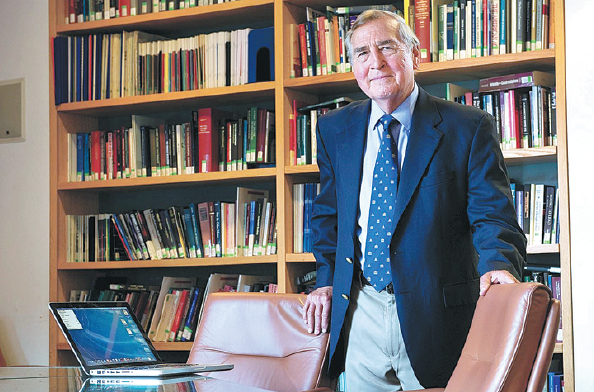
          China's modern construction techniques have impressed professor Graham Allison, pictured here in his office at Harvard.[Photo provided to China Daily]

          When asked about the changes in China that have impressed him most in the past four decades of reform and opening-up, Harvard University professor Graham Allison thought for a moment and then pointed outside his office window.

          "When I gave a presentation on my Thucydides Trap book to my students, I showed the bridge that's right under my office window here - the Anderson Bridge at Harvard - and I compared it with the Sanyuan Bridge in Beijing," said Allison, author of Destined for War: Can America and China Escape Thucydides's Trap?

          Allison said discussion of the renovation of the Anderson Bridge began when he was dean of Harvard's John F. Kennedy School of Government.

          "And I quit being the dean in 1989," he said. "The project began in earnest in 2012. It was a two-year project; and in 2014, they said it was not finished, it would take another year. In 2015, they said, 'Not yet, there will be one more year'. 2016 they said, 'We're not telling you when it will be finished.'

          "But in Beijing, the Sanyuan Bridge, which has twice as many traffic lanes as the bridge at Harvard, ... in 2015, the Chinese decided they wanted to renovate that bridge. How long did it take for the Chinese to renovate this bridge - the project that took Americans more than four years? Only 43 hours.

          "This is a pretty dramatic illustration of how China has very modern construction techniques, so that could be a very good lesson for Americans to learn," Allison said.

          But the contrast in the bridge renovations is just one example of the accomplishments China has made over the past 40 years, he said.

          This year marks the 40th anniversary of China's reform and opening-up, a policy initiated by Deng Xiaoping at the Third Plenum of the 11th Communist Party of China Central Committee in December 1978.

          These economic changes were so far-reaching that Deng described them as part of China's "second revolution".

          Since then, the country has become an economic giant with the world's largest foreign reserves ($3.2 trillion) and second-largest GDP ($12 trillion), while foreign direct investment in China reached $135 billion last year.

          According to Bloomberg, China's share of the global economy had grown from 1.8 percent in 1978 to 15 percent by 2017.

          "I first went to China in the 1980s," Allison said. "At that time, Shanghai was hardly Shanghai today. Everybody wore the same clothes, everybody seemed to struggle with life; there were not many cars, not much major building... a poor country and not that modern."

          Allison said he was invited by one of his students - the first Chinese to study for a master's at the Harvard Kennedy School. Today, more than 1,000 Chinese students are enrolled at Harvard.

          "But China now, in Shanghai or Beijing or any of other hundreds of cities, is a modern wonder," Alison said. "Infrastructure, airports, subways, skyscrapers, cars, all look very modern. They are modern cities indeed.

          "If you look at the opening up of peoples' minds, the improvement is also very significant. In 1978, most Chinese people never traveled abroad, but today about 10 to 15 percent of Chinese have traveled abroad. However, the biggest accomplishment of the reform and opening-up policy is what I call inverting the pyramid of poverty - in 1978, 90 percent of Chinese were living below the World Bank's extreme poverty line of $2 per day."

          As a result of reform and opening-up over the past 40 years, the pyramid has been turned on its head, "and now only 1 percent live below the extreme poverty level", Allison said. "The fact that in this single lifetime, some people have seen a 50-fold rise in their standard of living is amazing," he added.

          According to Chinese government statistics, 250 million people in rural areas lived below the national poverty line in 1978. By the end of last year, the figure had fallen to 30 million.

          In 2000, the United Nations announced eight millennium development goals, and at the top of that list was to halve the number of people living in extreme poverty before 2015. Just four years later, in 2004, Robert Zoellick, then president of the World Bank, declared that "China's efforts alone" had put the world on track to achieve this goal.

          "Between 1981 and 2004, China succeeded in lifting more than half a billion people out of extreme poverty," Zoellick said. "This is certainly the greatest leap to overcome poverty in history."

          In 2010, five years ahead of deadline, Zoellick declared mission accomplished, thanks primarily to China's success.


          1 2 Next   >>|
          Graham Allison
          Author of Destined for War: Can America and China Escape Thucydides's Trap?
          EDUCATION

          1958-1962: BA, magna cum laude, in history, Harvard University

          1962-64: BA and MA, first class honors in philosophy, politics and economics, University of Oxford

          1964-68: PhD in political science, Harvard University

          AWARDS

          US Department of Defense's highest civilian award

          Distinguished Public Service Medal

          2009: NAS Award for Behavior Research Relevant to the Prevention of Nuclear War (National Academy of Sciences)

          CAREER

          1968-present: Professor at Harvard University

          1974-1984: Member of the Trilateral Commission

          1977-1989: Dean of the John F. Kennedy School of Government

          1985-87: Special adviser to the Secretary of Defense under US President Ronald Reagan

          1993-94: Assistant secretary of defense for policy and plans

          1995-2017: Director of Harvard's Belfer Center for Science and International Affairs

          1996 and 2000: Organizer of the Commission on America's National Interests

          Present: Advisory boards of the secretary of state, secretary of defense and the CIA director

          FAMOUS WORKS

          Destined for War: Can America and China Escape Thucydides's Trap? (2017)

          Lee Kuan Yew: The Grand Master's Insights on China, the United States and the World (2013, with Robert Blackwill)

          Nuclear Terrorism: The Ultimate Preventable Catastrophe (2004)

          Essence of Decision: Explaining the Cuban Missile Crisis (1971)

          Author who shone light on the thucydides trap

          US academic hails speed of China's development, urges Beijing and Washington to avoid conflict
          Zhang Ruinan in Boston, US
          China's modern construction techniques have impressed professor Graham Allison, pictured here in his office at Harvard.[Photo provided to China Daily]

          When asked about the changes in China that have impressed him most in the past four decades of reform and opening-up, Harvard University professor Graham Allison thought for a moment and then pointed outside his office window.

          "When I gave a presentation on my Thucydides Trap book to my students, I showed the bridge that's right under my office window here - the Anderson Bridge at Harvard - and I compared it with the Sanyuan Bridge in Beijing," said Allison, author of Destined for War: Can America and China Escape Thucydides's Trap?

          Allison said discussion of the renovation of the Anderson Bridge began when he was dean of Harvard's John F. Kennedy School of Government.

          "And I quit being the dean in 1989," he said. "The project began in earnest in 2012. It was a two-year project; and in 2014, they said it was not finished, it would take another year. In 2015, they said, 'Not yet, there will be one more year'. 2016 they said, 'We're not telling you when it will be finished.'

          "But in Beijing, the Sanyuan Bridge, which has twice as many traffic lanes as the bridge at Harvard, ... in 2015, the Chinese decided they wanted to renovate that bridge. How long did it take for the Chinese to renovate this bridge - the project that took Americans more than four years? Only 43 hours.

          "This is a pretty dramatic illustration of how China has very modern construction techniques, so that could be a very good lesson for Americans to learn," Allison said.

          But the contrast in the bridge renovations is just one example of the accomplishments China has made over the past 40 years, he said.

          This year marks the 40th anniversary of China's reform and opening-up, a policy initiated by Deng Xiaoping at the Third Plenum of the 11th Communist Party of China Central Committee in December 1978.

          These economic changes were so far-reaching that Deng described them as part of China's "second revolution".

          Since then, the country has become an economic giant with the world's largest foreign reserves ($3.2 trillion) and second-largest GDP ($12 trillion), while foreign direct investment in China reached $135 billion last year.

          According to Bloomberg, China's share of the global economy had grown from 1.8 percent in 1978 to 15 percent by 2017.

          "I first went to China in the 1980s," Allison said. "At that time, Shanghai was hardly Shanghai today. Everybody wore the same clothes, everybody seemed to struggle with life; there were not many cars, not much major building... a poor country and not that modern."

          Allison said he was invited by one of his students - the first Chinese to study for a master's at the Harvard Kennedy School. Today, more than 1,000 Chinese students are enrolled at Harvard.

          "But China now, in Shanghai or Beijing or any of other hundreds of cities, is a modern wonder," Alison said. "Infrastructure, airports, subways, skyscrapers, cars, all look very modern. They are modern cities indeed.

          "If you look at the opening up of peoples' minds, the improvement is also very significant. In 1978, most Chinese people never traveled abroad, but today about 10 to 15 percent of Chinese have traveled abroad. However, the biggest accomplishment of the reform and opening-up policy is what I call inverting the pyramid of poverty - in 1978, 90 percent of Chinese were living below the World Bank's extreme poverty line of $2 per day."

          As a result of reform and opening-up over the past 40 years, the pyramid has been turned on its head, "and now only 1 percent live below the extreme poverty level", Allison said. "The fact that in this single lifetime, some people have seen a 50-fold rise in their standard of living is amazing," he added.

          According to Chinese government statistics, 250 million people in rural areas lived below the national poverty line in 1978. By the end of last year, the figure had fallen to 30 million.

          In 2000, the United Nations announced eight millennium development goals, and at the top of that list was to halve the number of people living in extreme poverty before 2015. Just four years later, in 2004, Robert Zoellick, then president of the World Bank, declared that "China's efforts alone" had put the world on track to achieve this goal.

          "Between 1981 and 2004, China succeeded in lifting more than half a billion people out of extreme poverty," Zoellick said. "This is certainly the greatest leap to overcome poverty in history."

          In 2010, five years ahead of deadline, Zoellick declared mission accomplished, thanks primarily to China's success.

          主站蜘蛛池模板: 亚洲综合在线亚洲优优色| 狠狠色综合播放一区二区| 人妻中文字幕精品一页| 最近中文字幕在线视频1| 色综合色综合色综合频道| 人妻在线无码一区二区三区| 国产综合视频一区二区三区| 成人内射国产免费观看| 亚洲日韩亚洲另类激情文学| 亚洲婷婷综合色高清在线| 亚洲中少妇久久中文字幕| 亚洲国产精品成人av网| 性动态图无遮挡试看30秒| 亚洲av综合a色av中文| 一区二区三区一级黄色片| 无码国产精品一区二区AV | 亚洲综合精品香蕉久久网| 四虎成人在线观看免费| 亚洲日本va午夜中文字幕久久| 亚洲性线免费观看视频成熟| 国产毛片三区二区一区| 人妻少妇偷人精品一区| 欧美亚洲另类制服卡通动漫| 在线免费播放av观看| 国产精品亚洲二区在线播放| 国产av一区二区三区| 久久国产自偷自免费一区| 亚洲av久久精品狠狠爱av| 国产精品一区二区三粉嫩| 国产偷窥熟女高潮精品视频| 老司机久久99久久精品播放免费| 亚洲精品区二区三区蜜桃| 免费乱理伦片在线观看| 在线观看无码av五月花| 国产重口老太和小伙| 亚洲AV小说在线观看| 少妇人妻真实偷人精品| 漂亮人妻被中出中文字幕久久| 国产黄色精品一区二区三区| 亚洲成人www| 丁香五月亚洲综合深深爱|