Tariffs crimping supply chains; businesses adjust







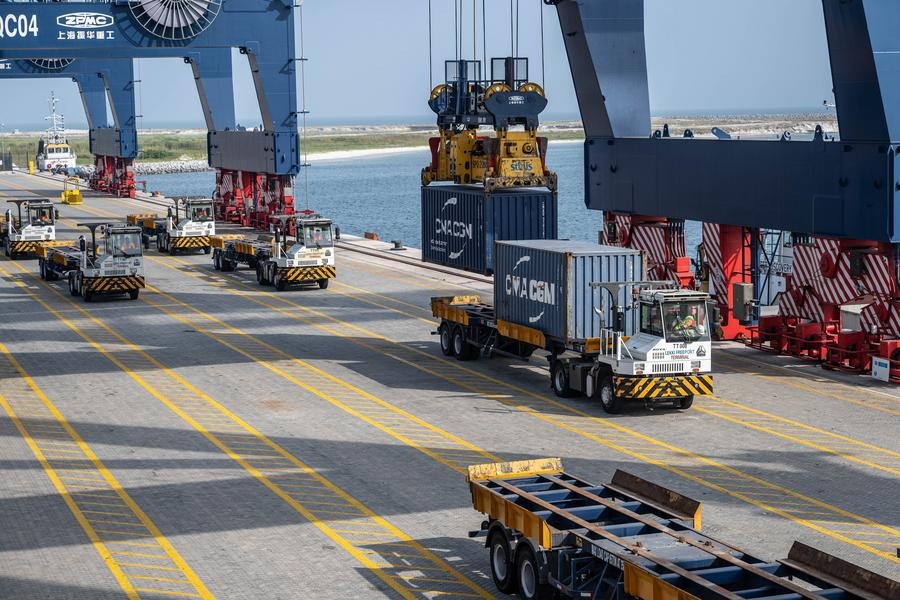
NEW YORK — The US administration’s tariffs on Chinese products, extended by $200 billion more in goods in September, are forcing businesses to rethink their supply chains.
But given China’s comparative advantages as well as cost and market rules, it will not be easy to shift the supply chains away from China, US trade experts have told Xinhua.
“Tariffs are taxes that raise costs for businesses and consumers. Families will see higher prices for countless products. For retailers, tariffs are very disruptive to complex global supply chains,” US National Retail Federation (NRF) spokeswoman Bethany Aronhalt told Xinhua.
“Right now, retailers are assessing their supply chains to determine possible alternative sources, but for certain products, China is the only source that exists,” she said.
The NRF is the world’s largest retail trade association representing discount and department stores, grocers, wholesalers, chain restaurants and internet retailers from the United States and more than 45 countries and regions.
The group, the spokeswoman said, holds that “tariffs and the retaliatory actions that follow are a threat to just about every sector of the US economy, including manufacturing, agriculture, technology, retail, energy and more”.
Adjusting supply chains is “not that simple in a global economy. Businesses make production or sourcing decisions months and years in advance, and they rely on very complex supply chains,” she said.
“Retailers and other importers could not easily or quickly switch to domestic sources because they do not exist on the scale that would be needed,” she said.
“Even if there were to be an eventual switch to US sourcing, it would take years to build up a base to support it. And for many products subject to tariffs, China is the sole source of US imports. No alternative sources exist,” she said.
As the new wave of tariffs that came on top of the $50 billion worth already taxed earlier this year begins to make China look more expensive, few other places around the world can match China’s advantages — its highly skilled workforce and the reliability of the supply chains.
Before the tariffs, some labor-intensive manufacturers already had started leaving China, as the country’s wages have risen for the past 10 to 15 years, Mary Lovely, an American professor of economics and an expert on trade with China, told Xinhua.
They have already seen apparel, footwear, toys, sporting goods and some electronics moving elsewhere in Asia.
“These are things that we would expect because as China develops, the rest of East Asia or the poorer countries of East Asia also expect to be pulled along with that train,” said Lovely, who is a professor of economics at Syracuse University and a nonresident senior fellow at the Peterson Institute for International Economics.
“China is an engine of growth for the region, so none of that is surprising,” she said, adding that “the tariffs will likely accelerate that”. She said that firms considering moving will probably do so because the additional 25 percent tariffs will make it tough for them to compete with subcontractors in other countries not facing tariffs.
“And that puts competitive pressure on China so it will accelerate changes in global value chains,” she said.
But not all firms can do that, Lovely said.
For one thing, companies produce or purchase higher-value items from China, which are made by more highly skilled labor and reflect developed relationships, she said.
“Many of those supply chains are certified by the FDA (Food and Drug Administration) in the United States or other regulatory bodies, and moving them is difficult,” she said.
She warned that “the uncertainty causes a kind of paralysis on investment, and we are already seeing some slowdown in investment flows”.
According to data from the US Bureau of Economic Analysis released in July, net foreign direct investment dropped to $51.3 billion in the first quarter, a 37 percent fall from the same quarter in 2017 and a 65 percent decline from the first quarter of 2016.
Michaels, a Texas-based arts and crafts retail chain, warned in early September that retail prices could be hit by the US administration’s new round of tariffs on Chinese imports.
An estimated $400 million of its product costs would be subject to those tariffs, CEO Chuck Rubin told a Goldman Sachs Group Inc retail conference in New York on Sept 5.
While the company with a large bulk of its goods imported from China is looking into shifting manufacturing to other countries, he said, “There is virtually no possibility of moving manufacturing into the US.”
Companies that are forced to rethink their sourcing may find their hands tied as “supply chains are built by companies with great care and substantial analysis”, said Professor Robert Sicina, executive in residence of the Kogod School of Business at American University in Washington DC.
“Without consistency, firms will move their supply chains away from the US, not towards it. This is just one example of the unintended consequences of President Trump’s actions,” said Sicina.
“The supply chain is always going to move to where the economics are best,” he said, adding that “the economics are overwhelmingly in favor of China”.
Another major, long-term unintended consequence, Sicina said, is that “foreign investment in the US will also be disrupted because of the tariffs”.
When investment flows into the United States, foreign investors have to consider the country’s trade policies, as extra tariffs will affect investors’ ability to import raw materials and export their products, Sicina said.