China and EU can jointly counter protectionism







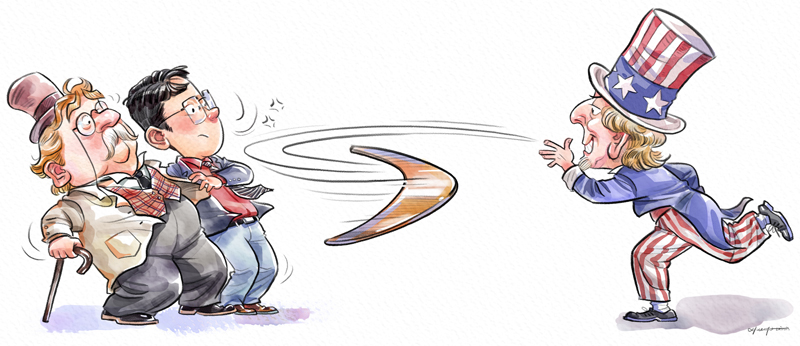
Wherever we look today, free trade is facing hard times. Over the past several months, we have been witnessing an unprecedented violent trial of the contemporary world order, which is taking place on several fronts: first, the criticism of cultural globalization, accompanied with the clash of identities; then the fear of political globalization, with the inefficiency of multilateral institutions (the United Nations, World Trade Organization, the 2015 Paris climate accord); and finally, the rejection of economic globalization, which we can see in the protectionist temptation blowing across the Atlantic.
On the latter, there are many examples of regional and international treaties whose hours are counted or the credibility has been compromised. North American Free Trade Agreement member states are divided, ratification of the Comprehensive Economic and Trade Agreement lags behind, the transatlantic partnership is stalled and the Trans-Pacific Partnership Agreement is structurally weakened by the United States' withdrawal. Only Africa is trying to move forward with the creation of a Continental Free Trade Area, led by the African Union, and with the renegotiation of the Cotonou Agreement.
My conviction is that the stability of the world economy is in the hands of the only powers capable of moderating the jolts of the US, which has become unpredictable and impetuous: Because the European Union and China together weigh nearly one-third of the global GDP, their agreement will be decisive for bending the destructive spiral triggered by the successive setbacks to world trade. China and the EU are facing the same challenges, that of a trade war and a spiral of retaliation.
The 20th EU-China Summit, hosted by Beijing in July, served to identify several common goals. First, China and the EU want to respond to the risk of an economic slowdown by consolidating economic and trade relations, which makes the former the main partner of the latter with more than 570 billion euros ($665 billion) of exports.
Second, they intend to search for concrete means to cope collectively with the protectionist measures of the US, which, in the absence of an alternative, could durably darken the prospects for world growth. The challenge for both parties is to anticipate a decline in trade with the US and to offset in the long term, the potential decline in exports. This means that beyond purely judicial actions, like WTO complaints, the future of world trade must be based on concerted initiatives, combined with the confidence of the people, the commitment of the states and the involvement of civil society.
We need structures and projects adapted to this new context. On the economic front, the priority is to resolve a number of mutual misunderstandings or anxieties between China and the EU. On both sides, fears are legitimate. And on both sides, the potential of financial and commercial exchanges is a powerful driver of growth. I am thinking in particular of the Belt and Road Initiative, about which the French senate recently presented a detailed report. Beyond apprehensions, this massive investment project in infrastructure and innovative sector, such as energy, digital and healthcare, offers Chinese and EU companies the opportunity to work together to develop the Eurasian zone. The initiative is an unprecedented opportunity to enhance mutual financial flows and to foster joint projects in third markets, starting with Africa, whose needs will continue to increase.
This implies common management, shared priorities and safeguards against the risks of drift and competition. But we also need discussions and collective decisions, at national and European levels, to streamline relations between companies, ensure the clarity of legal rules and nurture economic thinking on reciprocity, on access to public procurement and on protection of intellectual property. Highlights include G3-based financial stability between major central banks (the European Central Bank and the People's Bank of China for example) and the response to the climate emergency.
The calendar of the coming months is favorable to the impetus of a new EU-China policy. In Brussels, the imminence of the European elections, next May, imposes a clear and frank debate on the renewal of economic relations with China. In China, the celebration of the 40th anniversary of reform and opening-up provides a fertile ground for deepening economic openness in a country so sensitive to history, symbols and long-term dialogue. China needs to be more open to enterprises and investment. But let us first work on the conditions for a peaceful dialogue.
In France, we can rely on major milestones in our shared history, from the pioneering recognition of the People's Republic of China by former French president Charles de Gaulle, in 1964, to the creation of the global strategic partnership in 2004 by another former French president Jacques Chirac. The new era promoted by President Xi Jinping for his country must be the opportunity for new deals in France-China and EU-China relations in the spirit of the first visit to Beijing of French President Emmanuel Macron, last January.
The author is former prime minister of France. The author contributed this article to China Watch, a think tank powered by China Daily.