Australia's 5G ban not in global interest







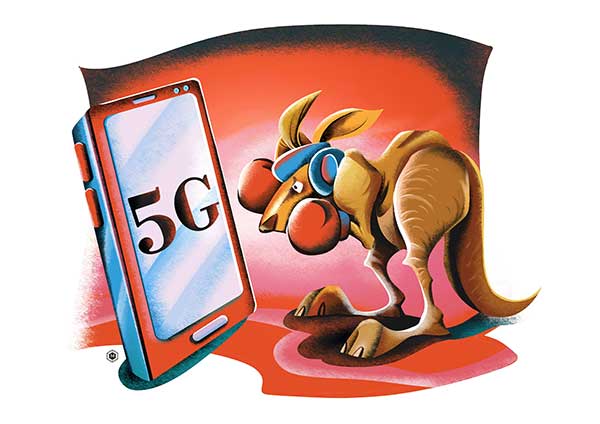
The Australian government's recent decision to ban Huawei from supplying 5G mobile network infrastructure equipment for security reasons is about to meet more crosswinds.
But before we go into the verdict, let us accept the fact that technological breakthroughs have introduced humans to an interface which has been socioeconomically transformational. Against this backdrop, the high priority China has attached to high-tech and tech-intensive development has generated a lot of political and economic interests globally. While China has mastered electronics manufacturing and become a formidable producer of information technology hardware, the tenets of global competition and the resulting conflicts have, until now, largely remained confined to politicization.
If we consider the huge benefits of 5G and its total commercial value and success, the matter would boil down to the fact of who can exploit it better, if not best. The Republic of Korea, the United States and Japan are not only the dominant players in 5G technology, but also competing with China to demonstrate their dominance in advanced technologies, with artificial intelligence being one of them.
If one goes by the sheer size of investment in 5G research and development, the US, the ROK and Japan are competing against each other (and against China) to launch the first commercial network, and 5G is believed to become widely popular faster than any other mobile technology.
Yet the slowing economic growth, market fragmentation, the amount of spectrum available, and the regulatory influence may pose a greater challenge to the proliferation of 5G technology in the developed world. In the US, for example, AT&T is the only company that has announced it would use 5G technology in selected cities. The case of Europe and rest of the world, including Australia, is not so different.
One needs to understand the emerging dichotomy. While many Western tech companies are still trying to show what they could offer or do with 5G technology and continue to invest in future technologies, big high-tech players would turn to China for mass production of hardware and eventually a huge consumer base. A Western high-tech giant, Qualcomm Inc, is already looking at China as a hot prospect. On the sidelines of US President Donald Trump's state visit to China in November, Qualcomm signed $12 billion worth of deals with three Chinese mobile handset makers (Xiaomi, Oppo and Vivo) to sell components over three years. Let's not forget, Qualcomm earns more than half of its revenue in China.
The 5G telecommunications network could emerge as the largest generator of entrepreneurs as well as consumers in China, and help its economy to transition to a higher stage. This is something that has not been evident in other economies with similar set of credentials.
According to media reports, 5G will go into operation in 2020, with the number of 5G users worldwide exceeding 1 billion by 2023-and more than half of which would be in China.
Different tech and telecom companies are racing to build products for 5G wireless networks, and a government cannot ban a company by assuming it could play dual roles. The Australian government's stance that it cannot allow a company to supply 5G mobile network infrastructure equipment as it can be "subject to extrajudicial directions from a foreign government that conflict with Australian law" is not a convincing reason for the ban on Huawei.
Worse, the Australian decision could potentially derail the advent of 5G technology globally and also disrupt the global supply chains in the telecom and semiconductor sectors.
The author is a senior fellow at the Research Institute of Maritime Silk-Road, Peking University HSBC Business School.