Belt and Road Initiative: Transforming the future







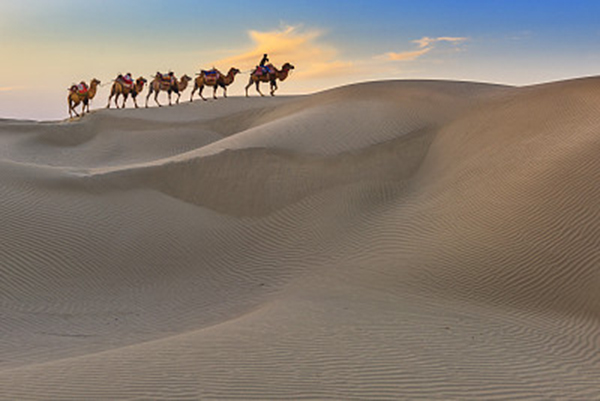
Roads have played crucial part in the history of the world. They have played key role in the economic, social and healthcare development. From ancient times the roads have been shaping the history of the world. They have driven trade networks leading to cultural exchanges, including the spread of technology, ideas, knowledge, and sometimes even bacteria. From the oldest civilization to the modern era some routes have become popular. Among these are spice route, incense route, amber route, tea route, salt route, trans-Saharan trade route, tin route but the most important among them which left an inerasable mark on the map of the world was the Silk route. The Silk Road history dates back to the first century BCE when it linked China to the Roman Empire for trade of silk from China in exchange of wool, silver and gold from Europe.
In order to re-establish and reconnect the nations using the old routes Chinese President Xi Jinping took the initiative in late 2013 and started to carve the routes along original Silk Road pathways through countries neighboring China (One Belt), to a new Maritime Silk Road that goes by sea to link with other countries in Asia and Africa (One Road) calling it One Belt One Road and later Belt and Road Initiative. This initiative is by far one of the of the largest infrastructure and investment projects in history, covering more than 68 countries, including 65 percent of the world's population and 40 percent of the global GDP as of 2017. Belt and Road is a massive trade and infrastructure project that aims to link China physically and financially to dozens of economies across Asia, Europe, Africa, and Oceania.
The Belt and Road Initiative can be a game changer for China making it more powerful in the East. The economic corridor by land and sea can be booster for local infrastructure development, transport, energy, technology, innovation and healthcare development. As this year marks the 5thanniversary of Belt & Road Initiative, the planning phase of BRI has almost been completed and now we are in the early and middle phases of implementation and most of the infrastructure projects in the Asia and Africa are in the development phase. The political stability and peace is important for these projects to proceed further and most of the corridors selected are progressing swiftly.
I come from Pakistan, Chinese call us “Iron Brother” and we call Chinese “"all-weather friend"” The friendship is higher than the Himalayas, deeper than oceans and sweeter than honey. During the state visit of President Xi to Pakistan in April 2015, he wrote in an open editorial that: "This will be my first trip to Pakistan, but I feel as if I am going to visit the home of my own brother." On April 20, 2015, Pakistan and China signed an agreement to commence work on the $46 billion agreement, which is roughly 20 percent of Pakistan's annual GDP. China Pakistan Economic Corridor is one of the key parts of the Belt and Road Initiative. Originally estimated at $46 billion, the value of CPEC projects is now worth $62 billion. CPEC is aimed at regional integration for peace and economic development. Pakistan is geographically placed at an important location and the CPEC will be a game changer for Pakistan development. Gwadar, a small village along the ocean which was hidden from the world eyes, is set to become the New Dubai. The CPEC includes Gwadar port, energy, transport infrastructure, free trade zones and healthcare projects.
The Gwadar port will act as means to circumvent the straits of Malacca in case of hostile situation. From Gwadar to Xinjinag, the 3,000 km and another 3,500 from Xinjiang to China’s eastern coast is much quicker route than the sea route of 12,000 km along the straits of Malacca. Chinese companies have started to train the local people and it will be helpful for the poverty alleviation domestically. The transport infrastructure of 1,100 km of motorway from Karachi to Lahore and upgradation of the railway lines elevating the Karachi-Peshawar main railway line speed to 160 km/h, $11 billion transportation projects and over $33 billion worth of energy infrastructure are to be constructed to help alleviate Pakistan's chronic energy shortages.
China-Pakistan Economic Corridor (CPEC) project has so far provided jobs to 70,000 Pakistanis in the last five years and will generate more than half million more employment opportunities in future. The corridor project consist of 43 initiatives valued at $50-$60 billion and the execution of 22 of them valued at $18 billion were planned in the first five years, 8 projects have been completed and work on 14 projects is underway.
The project has helped to increase foreign investment, and increase the country economic growth rate to the highest level in the last decade and it proved to provide massive employment opportunities for the generation. During a visit to the Pakistan parliament and senate house I met with the President of the Gwadar Chamber of Commerce and Industry Mir Naveed Baloch. He told me that the Gwadar is a huge plan and it will change the current shape of the area and will bring more business to the port.
The great BRI is set to change the economic trade history of the world. It is the future of this whole region and particularly will contribute to the rise of Asia. It is a guarantee for economic growth, enhanced connectivity, transformation, job opportunities, as well as sustainable peace development of the countries involved directly or indirectly. It is a pathway to promoting win-win partnerships for about 3 billion people across Asia, Africa, the Middle East, Central Asia and Europe. As I’m witnessing the greatest economic evolution in the world, I’m glad to be the part of the future. The Belt and Road Initiative is the beginning of future.
Muhammad Shahbaz is a Phd student of general surgery on CSC Scholarship, School of Medicine, Shandong University, and a research fellow at Qilu Hospital, Department of General Surgery.
The opinions expressed here are those of the writer and do not represent the views of China Daily and China Daily website.