



Kubuqi a successful example of desert greening







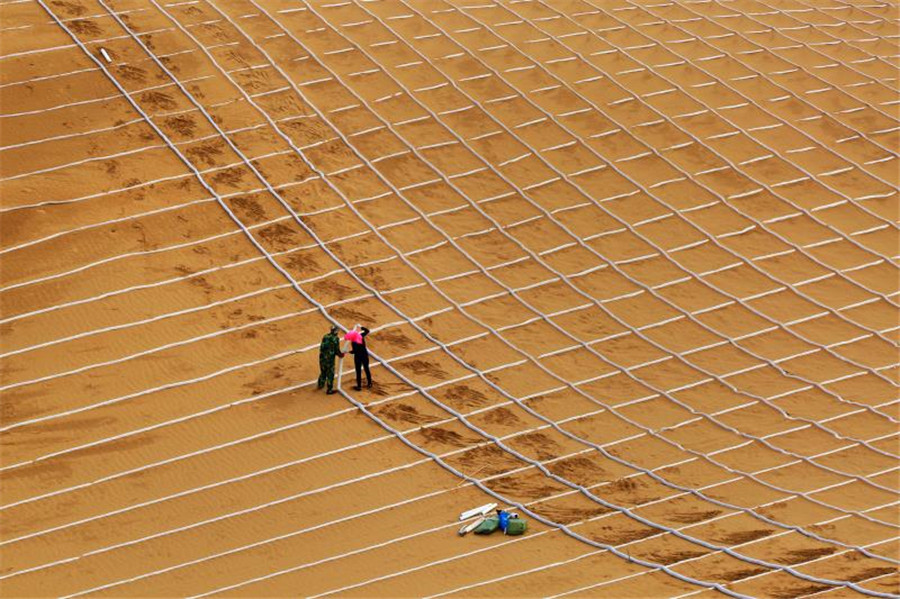
The world's most successful land reclamation project is not to be found in a coastal area, since it is not land reclaimed from the sea. Instead, one needs to look west from Beijing at inland China and land reclaimed from desert.
Begun 30 years ago, the Kubuqi desert greening project has succeeded in not only reining in the relentless growth of the seventh-largest desert in China, roughly the size of Kuwait, it has also turned about 6,000 square kilometers of the desert-one-third of it-green.
Situated about 800 kilometers to the west of Beijing in the Inner Mongolia autonomous region, the greening efforts have also controlled desertification in the rest of the area.
The project, which began about 30 years ago, can be looked to as an example of President Xi Jinping's call for efforts to advance green development and build an ecological civilization generation by generation so as to create harmony between humans and nature, and leave a better environment for future generations.
The success of the project, which has been praised by the UN Environment Programme as an "eco-pioneer" combines ecosystem restoration and ecological husbandry that sets an example for successful desertification control and ecosystem improvement based on effective government policies supported by private investment in the eco-industry, combined with the market-oriented engagement of local farmers and herdsman.
Those three elements-government policy support, the market-oriented participation of local residents and ecological improvement as a result of investment and new technology-have been vital to the success of the "Kubuqi model".
Elion, a private ecology and investment enterprise, has invested about 38 billion yuan ($5.82 billion) in the Kubuqi desert-greening project since 1988 helping to lift about 102,000 local farmers and herdsmen out of poverty.
Under the company's guidance and with the local government's support, the local residents benefit from the "environmental wealth "that is generated by the efforts to combat desertification. For example, the locals grow a drought-tolerant herb, Chinese licorice, which is the most used herb in traditional Chinese medicine. The plant helps enrich the desert soil, with the bacteria around the roots of the plants generating nitrogen, which forms a biological crust above the sand that begins the fertilization process of the desert soil.
Cistanche, another type of drought-tolerant herb, was introduced after the successful planting of licorice.
Elion has invented and applied more than 100 environmental technologies to ensure the plants survive the harsh environment, and ensure the ecological restoration is sustainable.
Solar panels have also been set up to feed electricity into the national power grid. And desert and oasis tourism, along with the sales of the herbs they grow have become a reliable source of income for the local residents, laying a solid foundation for the economic sustainability of the program. Besides, the total involvement of the residents in the desert-greening program ensures the social sustainability of the project.
The annual precipitation in Kubuqi has increased four-fold, from less than 100 millimeters to more than 400 millimeters over the past 30 years-thanks to 53 percent plantation coverage-which is a decisive change facilitating ecological sustainability.
As President Xi said in his congratulatory letter to the Sixth Kubuqi International Desert Forum at Erdos in Inner Mongolia in July 2017, the successful greening of a large part of the Kubuqi desert is valuable experience in environment management that can be useful for other parts of the world.
The success of "Kubuqi model" is one that shows efforts to combat desertification can be fruitful.
Desertification affects the lives of about 2 billion people, mostly in developing countries. Many previous efforts to control desertification have failed for lack of sustainability, which as the Kubuqi model shows, requires the collaboration of at least three parties-the local people, government, and the enterprises that can provide technologies and initial capital.
But despite its success and value as a role model, the "Kubuqi model" has its limitations. Since the Kubuqi desert is close to the Hetao Plain that extends from the point where the Yellow River, China's second-longest river, takes a U-turn midway through its journey to the sea, it has enough groundwater to nourish the licorice and cistanche crops, thereby increasing precipitation and enriching biodiversity.
China should encourage more enterprises to replicate the "Kubuqi model" in its other desert control projects in Inner Mongolia and neighboring Gansu province, where the climate and hydrological conditions are similar but not quite the same, so as to further gain experience and enrich the model in practice. Showing it can be successfully applied in other areas will help it promote the model worldwide.
The author is a writer with China Daily.








