Removing doubts key to success of CPEC







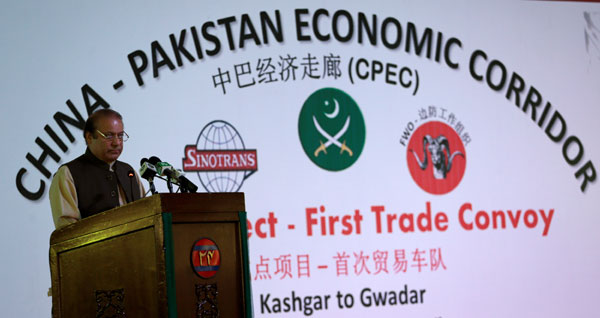
As a reciprocal development strategy, the China-Pakistan Economic Corridor has undergone long-term scientific appraisal by both Beijing and Islamabad. Still, some observers claim the loans from China could push Pakistan toward a crisis. Such doubts persist even after Imran Khan, former captain of the Pakistani cricket team, declared victory on Thursday after his party won the highest number of seats in the general election. But the fact is, certain challenges and problems arising from the advancement of the CPEC will not dim the bright prospects of its projects, let alone affect the all-weather strategic partnership of the two countries.
Four disputes over CPEC
Doubts about the CPEC are generally centered on four issues. The first is a debt problem, as many in the West believe the CPEC has had a negative influence or impact on Pakistan's economic development and political and security situations. They argue that given Pakistan's current economic development stage and its administration's governing capacity, the country could be pushed into a debt trap as it would have to pay back China's massive loans with interest.
Many Western media outlets have even said Pakistan expects China to offer it additional loans in the face of accumulative debt risks and a shortage of foreign exchange reserves, failing which it would be forced to seek help from the International Monetary Fund. Besides, they have over-hyped the flows of Chinese companies, workers and commodities into Pakistan in the name of the CPEC, claiming they would deal a strong blow to the local companies.
In response, Shamshad Akhtar, Pakistan's caretaker minister of finance, issued a statement emphasizing that Pakistan would unswervingly push the development of the CPEC forward. And on Pakistan's foreign exchange reserve shortage, the Chinese Foreign Ministry has expressed confidence in Pakistan's ability to overcome the present difficulties and maintain steady economic growth.
Second, critics have raised doubts over the distribution of the CPEC projects, which boils down to the question of Pakistan's development priority. Although Beijing and Islamabad have foreseen and taken care of this issue, by attaching importance to smaller Pakistani provinces in terms of setting up power grids and special economic zones, the allocation of CPEC projects is more or less subject to the sway of competition among political parties and local governments in Pakistan.
Nonetheless, that the "early harvest" projects have smoothly advanced shows that completing the other CPEC projects on schedule by 2030 would help Pakistan redress the strained relations among its different provinces and regions.
Third, some opinion leaders continue to claim that China would benefit more from the CPEC than Pakistan. Focusing on the short-term returns, some economists say Pakistan's interests would be compromised so long as China gains more than 50 percent of the profit from the CPEC while ignoring the fact that the CPEC projects would boost Pakistan's economic growth and employment in the long run.
Compared with the sharing of short-term benefits from the projects, more attention should be paid to their long-term contribution to the local people and industries, and overall economic development. Actually, Pakistan has gained much more than China in many CPEC projects, and the profits Islamabad has earned from them would be enough for it to repay Beijing's loans, as well as promote Pakistan's economic development.
And fourth, CPEC critics say there is a policy continuity problem. CNN recently said some see Imran Khan's victory in the elections as a potential watershed moment for Pakistan as his politics significantly diverge from the Pakistan Muslim League-Nawaz, and the Pakistan People's Party, two major parties in Pakistan. Since Khan pays closer attention to the alleged corruption in the CPEC projects, the critics say, his government may adopt a totally different attitude toward the CPEC.
The truth is, Khan doesn't have a problem with the CPEC, as he has openly said that Sino-Pakistani economic cooperation would greatly promote Pakistan's economic development and benefit the country's people. Which means the CPEC, which is reciprocal in nature, would not be forced to change course or disturbed.
Adopting an approach that is people oriented
While some of the criticisms of the CPEC are baseless or smell of ulterior motives, a few are undeniably constructive. Yet China and Pakistan are capable of avoiding the possible risks and removing barriers to meet the economic, diplomatic and security challenges arising from the CPEC. But to smoothly proceed with the CPEC and remove the misunderstandings and conflicts within, China has to take some reasonable and effective measures.
To begin with, it should put full faith in Islamabad's ability to execute the CPEC projects and connect them with Pakistan's development needs. Apart from energy generation and infrastructure construction, China should conduct a thorough study to determine what Pakistan's actual needs are, in order to help it solve its development problems by integrating the CPEC with the country's national development strategy and help the country develop as an export-oriented economy.
In accordance with the accusations from the Pakistani media that the CPEC would place a huge debt burden on Pakistan, and the Pakistani people are not actively involved in the program, China could consider appropriately extending the duration of the loans to Pakistan to reduce the burden, if any.
Second, China and Pakistan should spare no efforts to involve more Pakistani people in the construction of the CPEC, as it will help the general public recognize the essential goals of the program while creating more jobs for them. The two countries should also promote the construction of schools, hospitals and public facilities that are closely related to the people's daily lives, so as to gain more public support for the CPEC.
Third, it is of vital importance to disseminate the truth about Sino-Pakistani economic cooperation, including the CPEC. In fact, China should make known all the goals and results of the CPEC through a series of measures, including improving the quality of publicity and broadening its channels. It should also timely refute the malicious misrepresentations of and baseless allegations against the CPEC.
Moreover, China and Pakistan should expand their exchanges and communication with the people and cultivate talents to further strengthen bilateral relations, thus creating a more conducive environment for the development of the CPEC.
Fourth, China should enhance its strategic coordination with Pakistan's new government so as to further clarify the CPEC's purpose, which is to promote Pakistan's as well as the region's development. And while emphasizing the nonpolitical nature and inclusiveness of the CPEC, in order to avoid upsetting other countries, China and Pakistan should also strongly crack down on extremist and terrorist forces to ensure security for the advancement of the CPEC.
The author is a research fellow at the China Institutes of Contemporary International Relations.