



BRICS on right track to the future







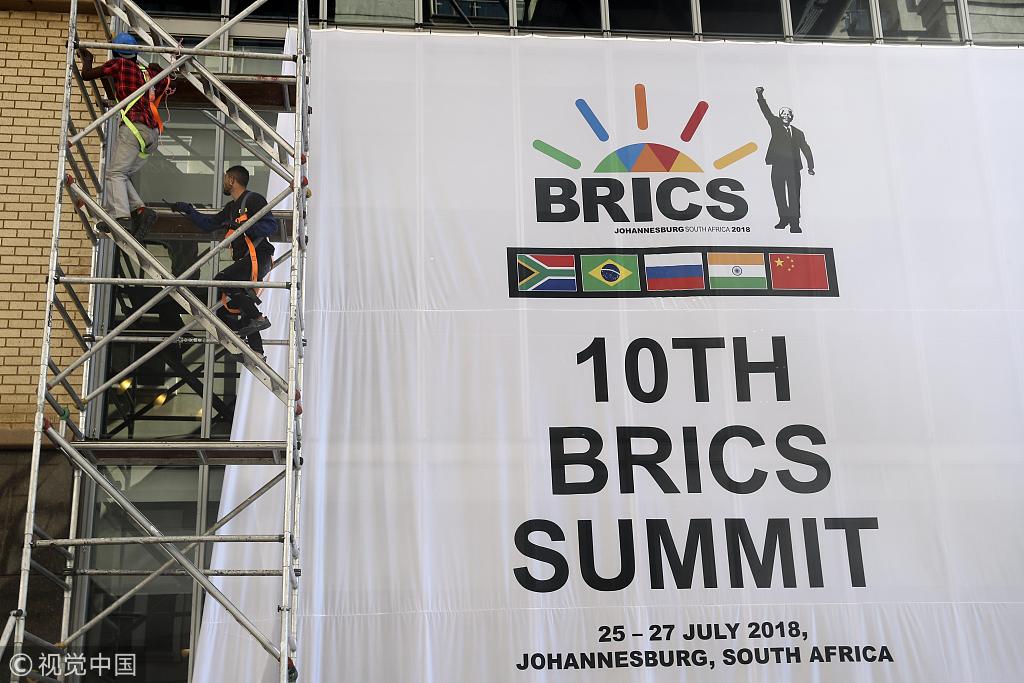
The 10th BRICS summit in Johannesburg, South Africa, from Wednesday to Friday will once again highlight the rising power of large emerging economies in the world economy.
When the first BRICS summit was held in Yekaterinburg, Russia, in 2009 after the global financial crisis, the combined economic power of the original four member countries-Brazil, Russia, India and China-amounted to some $10 trillion, or about a third of the combined total of the largest economies of the West-the United States, Germany, the United Kingdom, France and Italy-and Japan, the six major economies.
Today, BRICS is coping with a fragile global recovery that is overshadowed by the US' new unilateral and protectionist policies.
Russia, Brazil suffer political woes; China, India on track
In 2000, China's economy was barely a tenth of the US' GDP. Brazil was stabilizing after years of turmoil. The Russian economy had been crushed by the US-led "shock therapy". And reforms were intensifying in India.
A decade later, the world economy looked very different. The US economy was still more than twice as big as that of China but Japan's growth had been penalized by stagnation. Germany led by Chancellor Angela Merkel and France with president Nicolas Sarkozy at the helm were leading the European economic recovery. In Brazil, the era of president Luiz Inacio Lula da Silva brought about a dramatic catch-up, while reducing historical income polarization. India led by prime minister Manmohan Singh was experiencing accelerating growth. And in Russia, President Vladimir Putin had multiplied the size of the economy by almost six-fold.
Is the world economy's structural transformation on track after the past eight eventful years? The short answer is an emphatic "yes". Yet there are significant differences among the BRIC economies.
Let's use the largest economy, the US, as a benchmark to compare the original BRIC assumptions-in the early 2000s with the real economic development in the past almost two decades and the decade that is about to follow.
According to this simple exercise, China's economic expansion accelerated dramatically, even historically, in the 2000s, when its size relative to the US economy more than tripled from 12 percent to 40 percent. The original BRIC estimate was that China would surpass the US in the late 2020s, and that remains the case under President Xi Jinping's leadership. If the current trend prevails, the Chinese economy would be 13 percent larger than that of the US by 2030 (only 1 percent less than the original BRIC projection).
While India's growth trajectory slipped for a few years, it has recovered in recent years. If things go right, India's economy would double in the next decade. It could also soar to about a third of the US by 2030 (4 percent higher than the original BRIC projection).
However, Brazil and Russia have slipped significantly from the original projections.
Under Lula's visionary leadership, Brazil's GDP grew even faster than expected by the original BRIC projection. And the first term of president Dilma Rousseff was still not far behind the projection. Nevertheless, since the mid-2010s and Rousseff's contested impeachment, political turmoil has slowed down Brazil's growth, penalizing the middle class, working people and the poor. Now, Brazil's economy is positioned to be about 13 percent of the US' by 2030 (more than 40 percent less than originally expected).
In Russia, Putin was able to reverse the economy's drastic fall in the 1990s and restore the growth trajectory in the 2000s. For all practical purposes, Russia's economic prospects are very much in line with the original BRIC projection; it is the sanctions by the US-led West that account for the negative difference. Without the controversial sanctions, the Russian economy would have been about a fifth of the US economy by 2030. Thanks to the US-led "new Cold War", the Russian economy could be less than a tenth of the US GDP by 2030(some 55 percent less than expected).








