World Cup highlights two sides of Japan







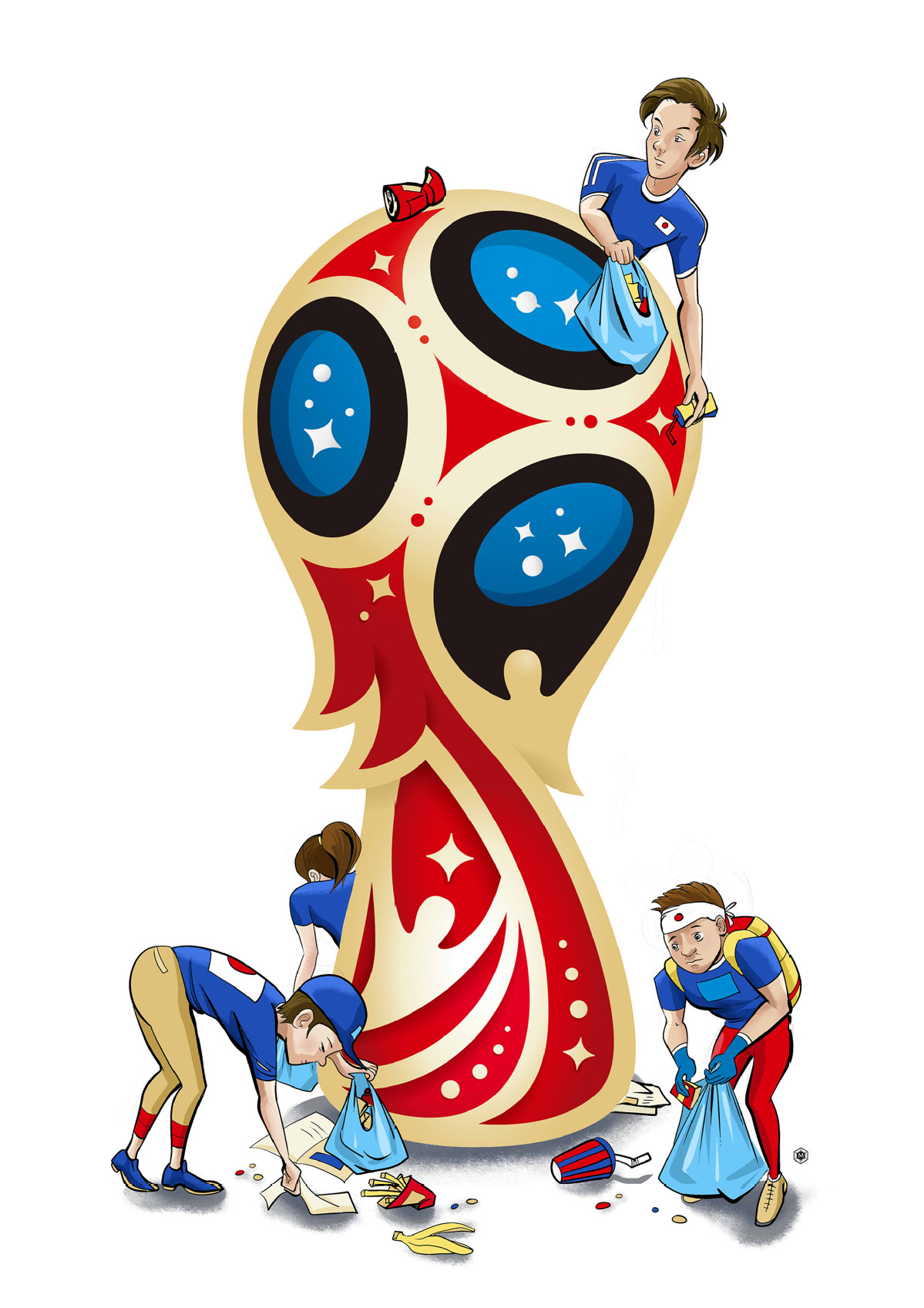
Japan's 2-3 loss to Belgium on Monday to a last-minute goal in the round of 16 at the ongoing Football World Cup in Russia has given the Chinese people plenty of food for thought and off-the-field issues for debate.
Part of the debate revolves around the stands in Rostov Arena in Rostov-on-Don that the Japanese spectators cleaned to perfection before leaving or the locker room sanitized by the Japanese players after the game.
The other prominent debate issue is the Japanese invasion and subsequent occupation of China which lasted until Japan's surrender in World War II in 1945, and the successive Japanese governments' reluctance to admit the country's wartime past and the atrocities it committed on the people of China and other Asian countries.
If one social media group has praised the Japanese players and fans for their civic and hygienic practices, the other has severely criticized Japan for its reluctance to accept history. If the first group has said Japan is an example for China in every aspect, the other contended the Japanese are "billionaires in small virtues, but destitute in larger issues of righteousness", which somewhat indicates they support the boycotting of Japanese goods.
Both camps seem to have taken their arguments beyond the realms of a healthy debate. But the silent majority analyzing the debate has the ability to rationally judge the issue. It is fair to say the majority of the Chinese people are already aware of the extreme stances taken by different camps when it comes to Japan. But as Chinese official discourse points out, Japan and China are separated by a thin margin.
Last year, Chinese mainland tourists paid 7.23 million trips to Japan, accounting for 26 percent of the total trips by foreign tourists. And Japanese tourists paid about 2.5 million trips to the Chinese mainland. This intensive people-to-people exchange speaks volumes about the nature of the two peoples, especially because such trips give them the opportunity to experience firsthand the way of life in each other's country and thus deepen mutual understanding.
With an annual bilateral trade volume of more than $300 billion, China has been Japan's largest trading partner since 2007, and Japan has been one of China's largest trade partners.
That the vicissitudes of bilateral political relations have not influenced the economic relationship between the second- and third-largest economies of the world drives home a message: the two countries have considerable common interests based on their economic complementarity.
Although the debate on Japanese people's hygienic habits, as seen at the World Cup, has been acrimonious at times, with the opposing camps hurling not-so-endearing terms at each other, it does not represent the views of the majority of Chinese people, who can now judge Japan more objectively and thus differentiate between the common Japanese people and rightwing politicians.
The Chinese people ought to know that although China has overtaken Japan in terms of economic scale, it still has a lot to learn from Japan when it comes to commitment to craftsmanship and professionalism, citizens' duties, social governance and organization, and energy saving and environmental protection. These factors have facilitated Japan's remarkable rise in different fields before and after World War II, including in soccer.
It is ironic, though, that Japan's source of inspiration in these fields was China during the Tang Dynasty (AD 618-907), and Japan seamlessly transplanted those ideas and practices into workable reforms that suited its national conditions during Meiji Restoration in the 1860s.
Basically, the Chinese soccer fans are happy to see Japan's performance on and off the soccer field in the World Cup, which, many say, was almost as predictable as its politicians' "ostrich policy" toward history. If one bears this fact in mind, it would not be difficult to understand Chinese people's complicated reactions to Japan's success in any fields.
The author is a writer with China Daily.