



China enters new stage of opening-up







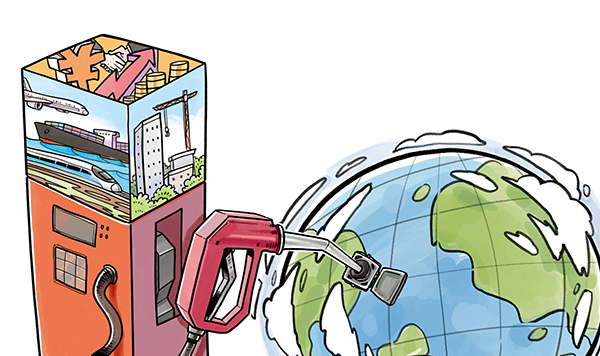
Both historical and international experiences show that only by further opening up to the outside world can China continue to develop its economy and maintain its vitality. However, the level and rhythm of opening-up must be adjusted according to the national conditions.
For least-developed and developing countries, their process of opening-up to catch up with the developed world generally goes through three phases: participation, deepening and maturity.
The first three decades of China's reform and opening-up, from 1978 to 2008, were the participation phase of opening-up. During those years, China's main goal was to integrate with the world economy by expanding exports and attracting foreign capital.
The purpose of expanding exports was to earn foreign exchange, in order to ensure a smooth flow of imports. A certain amount of foreign exchange reserves is also needed to deal with the consequences of global financial and economic crises, so that economic development is not seriously compromised.
To promote exports, China has adopted novel ways of developing processing trade and making full use of foreign investments, because the advantages of abundant supply of labor for processing trade, in which foreign-funded enterprises hold the majority share, can make it easier for China to integrate with the international division of labor.
The theoretical guidance for China's export-oriented strategy is the theory of factor endowment and comparative advantage in productivity. A country with abundant resources can to a certain extent offset the lack of advanced technology and be competitive in the world market when it comes to products that it has comparative advantage in.
A friendly domestic environment to integrate with the world economy was built between the launch of reform and opening-up in 1978 and Deng Xiaoping's southern tour in 1992. And from 1992 to China's accession to the World Trade Organization in 2001, the country witnessed significant improvement in all aspects.
Until the outbreak of the global financial crisis in 2008, China continued its aggressive opening-up policy. Thanks to this policy, Chinese exports saw explosive growth, the trade surplus expanded rapidly, and the introduction of foreign capital increased significantly. And in keeping with its promise on the accession to the WTO, China expeditiously reformed its institutional mechanisms.
Today, China's opening-up has reached the deepening stage. After the global financial crisis, China's economic growth slowed down, and its opening-up policy gradually shifted from quantity to quality.
First, although China is the world's biggest exporter of goods, the quality of its products still needs to be improved. So attention is being paid to upgrading the trade structure. Besides, accumulation of foreign exchange reserves through trade surpluses is no longer one of China's prime goals. As such, to maintain the trade balance, it has to increase its imports. In short, opening-up is now aimed at transforming China from a big trading country to a powerful player in international trade.
Second, as for foreign investment, the focus now is on attracting high-level investment from the European Union countries and the United States. The Chinese mainland's overseas capital investment is still dominated by East Asian economies such as Hong Kong, Macao and Taiwan, and Japan and the Republic of Korea. In order to introduce advanced technology, China needs to attract more high-level investment from Western countries. In addition, China is focusing both on attracting large-scale foreign capital and investing abroad. As a result, the scale of Chinese companies' investment overseas has rapidly increased.
Besides, China is capable of further opening up to attract quality investment and overcoming the difficulties that may arise in the process. Of course, it has to solve the problem of regional imbalances and take measures to facilitate the development of the service sector as the economy shifts its dependence on manufacturing for qualitative growth.
Finally, China can actively participate in global economic governance, through the Belt and Road Initiative for example, and establish an external environment conducive to further opening-up. This way, China will not only be ensured of helping shape the global economic and trading rules, but also can choose its trade partners accordingly.
In the new phase of opening-up, new thinking, new strategies and new patterns will emerge. China is fully aware of the benefits of reform and opening-up and will make more efforts to take part in the formation of international economic rules and promote globalization. It will also address the issue of uneven income distribution so everybody can enjoy the fruits of economic development and globalization.
The new phase of opening-up emphasizes the importance of striking the right balance between exports and imports (which means importing more). It also stresses that innovation should be strengthened to have a greater say in the global high-tech market, overseas investment must be expanded for the betterment of the economy.
China will open up its central and western regions to investors, boost the service sector, not just manufacturing, and make efforts to improve the global trading rules and raise the status of its trade partners along the Belt and Road, especially in Central Asia.
The new stage of deepening reform and opening-up is expected to continue till 2050, when China is likely to become a great, modern, socialist country and step into the ranks of advanced economies. For the next 30 years, China's determination to open up to the outside world will remain firm with new thinking, new strategies and new patterns.
It may take a small economy 30-40 years to catch up with an advanced industrialized economy. But for a large economy like China, it will take about 70 years to reach the stage of maturity, that is, becoming an advanced economy. China's journey may be long, but its determination to further open up its economy remains strong, and will never change.
The author is a researcher with the Chinese Academy of Social Sciences.








