



Committed to deeper reform, opening-up in the new era







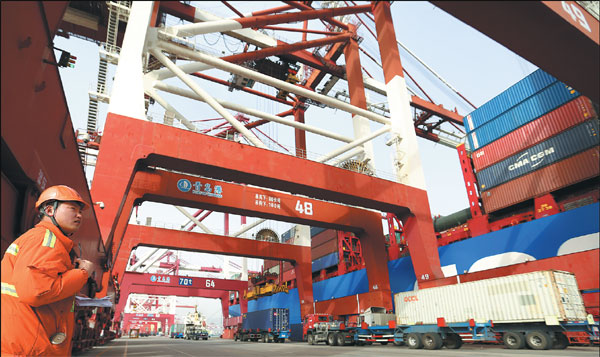
An employee oversees loading of cargo bound for the United States at Qingdao Port in Shandong province. Zhang Jingang / For China Daily
To mark the 40th anniversary of reform and opening-up this year, China has started a new campaign to deepen economic reform and opening-up, and mapped out a sweeping reform program for Party and government institutions.
The newly unveiled reform package — the eighth round of restructuring Party and government institutions in 40 years ago — will be of far-reaching significance to China’s bid to realize the “Two Centenary Goals” of achieving a moderately well-off society by 2020, a year before the 100th anniversary of the founding of the Communist Party of China, and building a prosperous, modern socialist country by 2049, the 100th anniversary of the founding of the People’s Republic of China.
It will provide a strong and forcible organizational guarantee for China to promote the modernization of governance which in turn will help achieve the “Two Centenary Goals”.
A country needs well-functioning institutions to provide good governance. But well-functioning institutions are neither born nor can they be developed overnight.
This means Party and government institutions must undergo necessary adjustments and reforms as China’s economy and society move forward and its people’s living conditions improves. Only by so doing can the country effectively modernize its governance and fulfill the “Two Centenary Goals”.
The latest round of reforms involve more than 80 central government and State organs, as well as institutions directly affiliated to them, which has hurt vested interests in a manner that has never been seen in past four decades.
So, given the complicated situation, all involved institutions should strengthen their political integrity and follow the policies of the core leadership. They should learn to distinguish the “gains” from the “l(fā)osses” both at the departmental and the personal levels, and take concrete actions to maintain the supreme authority of the CPC Central Committee.
The experience of the past four decades show the key to institutional reform is to promote optimization, coordinated development and high efficiency of their functions, and to avoid “integration in appearance but separation in essence”.
Under the overall reform framework mapped out by the top authorities, the institutions with the same or similar functions should be restructured, and clear “powers and responsibilities” demarcated so that the functions of different institutions are correctly defined. And after their merger, unified administration of affairs should be carried out to create the necessary time and conditions to help integrate their functions.
This ill be particularly important during the early days of institutional reform, because it will create a favorable environment and better conditions for middle- and late-stage merger or reorganization of different institutions. While evaluating, analyzing and overhauling the intersecting and overlapping of functions of different institutions, a strict performance management and administrative accountability system should be adopted, along with the efforts to promote internal information communication and sharing as a way of breaking the “island of information”.
And in the process of merger and reorganization of institutions, practical measures should be taken to reshape organizational culture, including taking measures to play down the culture of former institutions and build a culture of deeper integration for new institutions.
The author is a researcher at the Party School of the Communist Party of China Central Committee.





