Sino-Indian relationship to enter new era of cooperation







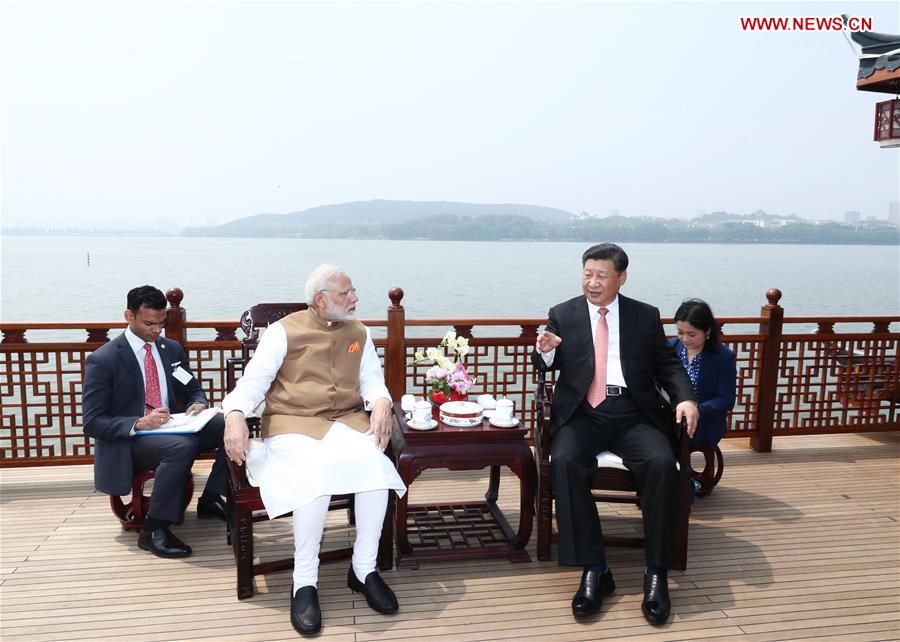
At their informal meeting on the shores of Wuhan’s East Lake, Chinese President Xi Jinping and Indian Prime Minister Narendra Modi exchanged views on bilateral relations and regional and international issues of concern. It is said that President Xi focused on managing divergences in a mature manner and emphasized planning comprehensive cooperation between the two countries and ensuring more intimate strategic communication. Modi posted his opinion on Twitter and said, “Productive discussions over tea. Strong India-China friendship is beneficial for the people of our nations and the entire world”.
In the two days of the landmark Wuhan meeting both countries successfully issued “strategic guidance” to their respective militaries to strengthen communication to build trust and mutual understanding and enhance predictability and effectiveness in the management of border issues. Similarly, both leaders also agreed on another strategic issue regarding Afghanistan to work on a “joint economic project”.
Indian Foreign secretary Vijay Gokhale, who already served as a senior diplomat at the Indian embassy in Beijing and can speak Mandarin fluently, told reporters that the two leaders expressed their support for the work of the special representatives on the India-China Boundary Question and urged them to intensify their efforts to seek a fair, reasonable and mutually acceptable settlement. He further said that Xi and Modi shared the view that peaceful, stable and balanced relations between India and China will be a positive factor for stability amid current global uncertainties.
After the Sino-Indian War of 1962, relationships between both countries eroded badly. It was the milestone visit of former Indian Prime Minister Rajiv Gandhi’s to China from Dec 19 to 23, 1988 that paved the pivotal road to a normalized relationship and built up mutual understanding and follow-up dialogue between the two giants. Chinese leader Deng Xiaoping welcomed Gandhi as “my young friend”, and said, “Starting with your visit, we will restore our relations as friends. We will be friends between the leaders of two countries. The countries will become friends. The people will become friends. ”
After the last year’s Doklang stalemate, bilateral relationships eroded, though both countries resolved the issues peacefully. It is said that like Rajiv Gandhi’s previous China visit in 1988, which also was held amid critical international contexts, the recent visit by Modi to Wuhan and the very inclusive informal discussions with Xi are believed to have paved a vital road to build trust and mutual understanding and enhance multi-level cooperation. Both leaders actually talked about issues, ranging from the border to terrorism, globalization, security, communication and development-related concerns.
When we trace back the history, visits to China by Indian prime ministers P.V. Narasimha Rao in 1993 and Atal Bihari Vajpayee in 2003 were recognized as milestones to enhance the bilateral relationship to a new height and maintain peace and tranquility along the border areas. Similarly, reciprocal visits by Chinese leaders since 1988 also have further promoted understanding and cooperation.
These two countries are very different from each other in terms of political, economic and even cultural aspects, though they have some historical similarities too. Still, on the issue of United Nations reform, India’s vow to become member of Nuclear Suppliers Group (NSG), the border issue and even on the categorization of the terrorist groups, both countries have diverse stands. Observers of China-India issues opined that these two most populous countries on the planet will get more through their cooperation rather than unhealthy confrontation and suspicions. Cooperation and competition are now two aspects of China-India relationships.
According to the data of China’s Ministry of Foreign Affairs, bilateral trade between China and India in 2017 reached $84.4 billion dollars, up 20.3 percent year-on-year, the biggest increase in the last five years. At a regular press conference, Gao Feng, spokesman for China's Ministry of Foreign Affairs. said, “As two of the biggest emerging economies in the world, China and India have strong economic complementariness and huge potential for cooperation. The economic and trade cooperation between the two countries has maintained a momentum of rapid development in recent years.”
It is said that as of the end of 2017, China had invested $8 billion in India, and India has become one of the most important overseas infrastructure cooperation markets and investment destinations for Chinese companies.
Though some hardliner politicians and experts in India don’t want to see Sino-Indian rapprochement and cooperation, history shows that when these two giants maintained understanding and peace, both gained enormously. When they are in confrontation, that created a very pessimistic environment in regional peace and order.
So like Rajiv Gandhi’s 1988 visit to China, the recent visit by Modi and his very exclusive discussion with Xi could play a vital role in enhancing the bilateral relationship on one hand and also contribute to regional and international peace, harmony and development. So we can conclude that the result of the Xi-Modi informal talks in Wuhan offers glimpses of a new era on Sino-Indian all around cooperation.
Buddhi Prasad Sharma is a PhD candidate at Communication University of China. He is also the president of the Himalaya Dialogue and Leadership Foundation, HDLF.
The opinions expressed here are those of the writer and don't represent views of China Daily website.