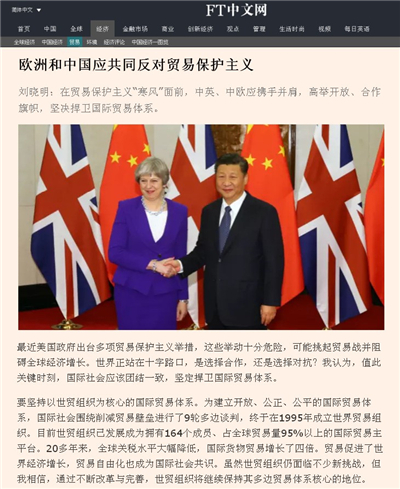
The Financial Times Publishes A Signed Article by Ambassador Liu Xiaoming Entitled "Europe and China must unite against protectionism"







On 29 March 2018, the Financial Times and its English website and Chinese website published a signed article by Ambassador Liu Xiaoming entitled "Europe and China must unite against protectionism". The full text is as follows:

The recent protectionist measures by the US administration are dangerous and risk triggering a trade war and hampering global growth. The world is at a crossroads between co-operation and confrontation. This is a critical time when the international community should be upholding the global trading system.
At the centre of this system is the World Trade Organization, which was established in 1995 by the international community in pursuit of open, fair and equitable trade following nine rounds of multilateral trade negotiation to reduce trade barriers. With 164 members that account for over 95 per cent of global trade, the WTO has become a major platform for trade issues. There has been a dramatic reduction in average tariffs applied by WTO members, and global trade in goods has quadrupled over the past 20 years. Trade has become a driving force for global growth and trade liberalisation is now an international consensus. Despite new challenges, this body is capable of reform and overhauling itself in order to cement its position as the centrepiece of the multilateral trading system. This will be key to warding off the potential disaster of trade protectionism.
Throughout the history of international trade, protectionism has been a spectre stalking the world. The Smoot-Hawley Act of 1930 was adopted to protect US businesses and jobs and to increase government revenue by raising tariffs on imported goods. It led to a wave of international retaliation and an exacerbation of the Great Depression. In 1933, US gross domestic product plunged by 45 per cent compared with 1929, and the contribution of trade to GDP dropped from 11 per cent to 6.6 per cent. History is a mirror. Last week the US government announced new protectionist measures against China, resulting in the S&P 500 losing well over $1tn in market value. The impact was also felt by the European and Asian markets. There is no need for history to repeat itself only for us to learn the straightforward lesson that there is no winner in a trade war.
China has been the powerhouse for global growth and a main contributor to an open world economy in recent years. Since becoming a WTO member in 2001, China has cut average tariffs from 15.3 per cent to 9.8 per cent, removed over 50 access restrictions on the manufacturing sector and opened about 120 sectors of the service industry to different degrees. It is now the largest trading partner of 124 countries and one of the top three markets for goods from 54 WTO members.
At the 19th Communist Party Congress, China reiterated its commitment to opening up on all fronts and building a community with a shared future for mankind. It has undergone four decades of effective reform and opening up and will continue to do so in the next 40 years. As President Xi Jinping said, “China will not close its doors to the world; we will only become more and more open.” This determination arises from China’s strong belief that openness brings progress, while seclusion leaves a country behind.
The UK and Europe have been advocates of trade liberalisation and firm supporters of the multilateral system of trade. The leaders of the UK, France and Germany have expressed their concerns over US protectionism and stressed that WTO rules should be the basis for solving trade disputes. This clearly points to shared interests for China and Europe in safeguarding the multilateral trade regime.
There is a saying in Europe that “a single tree cannot block the chilly wind”. Only if the UK, Europe and China stand shoulder to shoulder, will they be able to uphold openness and co-operation, and safeguard the international trade regime from the dangers of protectionism.