Trump's mixed messages on peninsula issue are dangerous







By continuing to test nuclear weapons and intercontinental ballistic missiles in 2017, the Democratic People's Republic of Korea raised tensions in the Asia-Pacific region. But equally disturbing have been the contradictory messages from the Donald Trump administration, such as a "preventive war", "bloody nose" and, especially, last week's unspecified "phase two" concept.
Such belligerent rhetoric is especially troubling now, because the just-concluded Pyeongchang 2018 Winter Olympic Games brought about rapprochement between the DPRK and the Republic of Korea. The DPRK sent high-profile officials and a nearly 500-strong delegation to the Winter Olympics, and its leader Kim Jong-un invited ROK President Moon Jae-in to visit the DPRK. More importantly, the DPRK also stated its willingness to hold talks with the United States.
Pyongyang has also offered to send a 20-member delegation next Wednesday to the March 9-18 Pyeongchang Winter Paralympics. It's true that the current reconciliation does not necessarily mean Pyongyang will abandon its missile and nuclear programs, but it seems this is a good time for all parties involved to pursue dialogue to denuclearize the Korean Peninsula.
Unfortunately, the Trump administration's messages to both Pyongyang and Seoul have been confusing, to say the least.
In fact, US Secretary of State Rex Tillerson may feel baffled himself. Back in December, when Tillerson said the US was willing to start diplomatic talks with the DPRK without any preconditions, he was quickly overruled by Trump. And in October, when Tillerson said in Beijing that Washington was in direct communication with Pyongyang to pursue diplomatic talks, Trump tweeted that Tillerson was "wasting his time" in trying to negotiate with the DPRK.
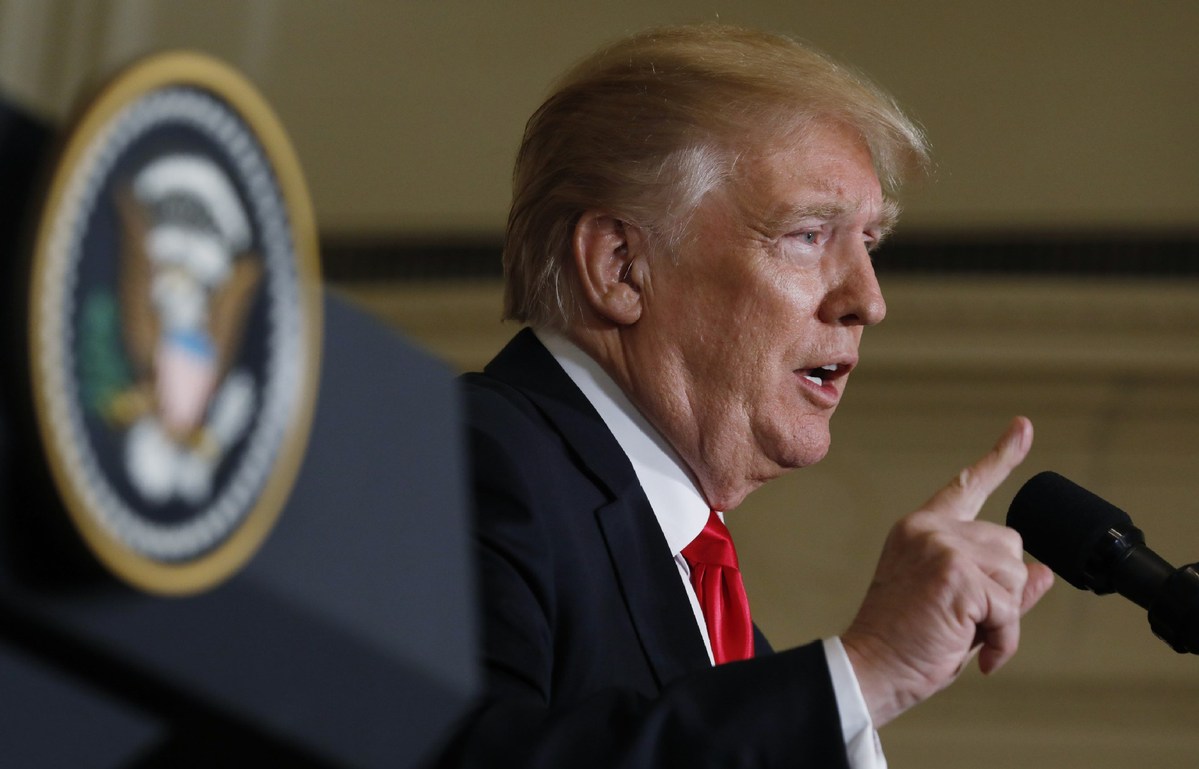
On Monday, Trump told US governors that the US is willing to talk only under the right conditions, that is, after the DPRK gives up its nuclear and missile programs. But on Feb 23, right after the US Treasury Department announced new unilateral sanctions on the DPRK, Trump told a news conference, where Australian Prime Minister Malcolm Turnbull, too, was present, that "if the sanctions don't work, we'll have to go to phase two. Phase two may be a very rough thing, may be very, very unfortunate for the world".
Although Trump did not specify what phase two means, many see it as a signal for preemptive military strike, which has been opposed by all countries, including US allies Japan and the ROK.
The DPRK's security concerns, it seems, are justified, as the US has pursued regime change in countries such as Iraq, which did not have any nuclear weapons, and Libya, which had abandoned its nuclear program years ago.
Back in August, Trump tweeted that Pyongyang will be "met with fire, fury...the likes of which this world has never seen before". And at the UN in September, the US president said he might be forced to "totally destroy" the DPRK. These were in addition to the constant US rhetoric that all options were on the table, a code for war. As such, Trump's war rhetoric shows that the DPRK's worry is valid.
The US is known to resort to military means to resolve issues, and the Trump administration seems to be following the same policy, as it seeks a hike in its 2019 defense budget and sharply reduce its funding for the State Department and US Agency for International Development, a sign of increased militarization of the US foreign policy.
But an all-out military conflict on the Korean Peninsula will result in the loss of countless lives and will be devastating for the region and the world. So no one, not even the US, should float such an irresponsible idea.
The author is deputy editor of China Daily USA.