Trump's fixation on deficit shows he needs an economics primer







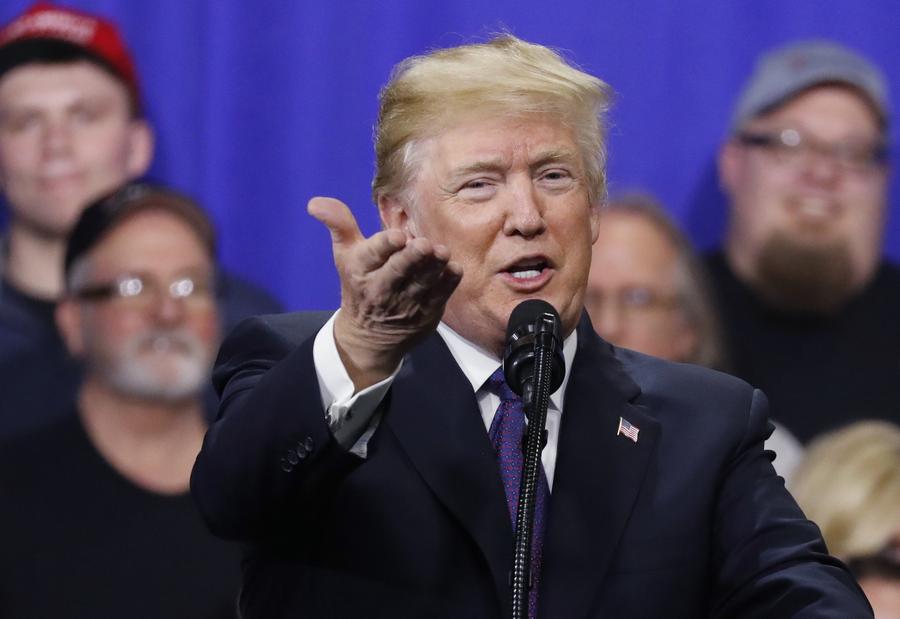
Donald Trump has been consistent in blaming the United States' economic woes on its trade partners, having done so even before he started campaigning to be president in 2016. However, his rationale is totally flawed.
The many economists I have talked to cannot understand why the Trump administration is so infatuated with the country's trade deficit.
When reports indicated that the US' trade deficit grew 12 percent in 2017 to $566 billion, economists were quick to point out that the Trump administration's tax reduction this year will help widen the US trade deficit by stimulating imports. Trump should raise taxes if he really wants to shrink the trade deficit.
The US has itself to blame because its trade deficit has everything to do with US fiscal policy, the low US saving rate and the role of the US dollar as a global currency.
In the past months, the Trump administration has been imposing punitive tariffs on a wide range of goods, everything from solar panels, washing machines to steel and aluminum products. The rationale is to safeguard US domestic industries from injuries caused by foreign imports. But if the US does not buy from China, the Republic of Korea or Mexico, for example, it will only buy from elsewhere, at higher prices.
A week ago, US Commerce Secretary Wilbur Ross released reports on the department's investigation into the impact on US national security from steel and aluminum imports under Section 232 of the 1962 US Trade Expansion Act. It is still not clear what actions Trump might take based on the reports. However, the tariff measures the Trump administration has introduced in the past months have already sparked protests and countermeasures from US trade partners, as well as strong backlash at home.
For example, the tariffs on solar cells and modules will effectively eliminate 23,000 jobs in US solar energy industry in 2018, much more than the few jobs it seeks to protect in several inefficient US firms. Several prominent US senators, such as John McCain, have criticized the tariffs on solar panels as a tax on US consumers.
This has not taken into account the huge damages it will cause the US and global renewable energy industry. Having withdrawn the US from the Paris climate accord, Trump probably does not care about this anyway.
The same backlash was triggered when Trump sat down on Feb 13 with US lawmakers to discuss the Section 232 case against steel and aluminum imports.
The Congressmen who expressed the deepest concern were mostly Republican. They believe that the tariffs will invite retaliation from other countries and also hurt US manufacturers, both downstream and upstream, by raising the prices of intermediary materials. The lawmakers also believe that the tariffs are likely to produce net job losses in the US.
After all, only 16 percent of US domestic consumption of steel was imported in 2016, and China, the favorite bogeyman for US politicians, accounted for only 2 percent of the 16 percent.
With only 3 percent of what the US produces domestically needed for national security reasons, it is hard for the US to make a case based on national security grounds.
In the solar panel tariff case, the Chinese mainland, Taiwan, the ROK and European Union have already taken the US to the World Trade Organization.
Clearly someone has to enlighten Trump on why his fixation with the trade deficit and tariffs is not helping the US while hurting the US' trading partners.
The author is deputy editor of China Daily USA.
chenweihua@chinadailyusa.com