African journalists among those who embrace new media







No need for anxiety in era of AI, international forum told
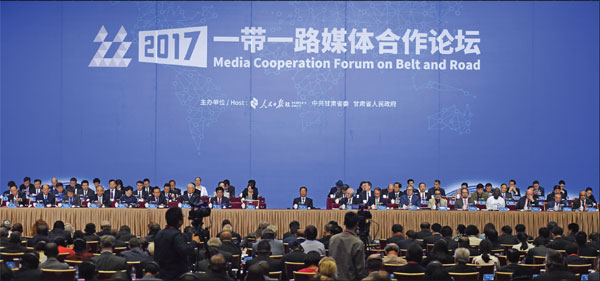
The issue of new technology and new media in mainstream journalism was a major topic for discussion at the recent Media Cooperation Forum on Belt and Road hosted by People's Daily for more than 300 international journalists in Dunhuang, Gansu province.
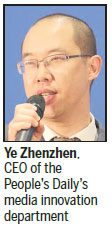
At a session on the theme "Media Convergence: New Concept and New Technology" the moderator, Ye Zhenzhen, CEO of the People's Daily's media innovation department, told journalists from 265 international media in 126 countries that there was no need for anxiety over new technology.
| The Media Cooperation Forum on Belt and Road hosted by People's Daily gathers international journalists in Dunhuang, Gansu province, in September. Xinhua |
"We don't need to feel anxious about new technology, since every kind of technology that is advanced and mature should be convenient, cheap and common, just like electricity today," he said at the September forum.
"So internet is a kind of technology that is not mature and not advanced, but it is going to be more and more mature and advanced and a new era is coming that is an era of AI (artificial intelligence)," he said.
Ye added that in China, the three giants of the internet - Baidu, Tencent and Alibaba - launched their AI strategy in July 2017, opening their resources for all the engineers and developers in China and around the world. Additionally, he noted, the giants of the technology world, such as Microsoft, Google and Facebook, are also now focusing on AI.
Ye also said Chinese media are currently using AI to produce stories and to recommend different content for various audiences.
He noted that on Aug 8, when an earthquake hit Sichuan province, "in 25 minutes the first report by AI was launched all around the internet. And so we find that the internet is entering a new era."
He also said that during China's Teachers' Day this year, People's Daily used AI to create a game dedicated to all teachers. Describing how the game was played, he said, "If you give one word to a machine, it will help you to write a poem and you can dedicate this poem to your teacher."
Stressing the importance of the role played by AI in today's media, David Chen, vice-president of Microsoft, said that years ago, anything that didn't work was attributed to AI, but now anything that works is ascribed to AI.
"History's biggest advancements occurred because of technology innovations - the steam engine, electrical power and, more recently, the digital revolution. Today, the world around us is rapidly changing, faster than any other point in history, driven by the rise of big data and the new era of artificial intelligence," he said.
Chen said that according to International Data Corp's projections, the digital universe will double every two years between now and 2020, reaching 20 zettabytes - a zettabyte is 1 with 21 zeroes - of data usage by 2020.
In separate interviews on the relevance of new technology and social media in their line of work, six African journalists currently on a study tour in China were unequivocal about the indispensability of both, saying they complement their work.
They say they believe that the spontaneity of social media platforms in churning out unedited and sometimes false news leaves much to be desired, adding that it is up to practitioners in traditional media to beat citizen journalists at their own game by incorporating social media platforms in their work.
All six journalists say their media outlets have integrated social media platforms, such as Facebook, Twitter, YouTube and WhatsApp, and use the internet to research and disseminate news as well as to interact with the public.
They say they also have invested in new technological equipment such as personal computers and professional cameras, installed free Wi-Fi and conducted training in the use of new media to aid journalists in their work. Additionally, they say, attempts have been made by some outlets to offer laptops, smartphones and tablets at subsidized rates to journalists.
Burundian journalist Blandine Niyongere, who writes for the daily Le Renouveau, says that although she believes new media should not replace traditional media, "this helps us to send out the information faster, to know about new things going on around the world and also to manage the traditional media."
However, she says she is concerned that people post information on social media without investigating. "This is a difficult thing for journalists. This is a very hard thing to handle, because everybody thinks they are journalists and therefore they make the work of trained journalists difficult."
Ugandan journalist Ronald Kato, who works with multimedia company Vision Group, says new and traditional media can complement each other.
"I think the traditional media practitioners are scared that new media has come to replace them, but I don't think new media has come to replace them; it has come to complement them," he says.
Rohey Bittaye, a journalist with the Gambian Radio and Television Services, says that although traditional media have been the source of authentic news for many years, social media have become the trend and so cannot be discounted.
"Before, it used to be teamwork, where you had about three or four people on a specific assignment - the reporter, light man, cameraman and soundman - and even an editor, but things have changed and with technology, you get to be handy as a journalist and you don't have to rely on the whole crew," she says.
South African journalist Melanie Peters, who works for Independent Media of South Africa's Weekend Argus, says she has invested approximately 40,000 rand ($2,900; 2,485 euros; £2,200) in new technology and data in her career.
"Artificial intelligence ... has been percolating in newsrooms for some time now. It's a game changer. But not necessarily a reality that news hacks want to embrace in a time when they already face much uncertainty in an industry that is undergoing a major shift," she says.
Mauritian journalist Thierry Ramasawmy, who works for Mauritius Broadcasting Corp, believes "there is a kind of blend or fusion between new media and the traditional. I personally believe that people trust more the hard copy thing or the news that is aired or broadcast."
He says massive investments have been made in new media by his employer for a dual objective - to keep up with the trend of other local media and to cater to advertising.
Alpha Daffae Senkpeni, a Liberian journalist and sub-editor for Frontpage Africa, thinks that new media is the future of global media because it brings innovation to speedily disseminating information and provides the opportunity to use multimedia to reach a number of people simultaneously.
However, he says he believes that African media are lagging behind in technological innovations and need to step up to reach China's level.
The author is a staff writer at the Ghanaian Daily Graphic and is in China on a fellowship program of the China Africa Press Centre.
(China Daily Africa Weekly 10/13/2017 page19)




Today's Top News
- Macao SAR holds flag-raising, reception to mark 26th anniversary of return to motherland
- China issues rules to regulate pricing practices of internet platforms
- US hits over 70 IS-linked targets in Syria in massive retaliatory strikes
- Coffee needs cooperation, not confrontation
- Technological innovation brings cultural heritage alive
- Consumption to play bigger part in growth