Grottoes and China's peaceful rise







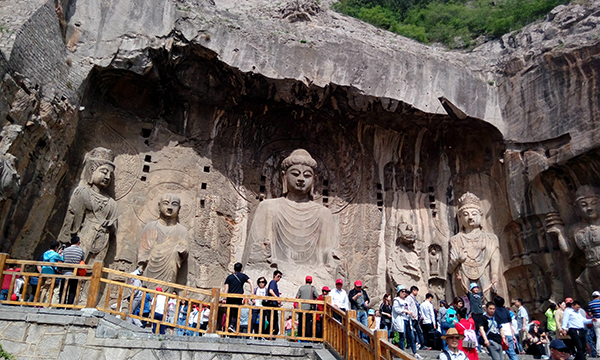 |
| A sculpture of the Buddha in Longmen Grottoes, Dengfeng, Henan. [Photo by Nanda Lal Tiwari/chinadaily.com.cn] |
"The main sculpture of the Buddha in this cave is 16.8 meters tall and it was carved between 460 and 470 AD. This is the second-largest sculpture here," tour guide of the Yungang grottoes, Daton city, Shanxi province, said. When I searched for more information, I saw a copper plate which had this inscribed, "The central Buddha, 16.8 meters tall, sitting with his legs crossed, is the second-largest sculpture in YunGang Grottoes. The Buddha has long earlobes that extend to the shoulders and the chin has collapsed. His right hand is raised and the arm is supported by a pillar." The plate had more information but this much was sufficient for me. I also realized that the chin had collapsed as the sculpture was carved over 1,500 years ago and during that long period adequate care was not taken.
There were many caves, some small, some big, at the small hillslope, and inside each cave were paintings depicting the Buddha's life and teachings. Some sculptures are so big and paintings so intricate that one is forced to imagine about the labor and skills invested for the art. While I was appreciating the magnificent creation and contemplating what devotion and diligence must have motivated the artists to carve such marvelous sculptures, the tour guide told us that not all the sculptures were made at the same time. There are sculptures made in different periods over a millennia." Instantly, I remembered what another tour guide had said during a recent visit to Mogao grottoes, Dunhuang city of Gansu province. "The oldest existing cave, cave No. 275, was made in 366 AD and the last one, youngest, was been carved in the 14th century." In the Mogao caves, there are Buddha's sculptures and the statues made up of wood, and the painting all around including the ceiling inside the cave as well. Of 735 caves, 400 have paintings inside and 80 caves are open to the public. Most of the painting are original as mineral pigment was used to draw them and the paintings depict, as elsewhere, the Buddha's life, teaching, pure land and the Buddha preaching to people. Most caves have three statues of the Buddha, Kashyap: the past Buddha, Shakyamuni Buddha: the present Buddha, and the Maitreya: the future Buddha. In some cases, the facial features of the main Buddha resemble the face of the ruling dynasty. For instance, the Buddha in cave 328, which was made in the 8th century, looks like a Han dynasty official with narrow eyes. The Buddha sculpture in cave 96 is the biggest statue here and the third-biggest in the world, 35.5 meter high, which was made in the 8th century by the only empress in China. The Mogao grottoes are some 30 km away to south from the Dunhuang city, a key transit point, in Gobi desert, along the ancient Silk Road.
As it was a cold outside, I felt comfortable as I got into the bus to return to Daton city. But then the images of the paintings and sculptures of the Buddha in the caves of these two northeastern provinces, Gansu and Shanxi, of China kept flashing in mind. I had to draw some conclusion and link that with the present to free my mind from the recurring images. While trying to understand the socio-psychological imprint of over millennia old art works on the Buddha, I also remembered about the Longmen Grottoes, Deng Feng city, Henan province, where I had visited in May this year. Even there the caves and the Buddha's sculptures have been carved out in the rock of the hillslope. There are no paintings inside the caves there but the Shaolin temple is world famous. Henan is in central China while Gansu and Shanxi are northeast provinces. This means Buddhism as a form of social life or religion has been at the heart and head of China.
And the Buddha is known for peace, non-violence, compassion, mutual respect and so on. The Buddha, who was born in Nepal, said man is master of his destiny. French revolution of the 18th century was based on the idea that all men are created equal and that man is creator of his own fate. In many ways Buddha was materialist as he believed in this world and said happiness and sorrows are outcome of one's knowledge and activities of one's present life. While thinking in this line, I found some link between what China is focusing on today and what Buddha said then: shared destiny, win-win cooperation, mutual respect, extensive consultation. After all, over two millennia preaching about the teaching of the Buddha through the monks in these grottoes must have made some kind of deep social psychology. Teachings of the Buddha have also been engraved in the public psyche the way the sculptures have been carved out in the rocks in different places across China. The Buddha preached for peace, China has made a peaceful rise without exploiting and dominating others and is spreading message of openness, inclusiveness, collaboration and cooperation in the global spheres by means of BRICS and BRI. And there is some interconnection.
The author is sub-editor, The Rising Nepal.