Focus should shift from food security to soil preservation







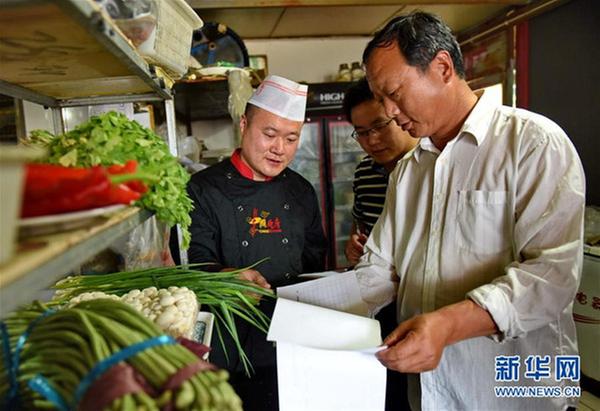 |
| A coordinator checks a purchase record book in a restaurant of Weixian country to ensure food safety on May 10. [Photo by Yang Shiyao/ Xinhua] |
After hitting an all-time-high of 621 million metric tons in 2015, China's food production seems to be overshadowed by the simultaneously increasing food imports, which have not just imposed extra financial burden on the country but also somewhat blunted the competitiveness of Chinese agricultural products in global markets.
The increase in food imports has a lot to do with China's price protection policy for domestic food procurement, which is aimed at helping farmers get proper prices for their products and ensure food security. The designed prices have been higher than the global average since 2011, prompting the government to procure costly homegrown food products for storage while buying from overseas markets to meet people's consumption demands.
That is not all. The shrinking of fertile land means food has to be shipped in from more distant places and more fertilizers and pesticides have to be used to stabilize production. This could compromise the fertility of large swathes of land and pollute the air and water.
China need not worry too much about food shortage. In the worst-case scenario, there would be a temporary halt in food supply. And since one person on average needs about 150 kilograms of food per year, China will need only one-third of its annual food production, or 210 million tons, to meet the basic food needs of the people in an extreme case.
So with the risk of starvation marginalized, the focus of China's agricultural policy should shift from food production to soil preservation. Letting land lie fallow over a certain period while maintaining its fertility is technically feasible.
Farmers in many European Union countries are asked to allow 10 percent of their land to lie fallow and plant catch crops during that time to maintain the vitality of the soil. China can take the same path and subsidize rice farmers to maintain their water conservancy facilities since rice is a staple food in China.