



The mushrooming demand for mushrooms







Diners in China have been flocking to restaurants to savor the earthy flavors of premium Yunnan fungus, especially the prized matsutake, and even the prohibitive prices this year have done little to deter gourmands
This summer's unusual rain pattern in Southwest China's Yunnan province has been bad news for mushroom gatherers.
The region, which is home to more than 250 types of mushrooms, saw its average rainfall between May and early June dip by 50 percent. What followed was 40 consecutive days of rain that resulted in floods and mudslides that have severely affected mushroom production.
Matsutake yield has dropped by a staggering 90 percent this year. Farmers said they only managed to gather about 10 metric tons of the mushroom daily over the past week, which is usually the peak harvest period.
But mushroom traders have actually benefited from the dismal harvest. Because of the low yield and high demand, the retail price of matsutake in Yunnan peaked at 3,000 yuan ($448) per kilogram this season.
According to the Yunnan Matsutake Association, domestic consumption of this particular mushroom was 1,000 tons last year. Demand for the mushroom is also high in Japan, especially during this time of the year when it is widely consumed during the Obon Festival, also commonly referred to as the Ghost Festival.
"We would usually wrap up our business this time of the year as exports to Japan, our main customer, nears its end," said Yan Ji, a 32-year-old mushroom trader from Kunming, the capital city of Yunnan. "This year, however, business has not even started to wane."
Growing popularity among diners
Yan, who works for his family business which sells premium mushrooms and vegetables to Japan and South Korea, noted that exports used to account for 90 percent of the company's earnings.
His company, Xintian Fungus, has been in the business for more than two decades and is among the top exporters in Yunnan province. The company sells a wide variety of gu, cultivated mushrooms that are available all year around, and jun, wild edible fungus that grow in forests and are harvested only between July to early September every year. The price of the latter is typically five to 10 times higher than the former.
He explained that while Chinese consumers are no strangers to savoring mushrooms, it was not until about three years ago that demand picked up in major cities such as Shanghai, Beijing and Guangzhou of Guangdong province.
Today, most of his customers that buy matsutake from his online retail store on Taobao.com, the country's largest online retail platform, come from China's Yangtze River Delta region, especially Shanghai.
"If matsutake is available all year round and Shanghainese consumers continue buying them from me at this price, I could soon be a billionaire and buy myself an apartment in Shanghai," he laughed.
Reasons for growing demand
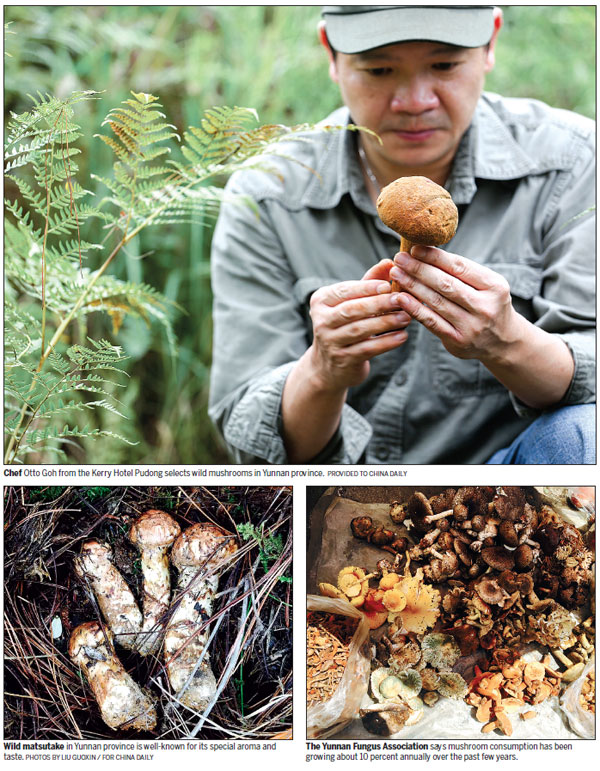
According to the Yunnan Fungus Association, mushroom consumption has been growing about 10 percent annually over the past few years. In 2015, around 80,000 tons of mushrooms worth 6.8 billion yuan were produced by the province.
Tang Xijin, chief of the matsutake association, said the growing demand of the mushroom was due to three key factors: an 8-minute feature on the matsutake in the popular food documentary A Bite of China in 2012, the expansive and fast-developing logistics network in the country and the perceived health benefits, including possible cancer prevention, that mushrooms have.
To cater to the growing mushroom market, SF Express, China's largest private express logistic firm, announced in July that it would launch a dedicated freight airline to ensure that consumers in 76 major cities in the country could receive fresh matsutake within 48 hours of harvest.

The soaring demand from coastal and other large cities in China has also led to a deluge of individual mushroom dealers entering the lucrative scene.
"People who used to sell facial masks and liquid collagen online are all entering the fray and they have greatly disrupted the way we deal with local farmers. Some of these new traders would meet with farmers and strike deals with them before we veteran players can. Others charge their customers unreasonably high prices," lamented Yan.
Mushroom tourism
Matsutake, which can be distinguished by its brownish cap and a plump white stem, grows at the roots of red pine trees. The best time to consume the mushroom is within three days of its harvest.
One of the notable matsutake harvest zones in Yunnan is in Shangri-La, Diqing Tibetan autonomous prefecture, where SF Express has established a logistics hub to deliver the mushrooms across the country. Gourmands have been known to travel all the way to this remote region to savor the matsutake.
"Mushroom tourism is still at its infancy but there is keen interest," said Eddie Zhu, general manager of Hylandia, a luxury hotel by hospitality group Shangri-La.
"It's just like a wine tour. Coming here to eat the mushroom doesn't necessarily make it taste better, but people just like to see where they grow and how they are harvested," said Zhu.
While there is no record of the number of guests who traveled to the region specifically to savor the matsutake, Zhu said that the hotel managed to sell 270 kg of the mushroom to their customers last year.
He expects mushroom tourism to extend the peak tourism season in the area by up to two months till mid-autumn. Tourist numbers are typically the highest from July to August and the lowest from December to April.
"The best matsutake mushrooms are not the longest ones but those that measure about 6 inches and have caps yet to open up like umbrellas - people believe these have the most intense aroma. I think Shangri-La tourism or mushroom tourism is also at a similar stage of opening-up now," said Zhu.
A culinary delicacy
In Shanghai, matsutake mushrooms used to be sold only in Yunnan restaurants and Japanese teppanyaki joints. Over the past two years, however, a variety of restaurants, ranging from Shanghainese to Cantonese and even Western style establishments, have started offering the premium produce to their diners.
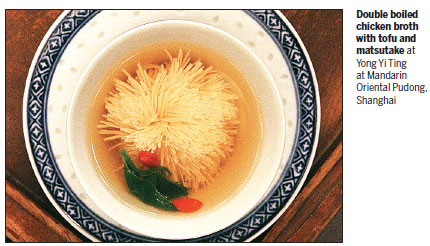
Chef Lu Yiming, one of Shanghai's most renowned chefs who runs two Michelin-starred restaurants - Yong Yi Ting and Fu He Hui - explained that offering the matsutake to customers falls in line with the current food trend of experiencing seasonal tastes.
At Yong Yi Ting, a restaurant within Mandarin Oriental Pudong that serves Huaiyang cuisine, Lu presents special menus featuring premium mushrooms from Yunnan and hairy crabs every year.
"Yunjun (short for Yunnan fungus) doesn't really fit into the concept of eating local. But it's native to China, and offers a variety of possibilities to showcase the refined culinary style of Huaiyang cuisine," said Lu.
On the mushroom themed menu at Yong Yi Ting this year, diners get to choose from a dozen dishes ranging from appetizers to soups and dim sum. Lu has also adopted the Shanghainese cooking style, such as red braising, to prepare some of the dishes.
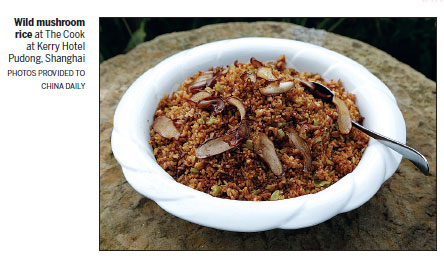
Malaysian chef Otto Goh, who runs The Cook at Kerry Hotel Pudong, is one of the latest fans of the matsutake.
Business at the restaurant during summer is usually slow as the main bulk of their customers - top executives from multinational companies - go on vacation. As such, Goh often makes trips to other Chinese cities in search of unique ingredients.
After visiting Yunnan thrice since last year and learning how to prepare a variety of mushroom dishes, the 44-year-old decided to introduce a matsutake buffet priced at 298 yuan. He said that the mushroom has the potential to achieve greater popularity among Westerners because of its unique earthy aroma and fleshy texture.
"The rationale is simple: we offer the best at the lowest price possible during the worst season so that we could drive business," said Goh. "There is a Chinese saying that good wine can be found even if it is hidden deep in an alley because it is just so fragrant. I believe this is the case with mushrooms."
xujunqian@chinadaily.com.cn
(China Daily USA 08/18/2017 page9)


Today's Top News
- First Senior Officials' Meeting of APEC China 2026 opens in Guangzhou
- White paper details HK's efforts to safeguard China's national security
- Japan urged to adhere to a peaceful path
- Epstein case ugly face of institutional failure
- Billions invested to integrate AI into daily life
- Xi stresses role of sci-tech innovation







