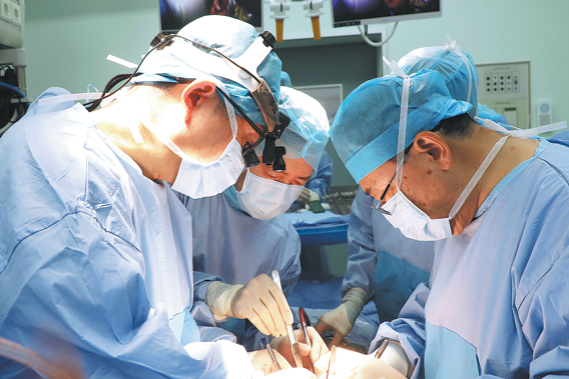
HK must flex innovation muscles to boost bay area







Shenzhen has become another gathering ground and hotbed for emerging industries on the Chinese mainland in recent years. In the first half of this year emerging industries contributed more than 40 percent of Shenzhen's GDP. Hong Kong, in this respect, apparently lags behind its mainland neighbor. Its knowledge-driven industries, old and new, account for less than 27 percent of GDP, currently.
Even more noteworthy is that Shenzhen has managed not to be complacent and realized its efforts to expand emerging industries have hit a "bottleneck" - insufficient local resources for innovation.
Currently Shenzhen has enough space in its science and technology parks and operators to run them, but cannot keep up with the growing demand for resources to sustain tech innovation, including talent and startup "incubators".
In Guangdong and particularly the Pearl River Delta region Shenzhen is not the only city facing financial difficulties. It is fair to say the availability of tech innovation resources in Shenzhen and other cities in the region will make or break the success of the tech innovation sector in the Guangdong-Hong Kong-Macao Greater Bay Area city cluster in the years to come.
Western countries such as the United States, Britain and Germany have attracted many quality science and technology researchers as well as inventors and innovators. Their achievements have been reasonably valued and applied over the years. That is why the Shenzhen municipal government has been encouraging local enterprises controlled by State-owned companies to establish tech innovation centers and industrial investment foundations in those countries. This is to acquire promising technologies and turn them into industrial production back in Shenzhen. Such purchases are meant to make up for the temporary shortage of innovation resources but the ultimate goal is to have adequate local resources. This is an opportunity Hong Kong can and should seize.
First of all, Hong Kong has world-class universities, where top-flight researchers do excellent work if they enjoy policy support and guidance. Secondly, the special administrative region government needs to increase funding for local universities' scientific and technology research. Currently the government maintains the "one for one" policy to encourage private donations to local universities, meaning the government will match individual donors' offers dollar for dollar. Next the government may consider raising the ratio of such encouragement funding offers to one for three or even one for four, meaning the government will give three or four dollars for every dollar in private donations for research at local universities.
For their part, universities need to set rules designed to encourage professors and lecturers to work on technology and innovation projects in addition to or as part of their teaching work. So far, local universities tend to evaluate faculty-member performance according to the number of theses published in prestigious academic journals; the more they focus on research in technology and innovation the less time they have to write academic papers. It is university administrators' responsibility to give credit where it is due.
Also, Hong Kong needs to develop companies capable of turning technology and innovation resources into industrial production. Currently in Hong Kong few if any traditional big companies are nearly as interested in technology and innovation as Li Ka-shing's are. That is why the SAR government should consider establishing a company similar to Singapore's Temasek Holdings, one of whose main functions is to help industrialize promising technology and innovations.
Hong Kong can attract major corporations from the outside. This includes the mainland-based and cross-national conglomerates, to invest here in technology and innovation industries. They in turn should boost innovation by locals and industrialization of technology and innovation in Hong Kong.
Hong Kong's "re-industrialization" would never bring back the labor-intensive manufacturing industry again or develop its own capital-intensive heavy industrial equipment manufacturing industry from ground up. The only viable choice is to expand the knowledge-oriented industries, including technology and innovation.
The reality in Hong Kong is that few if any small and medium-sized enterprises, which account for 98 percent of the total, are capable of joining technology development and industrial innovation. Traditional big companies, on the other hand, have invested scantily in research and development (R&D). As a result, the ratio of R&D to GDP has never exceeded 0.72 percent.
To change this situation the SAR government should increase funding for R&D in addition to offering tax breaks and discounts in land-use rights to draw major corporations from the outside and invest in technology development and innovation industries in Hong Kong. The SAR should not focus on the role of a "super-connector" only. It must be able to hold its own among the knowledge-oriented economies of the world to maintain its vital place in the Greater Bay Area city cluster. It should be noted that the central government expects Hong Kong to be more than a professional-services provider to the rest of the nation, too. That means the SAR needs to aim higher and be "smarter" than it is now.
(HK Edition 08/16/2017 page8)




Today's Top News
- Stronger RMB points to resilience
- US defense policy act fuels Taiwan tensions
- Japan's nuclear ambitions call for high alert: Editorial
- China repatriates 952 telecom fraud suspects from Myanmar
- Chinese defense ministry criticizes latest US defense bill
- China sets a world record in maglev technology