



Abe's 'Japan First' slogan doesn't gel with his TPP role







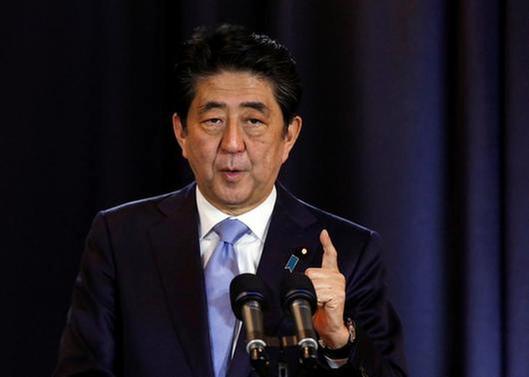 |
| Japanese Prime Minister Shinzo Abe gestures during a press conference in Buenos Aires, Argentina, November 21, 2016. [Agencies] |
Japanese Prime Minister Shinzo Abe has been sending mixed messages these days. He told an audience in Tokyo on Wednesday that he was following a "Japan First" policy, a term that smacks of US President Donald Trump's "America First" anti-globalization slogan.
To dilute the protectionist element in his slogan, Abe said Japan would pursue a path of global peace and prosperity.
After attending the Belt and Road Forum for International Cooperation in Beijing on May 14-15, Toshihiro Nikai, the secretary-general of Japan's ruling Liberal Democratic Party, said Japan should join the Asian Infrastructure Investment Bank "at an early stage" .
Subsequently, Abe said in a TV interview on Tuesday that Japan is still keeping a "careful" eye on the AIIB's operations and might think of joining it if the issues over the bank's governance are suitably resolved.
But he added: "We will continue to work closely with the United States." Japan, along with the US, has shunned the AIIB, which opened for business in January 2016 and has 77 members.
In a letter to President Xi Jinping delivered by Nikai, Abe lauded China's Belt and Road Initiative that aims for developing a big economic zone spanning Asia, the Middle East, Europe and Africa, and expressed interest in discussing the initiative with Xi, according to the Asahi Shimbun.
And in an op-ed article in The New York Times on April 22, 2015, Yoichi Funabashi, chairman of the Tokyo-based think tank Rebuild Japan Initiative Foundation, had explained why Japan ought to join the AIIB: "By distributing financial assistance to states in the Asia-Pacific, the bank will inevitably help shape the region's future economic architecture, as well as, implicitly, its security relations. Japan has a major strategic interest in participating."
But some people see the AIIB as China's attempt to spread its influence and directly compete with the Japan-led Asian Development Bank. What they fail to see is that given the need for infrastructure investment in Asia, there is more than enough room for the two banks to cooperate rather than compete.
In fact, the ADB estimates Asia needs $26 trillion in investment through 2030, or $1.7 trillion a year, to meet its infrastructure needs. And at present, multilateral lenders provide only 2.5 percent of total infrastructure investment.
So when the ADB convened its 50th annual meeting in Yokohama early this month, cooperation with the AIIB was on the agenda.
Takehiko Nakao, the ADB president, said we don't need to regard the AIIB as a rival. "There is a very large need to finance for the region's infrastructure development, so we can cooperate," he said.
And in an article she wrote for the March 10 edition of the Asahi Shimbun, Zeti Akhtar Aziz, former governor of Malaysia's central bank and an AIIB adviser, said the AIIB is open to collaboration with all countries and regions, and the US and Japan both have the expertise that can help the bank to develop fruitfully. She rightly pointed that for the advancement of the region and other parts of the world, collaboration and cooperation, not competition, are the keywords.
Japan's policy to always side with the US may backfire, as Trump's protectionist policies could pose a challenge to the ADB. Despite being the second-largest shareholder in the ADB, the US recalled its ambassador to the bank soon after Trump assumed office on January 20.
Besides, the US has also pulled out of the Trans-Pacific Partnership agreement, prompting Japan to advocate an 11-nation trade pact. But the talks among the remaining 11 signatories to the TPP agreement in Toronto earlier this month failed to produce a clear road map for the implementation of the agreement. They began new talks in Hanoi on Sunday.
If Japan, the largest economy in the US-less TPP agreement, wants to play a leading role in the negotiations and breathe fresh life into the pact, then Abe's "Japan First" slogan ought to be an oxymoron.
The author is China Daily Tokyo bureau chief. caihong@chinadaily.com.cn





