



Initiative offers ASEAN a golden opportunity







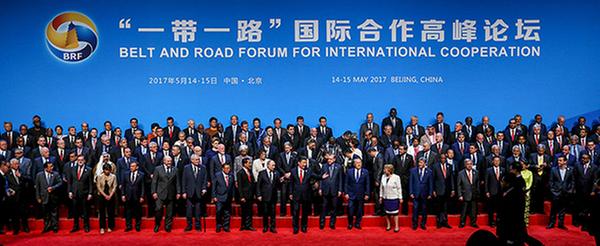 |
| President Xi Jinping and other delegates and guests take a group photo during the opening session of the Belt and Road Forum for International Cooperation in Beijing, on May 14, 2017. XU JINGXING/CHINA DAILY |
Assuming the chairmanship of the Association of Southeast Asian Nations in 2018, Singapore's priority for the regional bloc would be to advance cooperation, innovation and inclusive growth. This is a golden opportunity for ASEAN and China to cooperate and advance the Belt and Road Initiative (the Silk Road Economic Belt and the 21st Century Maritime Silk Road) in the region, which will stimulate governments, multilateral organizations and the private sector to join forces to cultivate international cooperation and shared economic advancement.
The Belt and Road Initiative connects businesses and people around the world at reduced costs. This is a natural desire of economies craving a better tomorrow, particularly for an increasingly integrated Asia. Asia's intra-regional trade has surged to eurozone levels. Furthermore, high-level cross-border investments reflect the integration of complementary production capabilities and resources to serve both traditional Western consumers and surging Asian consumption.
According to the Asian Development Bank, Asia accounts for 60 percent of the world's growth. To sustain this growth, we need to identify and capture cross-country synergies and stimulate innovation. This is predicated on economic openness and good physical infrastructure which strengthens connectivity.
The Belt and Road Initiative's benefits are clear. In the long run, it promises a rosy outlook: affordable connectivity that will naturally lead to economic cooperation and innovation. In the short run, infrastructure investment will immediately stimulate global growth.
The intriguing consideration is that, in the intermediate term, the Belt and Road Initiative's promise of an attractive economic outlook inspires improvements in government behavior and capital markets. The gist of this logic is that the Belt and Road Initiative's obvious rosy outlook combined with severe resource constraints will induce disciplined economic behavior.
Infrastructure investment is costly. McKinsey estimates that $57 trillion in infrastructure investment is required between now and 2030 to simply keep pace with global GDP growth. For economic infrastructure alone, Asia will require $8 trillion. There are many other similarly startling numbers. No government alone can meet these capital needs, not even China.
Clearly, the private sector needs to chime in. The only way to attract private sector investors is to offer bankable projects: developments that will reliably get private sector investors back their principal and promised returns.
This means governments will have to behave: prioritize the selection of infrastructure opportunities and ensure good governance. Additionally, to live within tight capital constraints, governments have to learn to be economical in implementation; this includes raising productivity and driving innovation in developing infrastructure.
Besides, the Belt and Road projects by design require meaningful government cooperation. Governments will oblige if there is a win-win situation. This inter-government cooperation is a particularly fascinating possibility. ASEAN member states can definitely benefit from good infrastructure investment-not just roads, transportation and ports, but also utilities such as water and electricity. This is a good opportunity for ASEAN and China to cooperate using complementary capabilities across countries. For example, Singapore can bring project management capability, airport engineering, and water management to the table, while railroad engineering can come from China. The list is long and impressive. Cooperation can be the impetus for long-lasting friendship among ASEAN, China, and other Asian economies.
Multilateral organizations such as the World Bank, Asian Infrastructure Investment Bank and the Asian Development Bank surely have great roles to play. They can contribute by cultivating information sharing, monitoring project implementation and enforcing governmental promises to alleviate fears of governments reneging on their commitments.
Moreover, they can guide the development of standard documentation for investment prospects, which will enhance investment instruments' tradability.
Bankability depends on liquidity. The need for capital may stimulate development in capital markets, including advancing appropriately governed and standardized securitization contracts. There could be obstacles. For example, projects could run into shortages of construction materials, while engineering, and project management capabilities may be lacking. These can be overcome.
The greatest obstacle to the attainment of the Belt and Road Initiative vision is economies' self-centeredness and short-term orientation. It takes leadership to do the right thing for us all: not to compete for short-term glory, political results and not to let national ego distort long-term rationality.
The Belt and Road Initiative vision is for the long term-harmonious cooperation and shared development for the world. Singapore, ASEAN, China and other Asian economies, with long-term vision and courage, can show leadership to the world, which is now being threatened by nationalism, nativism and self-serving statesmanship.
The author is the dean of and Stephen Riady distinguished professor at the Business School of National University of Singapore.
- Putin hails Belt & Road Initiative, calling for Eurasia integration
- CTG plans to invest $6b in Belt & Road economies
- Belt and Road Initiative promotes co-op between Auckland, China: official
- CPC publicity chief urges Belt and Road think tank cooperation
- President Xi's Belt and Road speech in numbers





