



Xiongan and Initiative made for each other







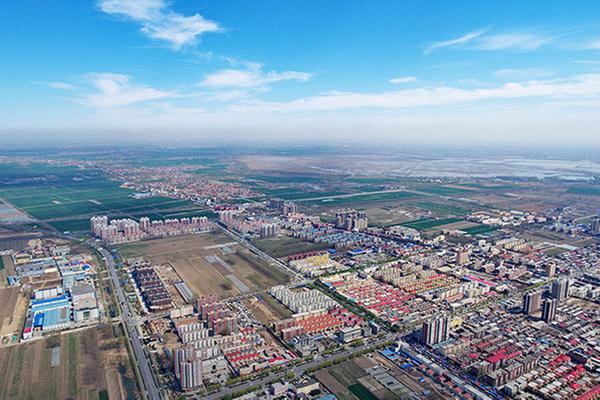 |
| Aerial photo taken on April 1, 2017 shows Anxin county, North China's Hebei province.[Photo/Xinhua] |
The proposed Xiongan New Area in North China's Hebei province is vital for coordinating the development of the Beijing-Tianjin-Hebei region and relieving Beijing of its non-capital functions.
Comprising Xiongxian, Rongcheng and Anxin counties, with their low population density and development level, the new area is like a sheet of white paper on which China can draw a blueprint for a brand new city meeting the highest standards. Many say the new area, when complete, will be comparable with the Shenzhen Special Economic Zone in Guangdong province and the Pudong New Area of Shanghai. But for that to happen, the authorities have to plan and develop the new area with an eye to the long-term future.
As the central authorities have said, the new area is in the first place "a demonstration area for coordinated development" and "an area piloting opening-up policies for development". Therefore, the planning for Xiongan must be done with the regional coordinated development in mind, so as to not only attract advanced technology, management and knowledge from around the world, but also help the new area to "go global".
Xiongan is also an experiment for carrying out the badly needed institutional reform, which will help boost the new area's opening-up, which is expected to prompt Xiongan's internal reform in return.
Through its opening-up, Xiongan should aim to attract advanced creativity and innovation from across the world, in order to become a new innovation center that has the potential of boosting national growth and sustainable development.
This is actually one of President Xi Jinping's key requirements to enable Xiongan to comprehensively open up to the outside world and become a new model for opening-up and a new platform for global cooperation.
Like Xiongan New Area, the Belt and Road Initiative (the Silk Road Economic Belt and the 21st Century Maritime Silk Road) is also a key development proposal for China. So the planning and development of Xiongan must seize the historic opportunities offered by the Belt and Road Initiative to integrate the construction of the Belt and Road routes.
As Xi has said, Xiongan's development must adapt to the requirements of the "new normal" of the Chinese economy, comply with the trend of economic globalization, adhere to reform and opening-up, and improve its economy by cashing in on the larger scope, broader field and deeper level of cooperation.
To become a big player in the construction of the Belt and Road routes, Xiongan must expedite the transformation of its government function, actively explore effective management models for innovation, form an institutional innovation system according to the rules of global investment and trade, and cultivate its new strengths in regional cooperation and competition. By doing so, Xiongan can also make greater contributions to the strengthening of the Beijing-Tianjin-Hebei region's open economy.
Statistics from the Ministry of Commerce show that, by the end of last year, Chinese enterprises had constructed 56 trade and economic cooperation zones in more than 20 countries along the Belt and Road routes, invested $18.5 billion, generated nearly $1.1 billion in tax revenue for local governments and created more than 180,000 jobs for local people. As such, Xiongan's integration into the Belt and Road Initiative should be based on a clear industrial policy and its special geographical position.
Hebei province's steel and cement industries, and Xiongan's garment and leather industries all have huge markets along the Belt and Road routes. The Bohai Bay close to Xiongan is not only a starting point of the ancient Silk Road, but also has the potential, thanks to its Huanghua Port, to become a new starting point of the "Eurasian Continental Bridge", with the Rotterdam port in the Netherlands as the western end of that bridge.
The author is a researcher in Belt and Road studies at the Party School of the Central Committee of Communist Party of China.








