China's new Silk Roads can change geopolitical history







|

|
| A man walks past the podium at the Belt and Road summit in Hong Kong May 18, 2016. [Photo/Agencies] |
All eyes are on China's ongoing two sessions, seeking clues about the future. The meeting is also likely to look ahead for international cooperation.
As China prepares to convene world leaders and members of the Asian Infrastructure Investment Bank (AIIB) for the Belt and Road Forum in Beijing this May, the geopolitical ground is shifting ever further in support of this initiative.
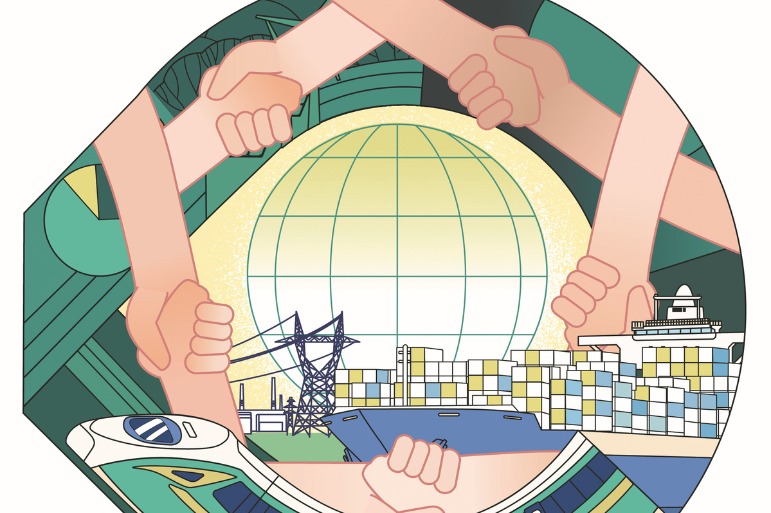
Already the many planned projects to connect the many countries of the Eurasian mega-continent together represent the largest coordinated infrastructure investment program in world history. What is more, over the past several years, European trade with Asia -- meaning the Eurozone countries trade volumes with China, India, Japan, South Korea, ASEAN and Australia -- has grown larger than Europe’s trade with the United States.
It has long been taken for granted that the US-EU transatlantic trade relationship is the world’s largest commercial area, and a foundational aspect of the Western alliance alongside NATO. But as I have written in Connectography, “culture across the Atlantic now competes with connectivity across Eurasia.” Indeed, European countries, such as Germany, which have even larger trade surpluses as a share of GDP than China, are very keen to continue their industrial export driven model because fast-growing Asian economies are very strong customers for their high-quality goods. Hence Germany’s leaders are not listening to the US Trump administration on issues such as joining AIIB or on revising their economic policy.
In the reverse direction, China has increased its foreign investment in Germany faster than to any other country. This has much to do with the very high quality of German engineering tools, machinery and other products. As a scholar of both German and Chinese political models, I have long argued that China can strongly benefit from Germany’s experience and lessons in social democracy, industrial quality, sustainable urbanization, welfare state policies and other aspects of governance. It is perhaps not well-known in China that the phase “Silk Roads” originates with the German Friedrich von Richthofen, who spoke of the “Seidenstrasse” in 1832.
The emergence of this Euro-Asian axis validates my fundamental thesis that geopolitical relations are driven less by ideology and culture than by economic complementarities of supply and demand. In geopolitical discourse it is often argued that security is the world’s most important global public good, and that America’s alliance system has been the foremost provider of it. Today, however, dozens of countries in Eurasia feel that infrastructure is the most important public good -- and China is the leading provider of it.
The American security role and Chinese infrastructure role should not be seen as rival public goods. To the contrary, they are highly complementary. I believe that a world order in which American, European and Chinese economies work in tandem while their resources help develop the markets and societies of the rest of the world is as close as one can imagine in geopolitics to the stars aligning. We must all work together towards that vision of a world of symmetry rather than hierarchy.
The connective infrastructure across the Eurasian landmass, as well as the “maritime Silk Road” developments across the Indian Ocean, enable a thriving Eurasian and African commercial expansion that encompasses more than two-thirds of the world’s population. However, to fully achieve the potential of these regions in the 21st century will require much more continued investment in the rapidly urbanizing societies across the developing world. This is the main ambition of the Belt and Road Initiative and it is an effort in which all countries of the world should actively participate.
Parag Khanna is a senior fellow at the Lee Kuan Yew School of Public Policy at the National University of Singapore. He is author of Connectography: Mapping the Future of Global Civilization.