Paper misleads US by pointing to wrong place of danger







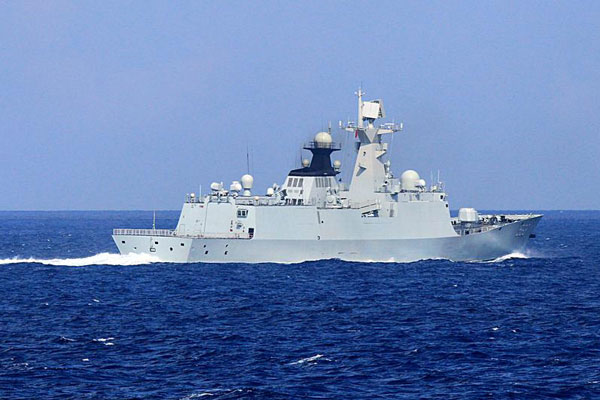 |
| A warship sails in South China Sea during a Chinese navy drill in South China Sea, July 28, 2015. [Photo/CFP] |
The Asia-Pacific Rebalance 2025 report unveiled by the Center for Strategic and International Studies (CSIS) on Wednesday reads like a call to prepare for a war with China.
The report, commissioned by the US Congress under the National Defense Authorization Act, calls for strengthening the US' capabilities, presence and partnerships in the Asia-Pacific, as if it wasn't the case, as Obama acknowledged in his State of the Union address on Jan 12, that the US is the most powerful nation on Earth, spending more on its military than the next eight nations combined.
Every suggestion the report makes is aimed mainly at China.
For example, China is the target when it calls for strengthening the capability, capacity, resilience and interoperability of the US' alliances and partnerships, forming a standing US joint task force for the Western Pacific, and encouraging Japan to establish a joint operations command. And China is the target when it calls for increasing the US' surface fleet presence, improving its undersea capabilities, continuing the diversifying of its air operating locations, bolstering regional missile defense, stockpiling critical precision munitions, developing advanced long-range missiles and augmenting its space, cyber and electronic warfare capabilities ... the list goes on.
China's growing anti-access/area denial capability, which is defensive in nature, is cited by the report as a major argument for the US to advance these capabilities. To justify its argument, China is described as a nation of "coercion" and a "potential adversary" despite the fact that China has not engaged in any military conflict for decades, except for a brief border conflict with Vietnam in 1979. The US on the other hand, has not only been constantly engaged in threat and coercion but also engaged in incessant wars.
The unpublished classified part of the report is probably even more heinous in its warmongering.
The report's short section on expanding confidence building and crisis management with China looks like an attempt at providing cover for a spokesperson for the Pentagon and the US military industry complex, given the CSIS has close ties with both.
The US' rebalancing to Asia-Pacific strategy, especially the military component, has been perceived negatively in China largely because it is believed to be aimed at China. Over the years, it has worsened the fragile strategic trust between the two nations.
If the next US Congress and administration adopt the CSIS report, it will only mean deeper distrust and more likelihood of a miscalculation, not to mention the report is likely to fuel an arms race in the region. And if fully implemented, it will make the Asia-Pacific region the most militarized in the world, with US weaponry.
One Chinese journalist who was at the release of the report on Wednesday said bluntly: "It should be called a China containment report."
It is just one of several reports by the US in recent years calling for a tougher stance on China.
Jeffrey Bader, a senior fellow at the Brookings Institution and a former Obama administration official for Asia, refuted such thinking last June in his article "Changing China Policy: Are we in search of enemies?" He hoped the next president will not discard the play book used by the American statesmen who built and nurtured the US-China relationship and built a generation of peace in Asia.
On Wednesday at the Council on Foreign Relations, former US defense secretary Robert Gates also called for a careful management of the relationship and said the US should acknowledge China's influence and role in the world.
But, unless they are doing marketing for the US military complex, it is the idea that the US should dominate the world that is clearly behind the CSIS report.
The author is deputy editor of China Daily USA. chenweihua@chinadailyusa.com