 |
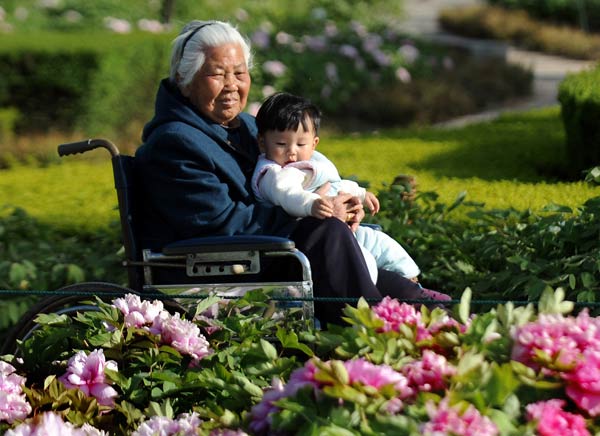
| An elderly woman and her granddaughter in a park in Luoyang, Henan province. WANG SONG / XINHUA |
Family friction
The problems facing older people aren't just related to health and loneliness, though. Financial disputes and a clash of lifestyles have resulted in Geng Yuchun, a farmer from Anyang, Henan province, living apart from his wife.
|
He Na: Reporter's log Respect is paramount My maternity leave ended when my son was 4 months old, so my parents-in-law moved from rural Heilongjiang province and came to live with us in Beijing. Compared with some families where there is constant low-level friction between young and old, our relationship is pretty good. I have to say that we're lucky, because they're such generous, tolerant people. We've been living under the same roof for almost three years, and I now understand the headaches and difficulties some older people face when they move to the cities. Although my parents-in-law know some of the older people in our building, they're not close friends, or people they can pour their hearts out to. My mother-in-law has a small notebook that contains the phone numbers of relatives, old friends, and neighbors. She often asks my husband to buy low-cost, long-distance phone cards so she can talk with them. They are happiest when they have visitors from their hometown; anyone will do. They don't need to be close relatives - one time, two people they barely knew in their hometown stayed in our apartment for more than a week. My parents-in-law are both in their late 50s, but they are very healthy and are used to hard work. Even before my son went to kindergarten, they started looking for jobs and finally found some cleaning work in our community. My husband and I objected strongly to this - my husband even quarreled with them, asking if they thought we didn't give them enough money every month and had taken menial jobs simply to embarrass us. My mother-in-law said they really want to work because they would be bored and prone to illness if they stayed at home every day. She said they would find work outside our community if we really thought they were embarrassing us. We had no choice, so we let them carry on. To our surprise, they are really very happy. The work has given them a new lease on life, and they have made some new friends. For the first few months, my husband and I tried to avoid them when we went downstairs, because we were wary of bumping into colleagues and neighbors when my husband's parents were working. Now though, we realize that filial loyalty isn't just about providing good food, clothing and money but also about respecting our parents' opinions and choices. |
Both sets of grandparents helped Geng's son and daughter-in-law buy a 50-square-meter apartment in Beijing in 2009. Geng, 64, and his wife moved in with the young couple, but when their grandchild was born in 2010, the apartment was too cramped to accommodate five people.
Initially, Geng's son rented a room for his father for 1,200 yuan ($195) a month, but this year the rent has jumped to 1,700 yuan.
The young couple's combined monthly income is 17,000 yuan, meaning that once they'd paid the mortgage, tuition fees, living expenses, and the room rental, their bank account was empty.
"To save money, I moved back in with my son and my wife went back to our village. My daughter-in-law is a city girl and doesn't like my wife. She thinks we're dirty, so she never eats at home. She and my son often quarrel about how to raise the kid and about education. Last year, it was so bad that they were like strangers and didn't talk with each other," Geng said.
"The older people in our building are very friendly, but because I can't speak Mandarin, just my local dialect, they just nod or say a few words when we meet. I really miss chatting with my neighbors in our village," he said.
Lifestyle is also an issue. Geng has found it hard to change his old habits. To conserve water, he doesn't flush the toilet every time he uses it, which infuriates his daughter-in-law, who slams the bathroom door to show her anger and disapproval.
In addition to the other problems, Geng has a number of health complaints, including high blood pressure, diabetes and arthritis, and, like a lot of elderly people, he finds it hard to pay the treatment costs.
"I don't have a fatal disease, but I'm not in the best of health, either. I buy medicine when I really can't stand the pain, but I never tell my son," he said.
More concerns
Li Jihua, 66, a retired teacher from Zibo, Shandong province, looks after her grandson in Beijing. She's made several new friends, but is annoyed that she doesn't enjoy the same rights as elderly people from Beijing. "It's not fair that I have to pay to use the bus or go to the park. Retired locals don't have to do that," she said.
Even worse, Li has to visit Zibo several times a year to qualify for medical insurance, and to ensure that she continues to receive her pension she has to visit her local bank regularly to prove she is still alive.
Ma Fengzhi, associate professor of sociology at Peking University, said the problems faced by "old newcomers" are the result of regional differences in what should be a national system.
"The most obvious example is that elderly people can't enjoy medical insurance when they are away from their registered residences. Without changing their hukou (household registration), they can't feel at ease in their new cities," she said, adding that the government needs to consider these issues when formulating age-related policies, and mobilize public and private forces to establish and improve the social care system.
Exiled in Shenzhen, Chen Zhijuan says she wants to devote the rest of her life to herself, not other people: "I don't want to end up useless and worn out. I want to be fit and active so I can enjoy seeing my granddaughter grow up."
Contact the author at hena@chinadaily.com.cn
Han Junhong and Zhao Xu contributed to this story.


Copyright 1995 - . All rights reserved. The content (including but not limited to text, photo, multimedia information, etc) published in this site belongs to China Daily Information Co (CDIC). Without written authorization from CDIC, such content shall not be republished or used in any form. Note: Browsers with 1024*768 or higher resolution are suggested for this site.
License for publishing multimedia online 0108263 Registration Number: 130349