Traffic volume
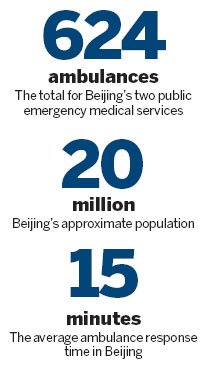
The high volume of traffic in many large Chinese cities is also having an impact on ambulance response times. In 2010, the average was 13 minutes in Shanghai and 15 minutes in Beijing. That's not much of an improvement from 2007, when ambulances in Guangzhou, capital of Guangdong province, took 15 to 20 minutes to arrive at the scene.
Medics say that victims of cardiac arrest have a much-improved chance of survival if treatment is administered within the first three to five minutes after the attack. In China, there is no set response time, but "more than 30 minutes on the road is quite normal. Sometimes the police have to be called to clear the road for ambulances", according to Li.
 |
|
A busy emergency room at the Armed Police General Hospital in Beijing. [Photo by Zou Hong / China Daily] |
A lack of funding is further exacerbating the problems faced by EMS units and has led to calls for stronger support from local governments.
 According to the Pre-Hospital Emergency Medical Management, a document released by the Ministry of Health in 2011, medical services should not delay treatment on the grounds of cost, a policy described as "treatment first and pay later".
In Beijing, patients are charged an average of 118 yuan ($19) for each ambulance trip. The charge was standardized in the 1990s and hasn't been altered since. However, inflation means it is now inadequate. "The cost for a single trip is around 400 yuan, and we also have to help the sick homeless, who are unable to pay even a cent," explained Li.
Each ambulance is staffed by a doctor, a nurse and one stretcher-bearer. "A doctor must be present, even if the patient is only being transferred from one place to another. Even if they have first-aid training, personnel are not allowed to work solo. Moreover, we don't have a standardized system for dealing with different cases in the EMS system, so resources are often wasted," he added.
EMS in France is strictly divided into several categories. Emergency call centers decide the type of ambulance, the staff and equipment and the hospital the patient should be taken to, depending on their condition, according to Li. If non-urgent patients insist on traveling by ambulance, their costs are not covered by medical insurance.
'Protocols'
The biggest difference between the US and China is that in the US, EMS providers are trained to follow formal and scientifically designed "protocols" and evidence-based guidelines, approved by a panel of experts in emergency medicine, EMS, administration, and the legal-ethical fields.
"Pre-hospital resources, including levels of education and training, equipment, and procedures are very limited, so we do not expect EMS crews to perform any complicated treatment at the scene, but instead focus primarily on triage, performing basic lifesaving measures and transporting patients as quickly as possible," said Xiao, the ER physician from the US. "Emergency physicians are the main gatekeepers of hospital-patient services in that they have to diagnose and stabilize patients as quickly as possible.
 |
|
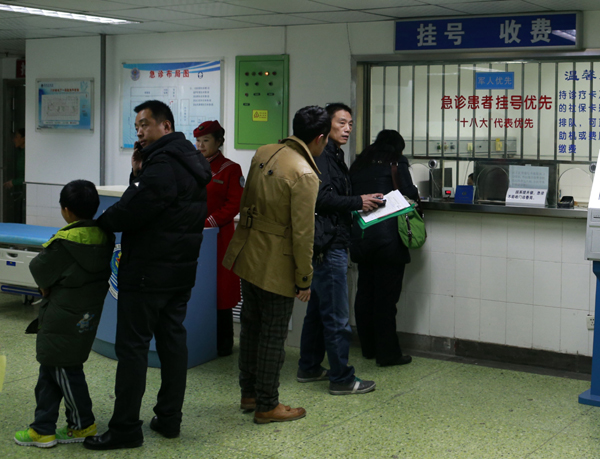
ER services at the Navy General Hospital in Beijing. A shortage of beds has become a major problem at many hospitals in China's larger cities. [Photo by Feng Yongbin / China Daily] |
However, things work the other way round in China, where people avoid a long wait at specialist outpatient clinics by booking appointments in the ER, a practice that's disallowed in most countries.
Even worse, some patients spend days in the ER because it's often impossible to arrange a bed for them in an inpatient department. In some cases, the "long-stay" can stretch for months.
However, in the US, 60 percent of those in inpatient departments are transferred from the ER within one day of admission.
"Beijing's hospitals receive many seriously ill patients from other cites. Rather than moving to a bed in the inpatient department, many of them chose to stay in the ER and occupy beds that should be available for the new patients," said Wang Zhong, a physician who used to work at the ER at Beijing Union Medical College Hospital but is now vice-president of Tsinghua University's Beijing Tsinghua Hospital.
Wang said his facility treats 300 to 400 patients every day, but he explained that in some other hospitals, such as Beijing Chaoyang Hospital and Peking University's Third Hospital, the number can be as high as 600 or 700.
"The system for regular post-traumatic reviews is not yet fully functional and the clinics are still under development. Those factors have resulted in patients becoming 'stranded' in the hospital," said Wang. When empty beds are difficult to hard to find in the ER, ambulances are forced to visit hospitals one by one.
To solve the problem, standardized "protocols" should be introduced and should play a pivotal role, said Xiao. In the US, the duration of each patient's stay is strictly monitored. For example, a patient with pneumonia may only stay in the hospital for one to two days, and if their condition necessitates a longer stay, the attending physician has to document the reasons clearly. Only medical costs meeting the standard patient care can be paid by federal or state Medicare/Medicaid programs or private insurance companies.
"The nationwide standardization of patient care should start in medical schools and continue throughout every doctor's career. Standardized care should be practiced across the entire medical system, regardless of the level of the hospitals and the practices of their physicians," Xiao said.
"If a high-quality standard of training for treatment of emergency cases could be implemented nationally, the patients would receive the same quality of care no matter which ER they attend. At least that would lead to fewer patients insisting on being taken to a 'better' hospital," said Xiao.
Tang Yue contributed to this story.
Contact the reporter at yangwanli@chinadaily.com.cn



Copyright 1995 - . All rights reserved. The content (including but not limited to text, photo, multimedia information, etc) published in this site belongs to China Daily Information Co (CDIC). Without written authorization from CDIC, such content shall not be republished or used in any form. Note: Browsers with 1024*768 or higher resolution are suggested for this site.
License for publishing multimedia online 0108263 Registration Number: 130349