Lack of hospital coordination means precious minutes and hours are lost, reports Yang Wanli.
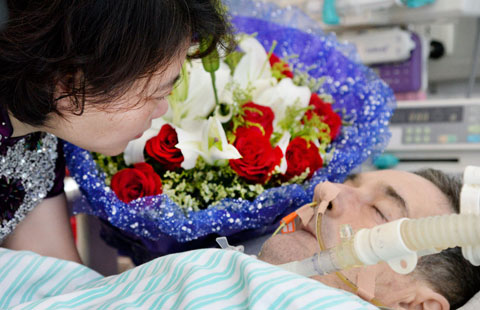
At midnight on a November day, Feng Shilan, a 66-year-old woman with leukemia, sank into a coma. Although an ambulance was summoned immediately, the next five hours saw the elderly lady crisscrossing Beijing as paramedics desperately hunted for a hospital that could admit her.
 |
|
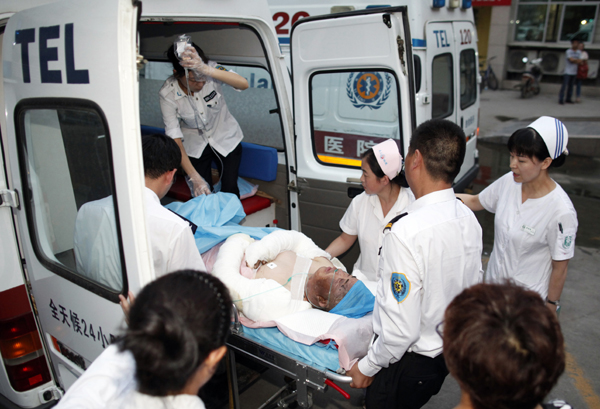
A survivor of a traffic accident in Yan'an, Shaanxi province arriving at Xijing Hospital in Xi'an. Calls are growing for a centralized information platform for emergency medical services to provide real-time information about bed numbers in China's hospitals. [Photo by Li Zonghua / for China Daily] |
The first five hospitals they visited had no beds available. The sixth did have a bed, but by then it was too late. Feng's condition deteriorated rapidly and she died the next day.
Feng's story highlighted a major problem in the Chinese healthcare system and prompted thousands of comments on Internet chat sites, with many of the posters asking why the capital doesn't have a centralized platform for emergency medical information.
"Are ambulances playing a game of chance?" asked one micro-blogger, writing under the name of Little Bean.
"In theory, the hospitals are required to provide us with up-to-date information about bed occupancy, but in practice it's hard to achieve because the procedures generally lack adequate supervision," said Li Jianren, director of the press office at Beijing Emergency Medical Center.
At present, not one city in China has a centralized information platform for emergency medical services. That isn't a big problem in some of the smaller cities where the supply can meet demand, but in the larger urban areas the shortfall is costing lives and wasting resources.
Unlike Western countries, most of which operate a system that provides real-time information about bed numbers and the level of preparedness for patients, in China, the only information available is bed availability and the staff are often overworked and unable to update the information as thoroughly as possible.
Ongoing discussions
The Beijing Health Bureau is now working to build a centralized information system for emergency medical services, said Ma Yanming of the bureau's press office. "The details are still under discussion," he said, but added that he didn't believe that such a system would radically alter the situation in the city.
Figures released at the end of May show that of Beijing's two public EMS departments, Beijing Emergency Medical Center had 421 ambulances, while the 999 response service, under the management of Beijing Red Cross, had just 203. That's for a city with a population of around 20 million. Meanwhile, Wuhan, capital of Hubei province, has only 50 ambulances to serve its 5 million residents.
Ambulance coordinators in China's larger cities have seen a huge spike in demand during the past five years and the most recent statistics show that Beijing's ambulance crews respond to eight out of 10 calls immediately.
"Demand has intensified in recent years, but that's not the most crucial factor in the current poor condition of the EMS system," said Ma. "The most important reason is that there are no regulations specifying patient rights."
If their condition is not life threatening, patients in China have the right to choose the hospital to which they are taken by the ambulance, so it's little surprise that most insist on being taken to the best-known, best-equipped facilities. Even if those hospitals are registered as full, patients will still insist on being taken to them in the hope that a strong argument, and possibly even a little cash, will be able to secure admission.
"This really stops the system from working efficiently. Even if we tell them the hospital is full, the patients insist on going there, because they know people have gained admission that way in the past. Of course, if they are refused we have to find another hospital and that wastes a lot of time," said Li from Beijing Emergency Medical Center.
"Patients in the US normally cannot choose the hospital when the emergency services are involved. We believe the decision has to be made by the pre-hospital care providers and hospital consultants, based on guidelines, local resources and the best interests of the patients. In terms of both the illnesses and resources at each hospital, the medical crews know more than the patients," said Xiao Feng, an emergency room physician since 2000 who worked in Beijing for 10 years before moving to the US.
In addition to the problem of choice, many patients see the EMS as a glorified taxi service. In Beijing, the services received an average of 1,600 calls a day in 2011 - 20 percent of cases were not urgent.



Copyright 1995 - . All rights reserved. The content (including but not limited to text, photo, multimedia information, etc) published in this site belongs to China Daily Information Co (CDIC). Without written authorization from CDIC, such content shall not be republished or used in any form. Note: Browsers with 1024*768 or higher resolution are suggested for this site.
License for publishing multimedia online 0108263 Registration Number: 130349