Homepage Recommend
Could nuclear cloud cross Pacific Ocean?
(China Daily)
Updated: 2011-03-16 08:05
 |
Large Medium Small |
|
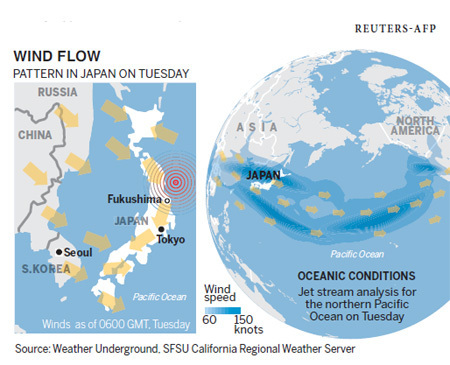 |
GENEVA / LOS ANGELES - Winds are dispersing radioactive material from Japan's quake-hit Fukushima Daiichi nuclear power plant over the Pacific Ocean, away from Japan and other Asian countries, the World Meteorological Organization (WMO) said on Tuesday.
|
||||


"At this point, all the meteorological conditions are offshore so there are no implications for Japan or other countries near Japan," Maryam Golnaraghi, chief of WMO's disaster risk reduction division, told a briefing in Geneva.
An explosion at the quake-hit nuclear power plant sent out low levels of radiation, prompting some people to flee the capital Tokyo and others to stock up on essential supplies.
The WMO's assessment was based on models derived from data from three meteorological agencies in Japan, China and Russia, as well as other information, WMO spokeswoman Clare Nullis said.
"So far they have been mainly offshore. That is, the winds have been dispersing materials introduced into the atmosphere to the open ocean," Golnaraghi said.
"However, meteorological systems develop and progress," Golnaraghi added.
Winds on Tuesday and Wednesday in the stricken area would mainly blow toward the northeast and east, but on Wednesday if particles are released in the lower levels of the atmosphere, "they will be westerly, they will be toward inland (Japan)", she said.
"So what it means is that depending on the concentration of the particles and depending on which level of the atmosphere they are issued, they could be taking a very different trajectory," Golnaraghi added.
California waits
California is closely watching the crisis, but officials downplayed the threat that a radioactive cloud blown across the Pacific could pose for the US west coast.
While radioactivity could reach the United States from the quake-hit Fukushima plant, the levels would not be high enough to cause major health problems, said the Nuclear Regulatory Commission (NRC).
Some experts disagreed, notably pointing to the west-east jet stream, but the NRC - which was asked by Japan on Monday to send nuclear experts to deal with the crisis - said even the Pacific island state of Hawaii faced little risk.
"Right now it's quite possible that there could be some radiation floating over the United States. But we don't think that it would be particularly harmful ... even in a worst-case scenario," spokesman David McIntyre said.
The comments came as Japanese authorities grappled with multiple crises at the nuclear plant, 250 km north of Tokyo, following Friday's magnitude-9 quake and tsunami in northeastern Japan.
A third huge explosion rocked the plant on Tuesday, while a spokesman said there appeared to be damage to the structure around the number-two reactor, while higher radiation levels were reported between Fukushima and Tokyo.
California's Department of Public Health said it is "monitoring the situation closely", and highlights its Nuclear Emergency Response Program, which sets out measures to be taken in case of a nuclear incident.
Reuters-AFP
| 分享按鈕 |
 主站蜘蛛池模板:
深夜免费av在线观看|
成年女人片免费视频播放A|
天天躁日日躁狠狠躁2018|
亚洲人成网站18禁止无码|
亚洲ⅴa曰本va欧美va视频|
国产高清视频一区二区三区|
18禁网站免费无遮挡无码中文
|
久久99精品国产麻豆婷婷|
不卡国产一区二区三区|
成在人线AV无码免观看麻豆|
日韩高清福利视频在线观看|
五月婷之久久综合丝袜美腿
|
亚洲欧美人成人让影院|
忘忧草www日本韩国|
国产午夜亚洲精品不卡福利|
素人视频亚洲十一十二区|
a级毛片毛片看久久|
99精品国产一区二区三|
熟女一区|
亚洲一区精品伊人久久|
337P日本欧洲亚洲大胆精品555588|
无码日韩做暖暖大全免费不卡|
亚洲精品入口一区二区乱|
国产高潮又爽又刺激的视频|
色欲国产一区二区日韩欧美|
亚洲自拍偷拍福利小视频|
国产精品国产三级国产试看|
国产一区二区黄色激情片|
亚洲大尺度无码无码专线|
国产成人综合亚洲欧美日韩|
日本一区二区三区内射|
国产乱码精品一区二三区|
国产线播放免费人成视频播放|
国产肉体ⅹxxx137大胆|
亚洲成人av免费一区|
亚洲欧洲日韩综合色天使|
在线免费成人亚洲av|
236宅宅理论片免费|
天堂V亚洲国产V第一次|
产国语一级特黄aa大片|
久久一区二区中文字幕|
主站蜘蛛池模板:
深夜免费av在线观看|
成年女人片免费视频播放A|
天天躁日日躁狠狠躁2018|
亚洲人成网站18禁止无码|
亚洲ⅴa曰本va欧美va视频|
国产高清视频一区二区三区|
18禁网站免费无遮挡无码中文
|
久久99精品国产麻豆婷婷|
不卡国产一区二区三区|
成在人线AV无码免观看麻豆|
日韩高清福利视频在线观看|
五月婷之久久综合丝袜美腿
|
亚洲欧美人成人让影院|
忘忧草www日本韩国|
国产午夜亚洲精品不卡福利|
素人视频亚洲十一十二区|
a级毛片毛片看久久|
99精品国产一区二区三|
熟女一区|
亚洲一区精品伊人久久|
337P日本欧洲亚洲大胆精品555588|
无码日韩做暖暖大全免费不卡|
亚洲精品入口一区二区乱|
国产高潮又爽又刺激的视频|
色欲国产一区二区日韩欧美|
亚洲自拍偷拍福利小视频|
国产精品国产三级国产试看|
国产一区二区黄色激情片|
亚洲大尺度无码无码专线|
国产成人综合亚洲欧美日韩|
日本一区二区三区内射|
国产乱码精品一区二三区|
国产线播放免费人成视频播放|
国产肉体ⅹxxx137大胆|
亚洲成人av免费一区|
亚洲欧洲日韩综合色天使|
在线免费成人亚洲av|
236宅宅理论片免费|
天堂V亚洲国产V第一次|
产国语一级特黄aa大片|
久久一区二区中文字幕|