Nuclear Meltdown
Japan radiation crisis escalates
By Shinichi Saoshiro and Chisa Fujioka (China Daily)
Updated: 2011-03-16 07:13
 |
Large Medium Small |
|
 This satellite image, released on Tuesday, shows the No 3 reactor at the Fukushima Daiichi nuclear plant burning after an explosion on Monday following Friday's earthquake and tsunami. AP/Digitalglobe |
TOKYO - Japan faced a potential catastrophe on Tuesday after a quake-crippled nuclear power plant exploded and sent low levels of radiation floating toward Tokyo.


Officials in Tokyo - 240 km to the south of the plant - said only minute levels of radiation had been detected so far in the capital.
Radiation levels in the city of Maebashi, 100 km north of Tokyo, and in Chiba prefecture, nearer the city, were up to 10 times normal levels, Kyodo news agency said.
There have been a total of four explosions at the Fukushima Daiichi nuclear plant since it was damaged in last Friday's massive quake and tsunami. The most recent were blasts at reactors No 2 and No 4 on Tuesday, followed by fire at the latter. Japan's Self-Defense Force and the US military were called in to put out the fire.
Japan told the UN nuclear watchdog a spent fuel storage "pond" - an area where used nuclear fuel is kept cool - was on fire and radioactivity was being released "directly" into the atmosphere.
"There has been a fire at the No 4 reactor and radiation levels in the surrounding area have heightened significantly. The possibility of further radioactive leakage is heightening," a grim-faced Kan said in an address to the nation.
Nuclear officials say they may seek US and Japanese military help to spray water from helicopters into the overheating spent fuel storage pool at No 4 reactor.
|
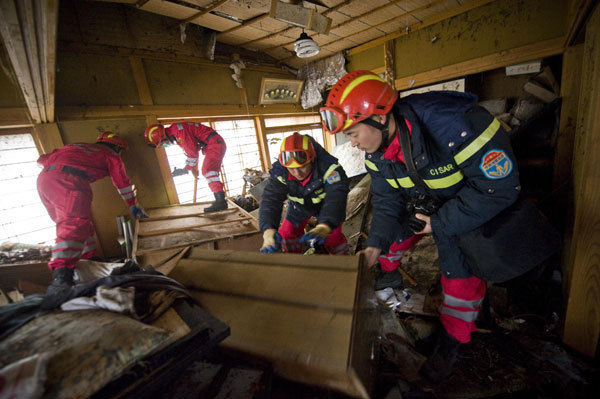 Members of the Chinese search and rescue team look for survivors at a house in Iwate prefecture, northern Japan, on Tuesday. Lu Xiaowei/Xinhua
|
Chief Cabinet Secretary Yukio Edano, talking of levels of radiation at the No 4 reactor, said: "There is definitely a possibility that this could affect people's bodies."
As concern about the crippling economic impact of the nuclear and earthquake disasters mounted, Japan's Nikkei index fell as much as 14 percent before ending down 10.6 percent, compounding a slide of 6.2 percent the day before. The two-day fall has wiped some $620 billion off the market.
The prospect of a nuclear catastrophe drove stocks down around the world. Stocks opened sharply downward on Wall Street, with the Dow Jones industrial average falling 284.87 points (2.38 percent). Major European indexes also posted falls of 2 to 4 percent.
|
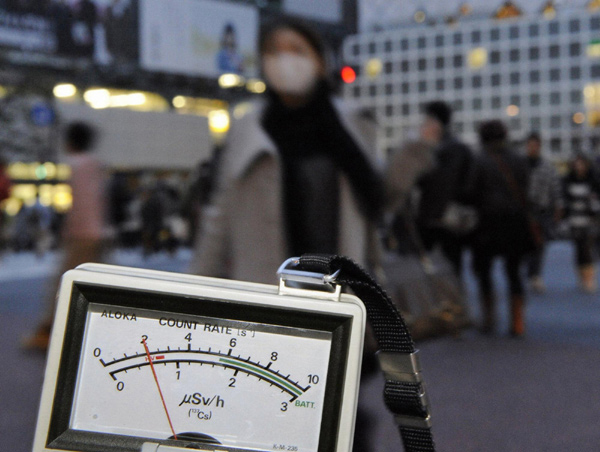 A radiation dosimeter indicates 0.6 microsieverts in Shibuya, Tokyo, March 15, 2011, after an earthquake and tsunami hit northern Japan. [Photo/Agencies] |
Levels of 400 millisieverts per hour had been recorded near the No 4 reactor, the government said. Exposure to over 100 millisieverts a year is a level which can lead to cancer, according to the World Nuclear Association.
The plant operator pulled out 750 workers, leaving just 50, and a 30-km no-fly zone was imposed around the reactors.
Despite pleas for calm, residents rushed to shops in Tokyo to stock up on supplies. Many stores sold out of radios, flashlights, candles and sleeping bags.
There was a real possibility of a leak in the No 4 reactor container, which houses the nuclear fuel rods, according to Murray Jennex, a professor at San Diego State University in California.
Concerns center on damage to a part of the reactor core known as the suppression pool, which helps cool and trap the majority of cesium, iodine, strontium in its water. The nature of the damage was unclear, as was its impact on the containment structure, a thick steel vessel that surrounds the core.
Authorities had previously been trying to prevent meltdowns in the complex's nuclear reactors by flooding the chambers with seawater to cool the reactors down.
A sudden drop in cooling water levels when a pump ran out of fuel had fully exposed the fuel rods for a time, an official said. The plant's operator, Tokyo Electric Power Co, had resumed pumping seawater into the reactor early on Tuesday.
AP contributed to this story.
Reuters
| 分享按鈕 |