

|
|
 |
|
News
Commentary
Business&Trade
Culture & Sci-tech
China-US Dialogue
From the US Media
Major Events
Key Documents
Video
Photo Gallery
Related Coverage
Timeline Milestones
Hotlinks
Li Hong:
Export-driven road hits snag  Liu Shinan:
Teachers are not children's punching bags  Hong Liang:
Information is power for investors too  You Nuo:
A protracted war against recession  Patrick Whiteley:
Why learning Chinese is easier in Year of the Ox  Lamy: China fulfilling WTO commitments well
(China Daily)
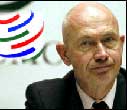
Updated: 2009-01-07 13:56 Pascal Lamy, director-general of the World Trade Organization (WTO), is on a four-day visit to China that ends on Spetember 8th, 2006. In an interview on Spetember 5th, 2006 in Beijing, he spoke to China Daily reporters Zhang Xiaogang and Xu Binglan, and Caijing Magazine reporters Lou Yi and Wang Feng. Following are excerpts of the interview transcript.
Q: Are you happy with China's implementation of its WTO accession commitment? A: Overall yes. Not a hundred per cent. China's implementation of its accession commitments has been reviewed by all the WTO, by all members. And the result is that overall the record is good. There are worries like intellectual property, subsidies in the manufacturing sector. But overall the picture we get from what the governments say is good. We just had a meeting with European businesses this morning. And that's also what they say. It (the accession commitment) has been taken very seriously by the Chinese authorities, the leadership. Obviously, there is a sort of sense (among Chinese officials) that China has to live up to its commitment and a country like China cannot afford to be criticized on this. In everyday life, there will be problems. Some barriers have disappeared. But there are activities here and there to reinvent them in more clever (ways). If you like, the US and the EU, they are also sometimes in the game. But overall, it (China) has broad-based change. The synergy between WTO accession and the reform process has worked. Q:How much likelihood is there for the Doha Round to be resumed? A: We are testing the political will to resume. The negotiations bumped into an obstacle in July. There is a disproportion between the size of the difference in negotiating positions and the political will to conclude. What we are doing for the moment is checking the level of the political will in the system at venues such as the IMF-World Bank meeting in Singapore later this month. My sense is that the will is there. They all would have a big problem with the failure of the round. It is clearer than it used to be. You are on the verge of a big hole and you don't want to fall into that big hole. It is a necessary condition, although it is not a sufficient one. Once this is confirmed, this will have to be translated into changes of position because it is also a necessity if the negotiation did not work on where it broke, which is agriculture. It can only succeed if the negotiation resumes there and new positions appear around the table. This probably needs effort from various players. Q: You said you will listen to what member countries say at international meetings to make judgment about their political will for the resumption of the Doha Round negotiation. But I am wondering how reliable are the statements? During the previous international conferences like the G8 summit, leaders always promised they will push for the progress of the Doha Round, but when the trade officials are at the negotiating tables, they still balked at an ambitious agreement. A: That is precisely what we need to test the political will for. You need to clarify political will after what happened. They know what happened. They know why it happened. So it is transparent now. It's on the table. If we register enough with expression of political will in the coming month, it will be more valuable. Q: Is there a likelihood for the Doha Round to resume next year? A: There is a possibility. There is no certainty. My own role is to test the political will and then to make sure position is adjusted. It may not happen on the first day. This sort of thing probably needs a bit of pre-cooking, quiet diplomacy. Q: What kind of timetable are you looking at? A: An important part in the timetable is the time limit for the US trade officials' capacity to negotiate, which ends in the middle of next year. It may and may not be extended. It's an open question. But clearly, it will be difficult to extend it without some sort of a notion in the system that a deal is in the making, which is why the crucial period is some time between mid-November and the beginning of next year. Q: It's almost a consensus that the EU and US have huge political difficulties in making concessions on agricultural issues. And it seems to me that the only thing that can persuade the major players to go back to negotiation is moral pressure people are talking about major WTO members betraying the poor countries in making the negotiating collapse. Do you agree with that? And now how big is that moral pressure? A: Obviously it is big. We need the system to be rebalanced in favour of developing countries. That is one of the mottoes of the negotiation. We have to remove obstacles to trade. We have to do that in a way that makes the system more development-friendly. On agriculture, we are not in a situation where it is a problem between the US and EU. It's one between US, EU and a number of developing countries. It's not just a North-South issue, it is also a North-North, South-South issue on things like market access. We know the sensitivity of India about this. It's true that the US and EU have to make an effort on subsidies. But it's also true that this round should not result in new obstacles to trade in agriculture, which the US fears about some proposals on the table. It's a trade-off. It is about finding the right proportion between the effort which the US and EU have to pay and the effort which a number of developing countries who have sensitivities on this issue have to pay. Q: What do you think China can do to push the progress of the Doha Round? A: China has a point. Agriculture is the most difficult area in the negotiation. But, in agricultural subsidies, China has fewer problems than others. China gives much less in subsidies to its farmers than the US or EU. China's agricultural and industrial tariffs are much lower than India or Brazil's tariffs. China does not have a lot to pay in this regard, although in areas like industrial market access, agricultural market access and service (market) opening, China will have to pay an effort, but which is in proportion to China's status as a developing country. Yes, China has its role, China will get a lot from the negotiation. Industrial tariffs are reduced in the US and EU and in many emerging developing countries. That's a net plus for China. Q: From your meetings with Chinese officials, do you think they agree with you on what you've said? A: Yes. I think there is a sort of conscience in the Chinese system that in front of surging protectionism here and there, China is probably one of the most vulnerable, given the huge importance of trade to its growth and its huge trade surplus. The WTO as an insurance policy against protectionism is extremely valuable to China. China is one of the main beneficiaries of this insurance policy. This country has to adjust to commitment requirements, and so on. That's true. But the other side of the coin is that China benefits from the rules and from the system. Others have to treat China fairly. The fact is that the political value for the Chinese authorities of a vibrant multilateral system is very high. That is basically what I have been told until now.  |
          |
主站蜘蛛池模板: 国产片精品av在线观看夜色| 在线观看无码av免费不卡网站| 高清无码爆乳潮喷在线观看| 国产成人国产在线观看| 日本一区二区三区小视频| 亚洲女同精品一区二区| 久久99精品久久99日本| 国产办公室秘书无码精品99| 国产精品久久久久久福利 | 国产综合色产在线视频欧美| 亚洲狠狠爱一区二区三区| 日本欧美午夜| 国产成人精品亚洲精品日日| 色偷偷女人的天堂亚洲网| 日韩美少妇大胆一区二区| 国产精品亚洲二区在线播放| 亚洲中文字幕av天堂| 国产成人精品午夜二三区| 国产不卡一区在线视频| 亚洲另类无码一区二区三区 | 久久国内精品自在自线91| 国产精品老熟女露脸视频| 中文字幕人成乱码熟女app| 最新中文乱码字字幕在线| 国产精品不卡无码av在线播放| 成人av午夜在线观看| 一级片麻豆| 国产普通话对白刺激| 欧美性大战久久久久XXX| 亚洲av日韩av永久无码电影| 7723日本高清完整版在线观看| 99久久无色码中文字幕| 自拍视频在线观看一区| 国产视频最新| 亚洲春色在线视频| 一区二区三区av在线观看 | 九九热在线免费视频精品| 欧美日韩精品一区二区三区高清视频 | 国产盗摄xxxx视频xxxx| 亚洲经典在线中文字幕| 成人爽A毛片在线视频淮北|


