When the Chinese press reports about the surging price of rice worldwide it tends to give the impression that China is safe because of its ample stocks.
Really? Most of China's stocks - currently about 50 million tons, according to some sources, is admittedly huge, but most of these stocks are in farmers' barns.
That is usually the situation. How much can the government count on these stocks in an emergency depends on the work experience and effectiveness of local government officials. Have they checked farmers' rice stocks lately? No one knows.
Besides, there is the "invisible hand" at work, or market forces. It is not easy to remain outside the global market and ignore rising prices.
The price of rice increased five times its level in the late 1990s, as part of the general rise in food prices.
On March 27, the price of rice in Thailand went up $760 per ton, from $580. Some trade officials are talking about the likelihood of more than $1,000 per ton in the future.
Rice merchants have described the rise as "never so crazy".
The World Bank warns that the main rice suppliers: China, Vietnam, India, Thailand, Indonesia, Cambodia and Egypt are all placing or ready to place, restrictions on their exports, and this could cause social unrest in some countries where rice is the main staple. In Haiti, people have already begun to agitate against rising food prices.
Those in charge of food policies now face many challenges. How will China manage to shut out overseas black marketers in its pledge to keep domestic prices stable - given its abundant stocks. Will farmers turn down these black marketers offering prices many times higher than the government's price - currently between 1,500 yuan and 1,800 yuan (or around $250) per ton?
Through the era of reform China has seen several major incidents of smuggling, from raw materials, automobiles, auto parts to oil products. It is economic common sense that when there is a widening price gap, there are opportunities for smugglers.
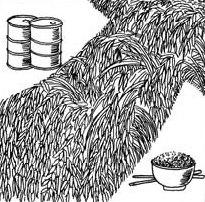
If China does have abundant stocks, it should try to take advantage of the rising prices to export a little more. This would not harm anyone. As a major rice producer in the world, China always focuses on its own needs, and has never attempted to be a major exporter. But that does not mean it should always stay away from the market, even when it offers a good price.
That China does not at present want to increase its rice exports may indicate that stocks in farmers' barns still do not generate enough sense of security for the central government. After all, nothing can be more valuable than the insurance of internal stability.
Or it may indicate that despite the good prices, the trade is not considered sustainable and able to generate revenue year after year. But if, as many people have pointed out, the current food price inflation is only a by-product of the boom in biofuels, then the ultimate challenge to a government, is how to divide its land resources, like a fund manager reallocating an investment portfolio.
It needs to calculate how much land should be used for food and for energy - and at what price. And before this can be solved, no country in the world can claim to be 100 percent sure of its future food supplies. But by the same token, no government can afford to be complacent.
E-mail: younuo@chinadaily.com.cn
(China Daily 04/14/2008 page4)