Some tens of millions of people will set off in a few days for scenic areas in and out of the country as the labor holiday week begins on May 1. The number of travelers during this holiday season will hit a new all time high, according to government agencies.  Many tourists on the road are urbanites seeking to escape city noise, crowds, pollution, traffic jams and even fierce competition in every sector. But they will return. Few will abandon city life. Many tourists on the road are urbanites seeking to escape city noise, crowds, pollution, traffic jams and even fierce competition in every sector. But they will return. Few will abandon city life.
The ever growing cities keep luring or forcing ever more rural people to give up farming as the acreage of tilled land dwindles and farming alone can hardly help improve their standard of living beyond basic sustenance. But this week, an Inter Press Service (IPS) report sounded the alarm against lopsided urbanization. It warned that disproportionate growth of the world's urban population would further destroy the earth's already endangered biodiversity. The report highlighted the fact that urban residents, who now make up more than half of the world population but live on 2 percent of the globe's surface, consume at least 75 percent of the resources. The report quoted Ahmed Djoghlaf, executive secretary of the UN Convention on Biological Diversity, as saying: "We are consuming more natural resources than can be regenerated. We are living beyond the means and capacities of our planet." And if no urgent action is taken soon, about one-fifth of the world's plant species "may be doomed to disappear" by the middle of this century, according to Djoghlaf. The warning is loud and clear. Djoghlaf actually singled out China along with India, Indonesia and South Africa as countries "where urban planners have failed to incorporate environmental concerns". Djoghlaf's criticism may be too harsh for us Chinese to swallow as our country has accomplished in the past 30 years what has taken the Western countries more than a century, bringing one-fifth of the world's population out of poverty. Even the UN's example of "green city" Curitiba in Brazil may not work for mega Chinese cities such as Beijing and Shanghai. While the population density of Curitiba is about 2,700 people per square kilometer, it is more than 4,000 in Beijing. Compared with Curitiba, Beijing's greater population density obviously requires a far more sophisticated public transportation system, residential planning and management.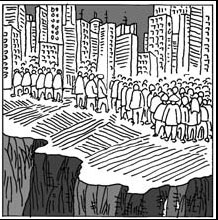 Despite our excuses and misgivings, I believe we should still take Mr Djoghlaf's criticism to heart and act not only to incorporate environmental concerns in city planning but to enforce our existing plans. In fact, there is no lack of public awareness of environmental protection among China's urban residents and experts as well as public servants, and there is no lack of relevant laws. But policy incentives to enforce the laws on environmental protection are still negligible. For instance, factories and plants risk fines or even closure. But they remain unwilling to pay the high costs of installing and running their equipment to clean up the illegal discharges and other pollutants. Even urbanites conscientious about energy saving have to deal with the fact that electricity-saving bulbs are 10 to 15 times more expensive than ordinary ones; and that taking buses and subways to work means huge crowds and other personal discomforts. Above all, we may have to give up some of our newly-acquired convenience, which has become an essential part of urban life, in order to protect the environment and biodiversity for future generations. It is still easier to say than to do. E-mail: lixing@chinadaily.com.cn (China Daily 04/26/2007 page10)
|