Looking at the horizon of Chinese-language teaching in the English-speaking world, anyone with knowledge of both languages cannot but feel disappointed. I obtained most of my basic English during the "cultural revolution" in the 1970s, when any overseas contact, direct or indirect, was difficult. But still, more and more people realized that English was going to be useful and started to prepare themselves.  It is amazing, in fact, to see language learning finally moving both ways more than 40 years later. A growing number of students are studying Chinese in US schools. But despite all the progress in technology, especially the Internet, students are still experiencing many unnecessary difficulties. It is amazing, in fact, to see language learning finally moving both ways more than 40 years later. A growing number of students are studying Chinese in US schools. But despite all the progress in technology, especially the Internet, students are still experiencing many unnecessary difficulties.
Their biggest challenge is even harder to tackle than that faced by China's English learners in the 1970s. Scaremongers are spreading fear of learning Chinese - some from China, some from the overseas Chinese communities. More scaremongering is coming from native English speakers who don't speak much Chinese. They repeatedly harp on what a difficult language Chinese is when it is actually not. Recently, when discussing the lack of Chinese language teachers in schools, one US newspaper began its report: "It takes brute memorization, meticulous pronunciation, and, compared with Spanish, a good deal more time spent in bug-eyed incomprehension. Nevertheless, American students are clamoring to learn Chinese. The problem: There aren't enough teachers to meet the demand." The opening sentence is unwarranted if one knows how Chinese is spoken in a daily context. In terms of memorization, there are no more than 300 particles that form most characters, with 100 or so used most frequently. The number is by no means harder to deal with than the road signs (written and in symbol form - like the shape of a building at the corner where you must make a right turn) that all drivers have to remember. Moreover, when people are using the computer to input Chinese writing (usually by using pinyin, the alphabetic system to spell out the words) instead of writing characters stroke by stroke, their written ability depends more than ever on their oral proficiency. Even the pronunciation system has been simplified in modern Chinese. Separate characters are used less and less. Instead, most expressions and phrases contain two or more characters. So, for instance, when you say yinyue, it must mean music - no matter what your tones are. That being the case, Chinese learners don't have to be meticulous in their tones when they walk around China. Sometimes you just have to repeat your key word a few times. Many Chinese speak in their local accents, and all the accents carry some tonal variations.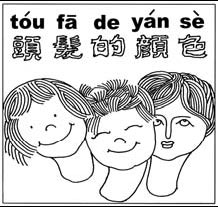 People often forget to mention the easier aspects of the Chinese language. It contains very few gender differences or variations of verb forms and cases. The real problem in overseas Chinese language teaching appeared right beside the American newspaper report posted on its website. The posting showed five characters (written in the archaic style no longer used on the Chinese mainland except by calligraphers) marked by stand-alone pinyin phonetics without identifying the characters' relations to words. The five characters mean "hair colors". In pinyin, they should be written as toufa de yanse rather than tou fa de yan se as written by the teacher. Written that way, the teacher failed to bridge students' oral skill with learning the words and expressions. Presumably, the emphasis of the class would remain on strict pronunciation. The result would be even more frustrated students. Good teachers should not scare students. But where are they? E-mail: younuo@chinadaily.com.cn (China Daily 04/09/2007 page4)
|