<tt id="6hsgl"><pre id="6hsgl"><pre id="6hsgl"></pre></pre></tt>
          <nav id="6hsgl"><th id="6hsgl"></th></nav>
          国产免费网站看v片元遮挡,一亚洲一区二区中文字幕,波多野结衣一区二区免费视频,天天色综网,久久综合给合久久狠狠狠,男人的天堂av一二三区,午夜福利看片在线观看,亚洲中文字幕在线无码一区二区
          The China Story at your Fingertips
          OPEN
          LIVE UPDATES
          What we know

          US attack against Venezuela left 100 dead, Venezuela's interior ministry said.

          US European Command said it has seized an empty oil tanker linked with Venezuela and registered as a Russian vessel in the North Atlantic in an operation.

          07:57 2026-01-07
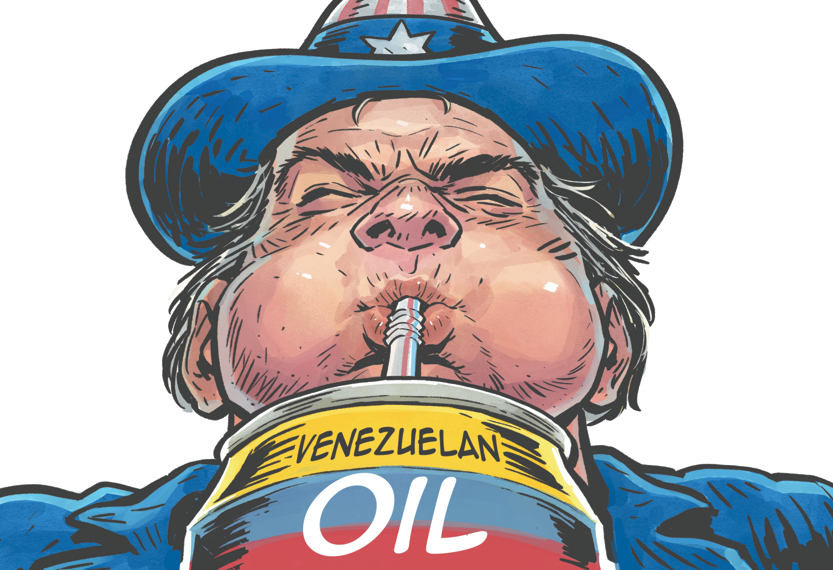
          A never-ending thirst for oil behind US seizure of Maduro
          By Cai Meng
          Cai Meng


          07:13 2026-01-07
          UN members denounce US attack
          By ZHAO HUANXIN in Washington
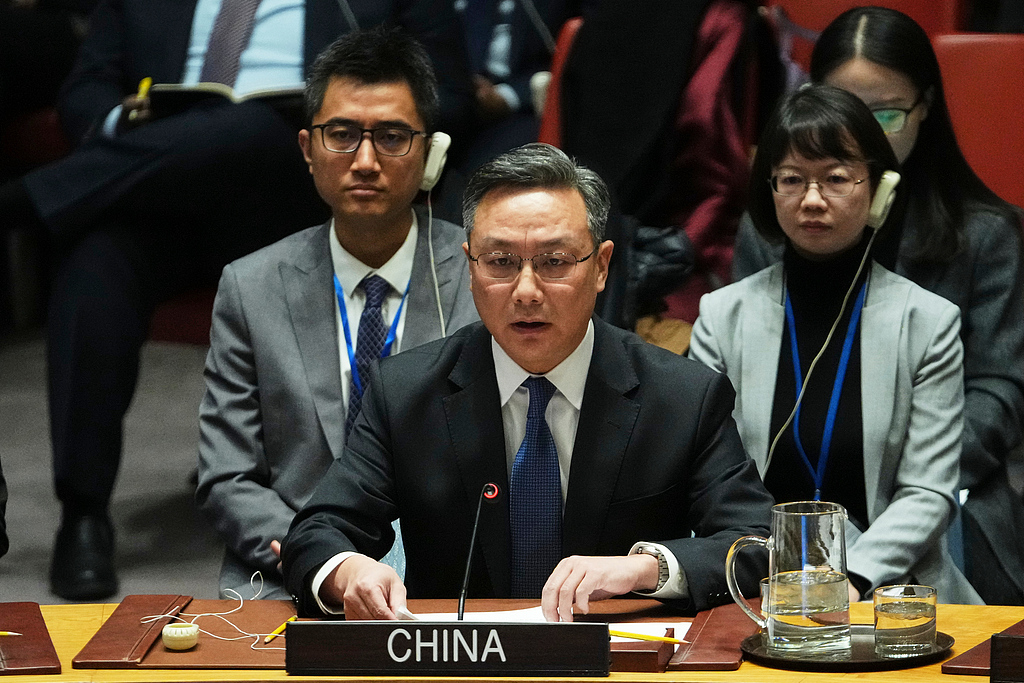
          Sun Lei, the charge d'affaires of China's Permanent Mission to the United Nations, addresses the Security Council at UN headquarters, on Jan 5, 2026. [Photo/CFP]

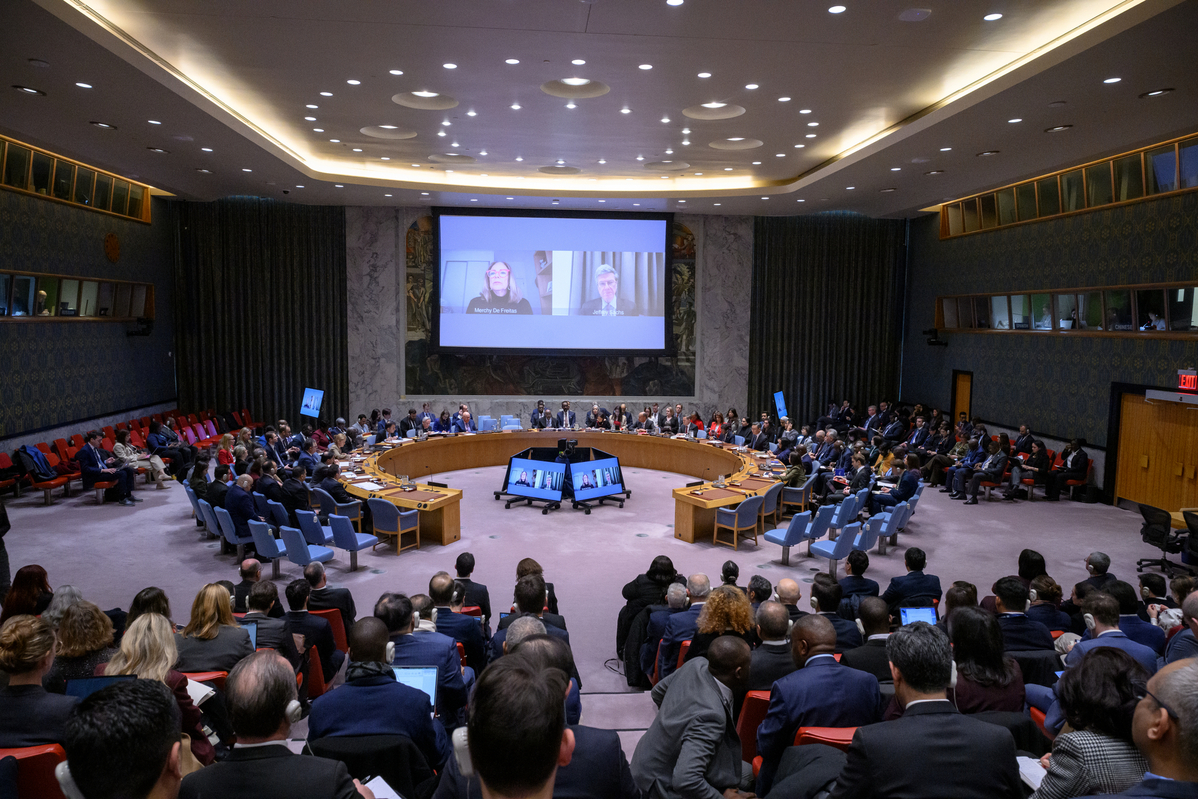
          The United Nations Security Council's first meeting of 2026 heard a global chorus of UN member states strongly denounce the United States' strike in Venezuela as a grave violation of the UN Charter, although a US representative defended it as a "surgical law enforcement operation".

          At Monday's emergency session, Sun Lei, China's deputy permanent representative to the UN, urged Washington to heed the international community's "overwhelming voice", comply with international law and the UN Charter, halt actions that infringe on other countries' sovereignty and security, stop toppling Venezuela's government, and return to dialogue and negotiations as the path to a political solution.

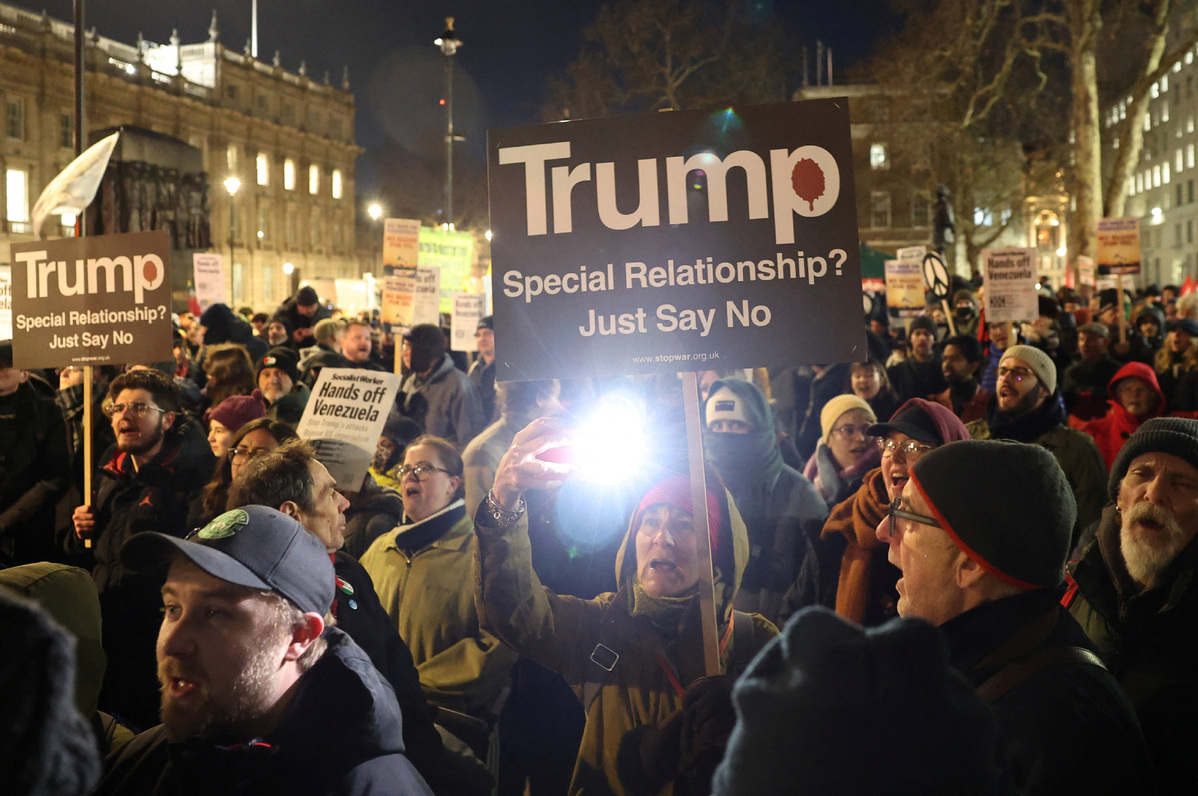
          Venezuelan President Nicolas Maduro, seized and brought to the US on Saturday after a large-scale US strike in the South American nation, pleaded not guilty in federal court in New York on Monday to charges of narco-terrorism. Crowds of protesters gathered outside the courthouse, many voicing opposition to the US action against Venezuela.

          Sun expressed China's "deep shock" and strong condemnation of what he described as the "unilateral, illegal and bullying acts" of the US, and he called for Washington to ensure the safety of Maduro and his wife, and to release them immediately.

          "The US has placed its own power above multilateralism and military actions above diplomatic efforts,"Sun said, warning that such actions pose a grave threat to peace and security in Latin America and the Caribbean and even internationally.

          He said the US military strikes "wantonly trampled" on Venezuela's sovereignty and violated core tenets of the UN Charter, including the principles of sovereign equality, noninterference in internal affairs, peaceful settlement of international disputes, and prohibition of the use of force in international relations.

          "The lessons of history are a stark warning," Sun said, adding that military means are not the solution to international problems, and the indiscriminate use of force will only lead to greater crises.

          He cited past US actions, such as bypassing the Security Council to launch military operations against Iraq, attacks on Iran's nuclear facilities, and the imposition of economic sanctions, military strikes and armed occupations in Latin America and the Caribbean.

          The Security Council holds an emergency meeting on Venezuela at the UN headquarters in New York, Jan 5, 2026. [Photo/Xinhua]

          Those actions caused persistent conflict, instability and immense suffering for ordinary people, he said.

          The envoy reiterated that China firmly supports the Venezuelan government and people in safeguarding their sovereignty, security and legitimate rights and interests, and supports countries in the region in upholding Latin America and the Caribbean as a zone of peace.

          He called on the US to change course, cease bullying and coercive practices, and develop relations and cooperation with countries in the region on the basis of mutual respect, equality and noninterference in internal affairs.

          Addressing the UN meeting, US economist Jeffrey Sachs said that the US military action and ongoing pressure violate Article 2, Section 4 of the UN Charter, which prohibits the threat or use of force against the territorial integrity or political independence of any state.

          Sachs, president of the UN Sustainable Development Solutions Network and director of the Center for Sustainable Development at Columbia University, called these actions part of a long-standing US pattern of "covert regime change", citing a historical record of 70 such operations between 1947 and 1989 alone.

          The US should "immediately cease and desist from all explicit and implicit threats or uses of force against Venezuela", he said.

          Sachs said, "Peace, and the survival of humanity, depends on whether the United Nations Charter remains a living instrument of international law, or is allowed to wither into irrelevance."

          At the meeting, Russia's UN ambassador, Vassily Nebenzia, also called for the immediate release of Maduro and his wife.

          The Russian envoy called the US military action in Venezuela a "crime cynically perpetrated" and a harbinger of a return to an era of "lawlessness", stressing that any conflicts must be resolved through dialogue as enshrined in the UN Charter.

          Backers of the US military operation in Venezuela, including Argentina, framed the action as a law-enforcement, anti-narco-terrorism step and argued it could open a path to restoring democracy.

          Representatives of many countries pushed back by arguing that democracy cannot be delivered through force and coercion, and that any political outcome must be decided by Venezuelans through peaceful and lawful means.

          Leonor Zalabata Torres, Colombia's UN envoy, said that "democracy cannot be promoted or defended through violence or coercion", and Venezuela deserves peace and democracy, prosperity and dignity, with a government whose sovereignty is defined by no one but the Venezuelan people and their institutions.

          Mexico's UN envoy, Hector Vasconcelos, warned that "regime change by external actors and the application of extraterritorial measures" is contrary to international law and that, historically, all such actions have done is to exacerbate conflicts and weaken the social and political fabric of nations.

          Paula Narvaez Ojeda, Chile's UN representative, noted that foreign interference caused extreme damage to her nation, and she stressed that democracy is best recovered through "the strength of organized citizens and through our institutions".

          Spain's representative to the UN, Hector Gomez Hernandez, said that democracy "cannot be imposed by force" and "force never brings more democracy".

          Brazil's UN ambassador, Sergio Franca Danese, said that international norms are "mandatory and universal" and do not allow for exceptions based on ideological, geopolitical or economic interests, such as the "exploitation of natural or economic resources".

          The envoy dismissed the notion that "the end justifies the means", saying that such reasoning lacks legitimacy and grants the strongest the right to define what is just or unjust while imposing decisions on the weakest.

          Representatives from other countries also emphasized that the US military intervention constituted a fundamental breach of the UN Charter and the principles of sovereign equality.

          France's representative said that when a permanent member of the Security Council violates the UN Charter, it "chips away at the very foundation of the international order".

          South Africa warned that "no nation can claim to be legally or morally superior" to another.

          Pakistan said that unilateral military action "contravenes these sacrosanct principles", while the A3 group, consisting of the Democratic Republic of Congo, Somalia and Liberia, said full respect for states' sovereignty and territorial integrity under the UN Charter is an essential foundation for international cooperation and peaceful coexistence.

          Online See more by scanning the code
          07:08 2026-01-07
          US attacks on Venezuela violate international law
          By Marc Weller
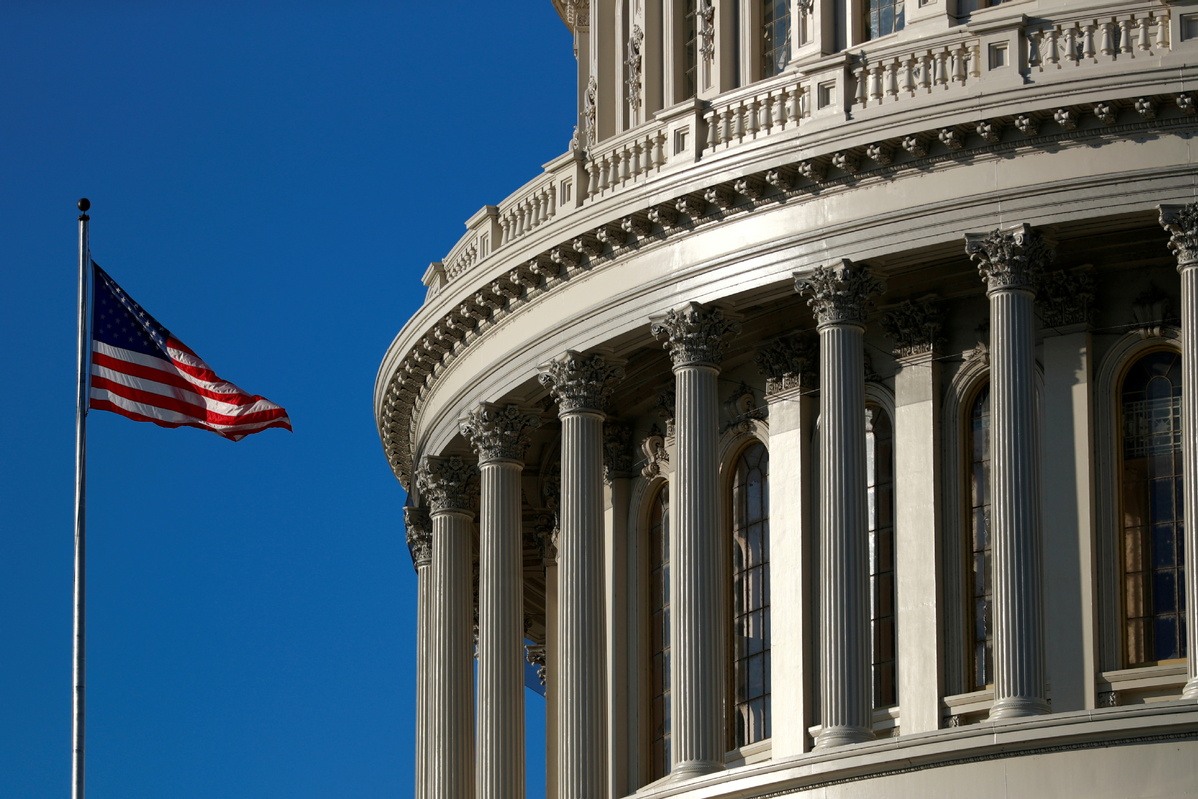
          An American flag flies outside of the US Capitol dome in Washington, US, Jan 15, 2020. [Photo/Agencies]

          The capture of Venezuelan President Nicolás Maduro and his wife by US forces operating in Venezuela, and his forced transfer to the US for trial, pose a significant challenge for international law.

          The US has described the operation as a judicial "extraction mission" undertaken by law enforcement operatives supported by the military. Yet this was a military operation of considerable scale, involving strikes on military targets in and around Caracas, the capital, and the forcible abduction of a sitting president by US special forces. It is clearly a significant violation of Venezuelan sovereignty and the UN Charter.

          This fact is compounded by President Donald Trump's announcement during his news conference of Jan 3 that the US will "run" Venezuela and administer a political transition, or regime change, under the threat of further, more massive uses of force. In addition, there seems to be a determination to use the threat of force to extract funds and resources in compensation for supposed "stolen" or nationalized US assets and oil.

          It is difficult to conceive of possible legal justifications for transporting Maduro to the US, or for the attacks. There is no UN Security Council mandate that might authorize force. Clearly, this was not an instance of a US act of self-defense triggered by a prior or ongoing armed attack by Venezuela.

          The White House asserts that it is defending the American people from the devastating consequences of the illegal importation of drugs by "narco-terrorists" — consequences that could be compared to an armed attack against the US.

          However, in international law, only a kinetic assault with military or similar means qualifies as a trigger for self-defense.

          This leaves the argument of "pro-democratic intervention". Notably, the US did not use "pro-democratic" action as a "formal legal justification" when it invaded Grenada in 1983 and displaced its government. Neither did it do so when it invaded Panama in 1989 and captured the then president Manuel A. Noriega, with a view to putting him on trial for drugs offenses.

          Washington avoided doing so because it feared creating a precedent that would justify "pro-democratic" interventions by other countries which it might oppose. Instead, it relied on an unconvincing claim to self-defense.

          In the case of Venezuela, the US alleges that Maduro "stole" the presidential poll of 2024, that opposition candidate Edmundo Gonzalez Urrutia was the true victor, and that Venezuelan authorities falsified the result of 2025 parliamentary elections.

          But in classical international practice, those who exercise effective control over a country's population and territory will be treated as the government. Considerations of legal or political legitimacy matter less. Accordingly, most governments have abandoned the practice of formally recognizing newly established governments, however they come to power. If they are effective, they are the government.

          However, in the 1990s, with the end of the Cold War, the doctrine articulated by the Universal Declaration of Human Rights gained in currency.

          In 1990, Jean-Bertrand Aristide was elected president of Haiti. But he was soon displaced in a coup mounted by a military junta. In 1994, after many failed diplomatic attempts to restore the democratic outcome of the elections, the UN Security Council formally authorized a US-led force to facilitate the departure of the generals. Faced with the imminent US invasion, they gave in and power was restored to Aristide.

          This doctrine cannot be invoked in cases of creeping authoritarianism or in response to claims that elections have not been free and fair. It only applies in cases of counter-constitutional coups or where there is an election result that remains unimplemented by a sitting government.

          The doctrine is generally only applied where the UN Security Council, or at least a credible regional organization, has granted a mandate — to avoid individual states seeking regime change in pursuit of their own agendas. Clearly, in this instance, there was no mandate from the UN or the Organization of American States.

          Maduro and his wife will however find little comfort in the fact that they were removed from Venezuela by way of an internationally unlawful intervention. US courts consistently apply the so-called Ker-Frisbie doctrine, which holds that they will exercise jurisdiction, irrespective of the means by which the body of the defendant was procured for trial.

          The US will also refuse to extend Maduro the immunities that automatically apply to a serving president when travelling abroad. This too, is legally controversial. But as Noriega experienced before him, the US authorities are unlikely to be deterred by this fact.

          Overall, this episode further erodes international confidence in the principle, agreed after the horrors of the 20th century's world wars, that states must not enforce their legal claims or political demands through the use of force.

          The fact that the US now claims to "run" Venezuela and to put in place its future government under the shadow of the gun, along with the demand to dominate the oil sector and extract compensation, will reawaken uncomfortable memories of previous US dominance in the region.

          The UN Secretary-General has noted that the rules of international law have not been met in this instance, calling it a "dangerous precedent". Many other governments and international institutions are speaking out in a similar vein, though some others have expressed support.

          It will be interesting to see whether the UK and other European US allies will be able to overcome the recently developed sense of diplomatic deference to President Trump and stand up in defense of the international rule of law. This may well be the moment when Western Europe realizes that the US has decisively abandoned the core values that united them for the past century.

          The author is a professor of International Law and International Constitutional Studies in the University of Cambridge. The original version first appeared on the website.

          https://www.chathamhouse.org/2026/01/us-capture-president-nicolas-maduro-and-attacksvenezuela-have-no-justification

          The views don't necessarily represent those of China Daily.

          If you have a specific expertise, or would like to share your thought about our stories, then send us your writings at opinion@chinadaily.com.cn, and comment@chinadaily.com.cn.

          05:58 2026-01-07
          Trump weighs options to acquire Greenland
          FILE PHOTO: An aerial view shows a fjord in western Greenland, September 16, 2025. [Photo/Agencies]

          WASHINGTON - US President Donald Trump and his team are weighing "a range of options" to acquire Denmark's Greenland, including "utilizing the US military," White House Press Secretary Karoline Leavitt said Tuesday.

          "The president and his team are discussing a range of options to pursue this important foreign policy goal, and of course, utilizing the US military is always an option at the commander-in-chief's disposal," Leavitt told Xinhua in an emailed statement.

          She said that "President Trump has made it well known that acquiring Greenland is a national security priority of the United States, and it's vital to deter our adversaries in the Arctic region."

          White House Deputy Chief of Staff Stephen Miller said Monday that nobody would fight the United States if it tried to seize Greenland, which is Denmark's autonomous territory.

          It was "the formal position of the US government that Greenland should be part of the US," Miller said in an interview with CNN.

          "We do need Greenland, absolutely. We need it for defense," Trump reiterated in a phone interview with The Atlantic on Sunday, reaffirming that Venezuela may not be the last country subject to US intervention while claiming it was up to others to decide what a US large-scale strike against Venezuela means for Greenland.

          Hours after the US capture of Venezuelan President Nicolas Maduro early Saturday morning, Miller's wife, Katie Miller, also a Trump ally, posted on X an image of a map of Greenland overlaid with the American flag, writing, "SOON."

          "Our country isn't something you can deny or take over because you want to," Greenland's Prime Minister Jens-Frederik Nielsen said in a statement on Tuesday.

          "Very basic international principles are being challenged" by Washington's repeated threats, Nielsen said.

          Danish Prime Minister Mette Frederiksen warned that "if the US chooses to attack another NATO country militarily, then everything stops, including NATO and thus the security that has been established since the end of the Second World War."

          Leaders of France, Germany, Italy, Poland, Spain, Britain and Denmark issued a joint statement on Tuesday, which said that "it is for Denmark and Greenland, and them only, to decide on matters concerning Denmark and Greenland."

          The leaders underscored that Arctic security remains a key priority for Europe, and it is critical for international and transatlantic security, noting that NATO has made clear that the Arctic region is a priority and European allies are increasing their presence in the area.

          Greenland, a former Danish colony, was granted home rule in 1979. In 2009, Denmark passed the Act on Greenland Self-Government, expanding the island's authority over its domestic affairs. However, Denmark retains authority over Greenland's foreign, defense and security policy, according to the Prime Minister's Office of Denmark.

          "Annexing Greenland would be a strategic catastrophe" for the United States, Casey Michel, head of the Human Rights Foundation's Combating Kleptocracy Program, warned on Tuesday.

          "Any attempt by the United States to claim the island would quickly spiral out of control," Michel wrote on Foreign Policy. "What alliance could survive something like this? What ally would ever trust the US not to do the same in the future?"

          "In a world of imperialism, as the saying goes, appetite grows with eating," said Michel.

          04:15 2026-01-07
          Spanish PM warns US operation in Venezuela sets dangerous precedent
          Spanish Prime Minister Pedro Sanchez arrives for the Coalition of the Willing summit at the Elysee Palace in Paris, France Jan 6, 2026. [Photo/Agencies]

          MADRID -- Spanish Prime Minister Pedro Sanchez on Tuesday said that the US forcible seizure of Venezuelan President Nicolas Maduro risked pushing the world into a dangerous new era and insisted his country would "not remain silent" in the face of violations of international law.

          Speaking to the press after the Coalition of the Willing meeting for Ukraine in Paris, Sanchez said "The operation in Caracas sets a terrible and very dangerous precedent that pushes the world toward a future of uncertainty and insecurity, as we already suffered after other invasions driven by the thirst for oil."

          He stressed that Spain could not recognize the legitimacy of a military action that violates international law and appears to serve no purpose other than overthrowing a government to seize its natural resources.

          The Spanish government has been strongly critical of the attack on Venezuela, with Foreign Minister Jose Manuel Albares saying on Monday that the attack was "clearly contrary to international law" and that "the use of violent means and force must be completely absent" from foreign policy.

          Sanchez also said "We cannot accept it, just as we cannot accept the threat to the territorial integrity of a European state like Denmark," referring US President Donald Trump's threat to annex the Danish territory of Greenland.

          "We will not remain silent in the face of increasingly frequent violations of international law. We will always stand on the side of legality. We will use all the resources at our disposal to strengthen multilateralism," Sanchez noted.

          23:05 2026-01-06
          UN Security Council holds emergency meeting as nations denounce US strikes on Venezuela
          By Wang Haoran

          The UN Security Council held an emergency meeting on Monday, during which members strongly denounced US' assault on Venezuela.

          China condemns "the unilateral, illegal, and bullying acts by the United States", said Sun Lei, charge d'affaires of China's Permanent Mission to the United Nations.

          "Military means are not the solution to problems, and the indiscriminate use of force will only lead to greater crises," he said. "China firmly supports the government and people of Venezuela in safeguarding their sovereignty, security, and legitimate rights and interests."

          Brazil warned US' acts set an "extremely dangerous precedent", while Colombia emphasized that Venezuela's government must be defined by its people.

          20:31 2026-01-06
          Solidarity and cooperation needed to uphold intl law in face of lawless US: China Daily editorial
          An activist holds a poster that reads 'Condemns Donald Trump's military aggression in Venezuela', during an anti-US protest, after the US struck Venezuela and captured its President Nicolas Maduro and his wife Cilia Flores, outside the US Embassy in Jakarta, Indonesia, January 6, 2026. [Photo/Agencies]

          The United States' forcible seizure of Venezuelan President Nicolas Maduro and his wife, followed by the US administration's brazen threats against five other countries, marks a deeply alarming escalation of its unilateralism and militarism that strikes at the very foundations of the postwar international order.

          Having launched what Washington dubbed "Operation Absolute Resolve" against Venezuela, US President Donald Trump went on to warn that further military action could be taken against Colombia, Mexico, Cuba, Iran and even Denmark, an ally and NATO member, over Greenland. Such rhetoric, coming immediately after a military operation that openly violated another country's sovereignty, raises profound concerns about where the limits of US power now lie.

          Beijing is "deeply shocked by and strongly condemns" the US' blatant use of force and its seizure of the Venezuelan leader and his wife. The move is a clear violation of international law, the basic norms governing international relations, and the purposes and principles of the UN Charter. China has called on Washington to ensure the personal safety of Maduro and his wife, release them immediately, stop toppling the Venezuelan government, and resolve disputes through dialogue and negotiation.

          In calling the operation in Venezuela "special law enforcement" — so that it does not need the authorization of Congress — and saying the US doesn't care about what the UN said about its actions, US Secretary of State Marco Rubio is actually declaring to the world that the US administration believes that it can do anything it wants as it is not subject to congressional oversight domestically or the restraints of international law.

          As Sun Lei, charge d'affaires of China's permanent mission to the United Nations, warned at an emergency meeting of the UN Security Council on Monday, the US, by placing its own power above multilateralism and military action above diplomacy, has seriously undermined the cornerstone principles of sovereign equality, noninterference and the peaceful settlement of disputes that are the foundations of the international order.

          History has repeatedly shown that military force only creates chaos, suffering and long-term instability. The cost incurred by the US administration thinking it can act as a global lawmaker, a world policeman and an international judge will ultimately be paid by the world, including the US itself, in the future in various forms.

          The implications of allowing the US action to pass without consequence are far-reaching. If the abduction of a head of state, the bombing of a sovereign country and open threats of further armed intervention are normalized, as Venezuela's UN ambassador warned, adherence to international law becomes optional, and force becomes the ultimate arbiter of international relations. The postwar international order, forged at immense human cost in the aftermath of two world wars, now stands at risk of being dismantled, threatening to usher in a world ruled by the law of the jungle.

          The US administration's renewed threats over Greenland vividly illustrate the spillover effects of the risks. To protect Greenland's security is not a pretext but an open threat to Denmark's sovereignty. What truly draws the US to Greenland is the latter's resources. No wonder the US leader's claim that the US "absolutely" needs Greenland prompted rare and unusually blunt responses from European leaders. Jens-Frederik Nielsen, Greenland's prime minister, called the rhetoric "completely and utterly unacceptable", while Danish Prime Minister Mette Frederiksen warned that any US military action against another NATO member would effectively bring the alliance to a halt.

          Beyond the immediate international ramifications, the US' lawless behavior also exposes troubling questions about the internal governance of the US itself. The military action against Venezuela was not authorized by Congress, raising doubts about the effectiveness of constitutional checks and balances that are supposed to restrain such use of force. When a single leader can deploy overwhelming military power abroad and threaten multiple countries in quick succession, what safeguards remain to prevent catastrophic miscalculation?

          What if the US chariot — powerful, heavily armed, yet seemingly without brake pads — is allowed to race unchecked across the global landscape? The international community cannot afford to look away. Upholding the UN Charter is not a matter of selective interpretation or political convenience. It requires collective action, clear condemnation of violations and concrete steps to ensure accountability. As China has stated, it stands ready to work with the international community to defend international law, fairness and justice.

          If the rules-based international order is to survive, sovereignty must not become a privilege reserved for the powerful. Respect for law, not fear of force, must remain the foundation of global governance.

          18:39 2026-01-06
          UN human rights office says US intervention in Venezuela undermines fundamental principles of intl law

          GENEVA -- The United Nations (UN) High Commissioner for Human Rights is deeply worried about the situation in Venezuela following the US military operation in the country, a spokesperson for the UN human rights office said on Tuesday.

          Speaking at a regular press briefing in Geneva, spokesperson Ravina Shamdasani said the High Commissioner believes the US action undermines a fundamental principle of international law -- that a state must not threaten or use force against the territorial integrity or political independence of another state.

          She also said, in response to questions from reporters, that the US action breached the UN Charter and damaged the international security architecture, making every country less safe.

          She said it was essential for the international community to maintain clarity, stressing that the US action should not be portrayed as a measure taken to defend human rights, but rather as an action carried out in clear violation of international law.

          The US action in Venezuela sends a signal that "the powerful can do whatever they like, she added. It weakens the mechanism that we have to prevent further conflict, to prevent even a Third World War, namely the UN," she stressed.

          "This is why we're calling on all states to speak with one voice in defense of the UN Charter and in defense of international law," she said.

          17:07 2026-01-06
          China says it respects Rodriguez taking office as Venezuela's acting president
          By ZHANG YUNBI

          In response to Delcy Rodriguez taking office as Venezuela's acting president, Beijing voiced its "respect" on Tuesday to the arrangements made by the Venezuelan government in accordance with the country's Constitution and laws.

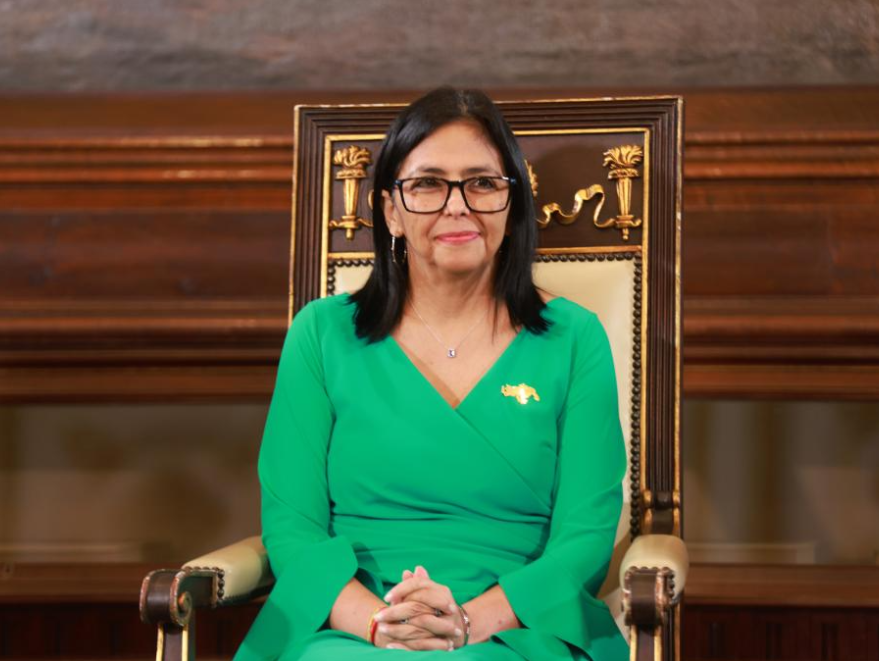
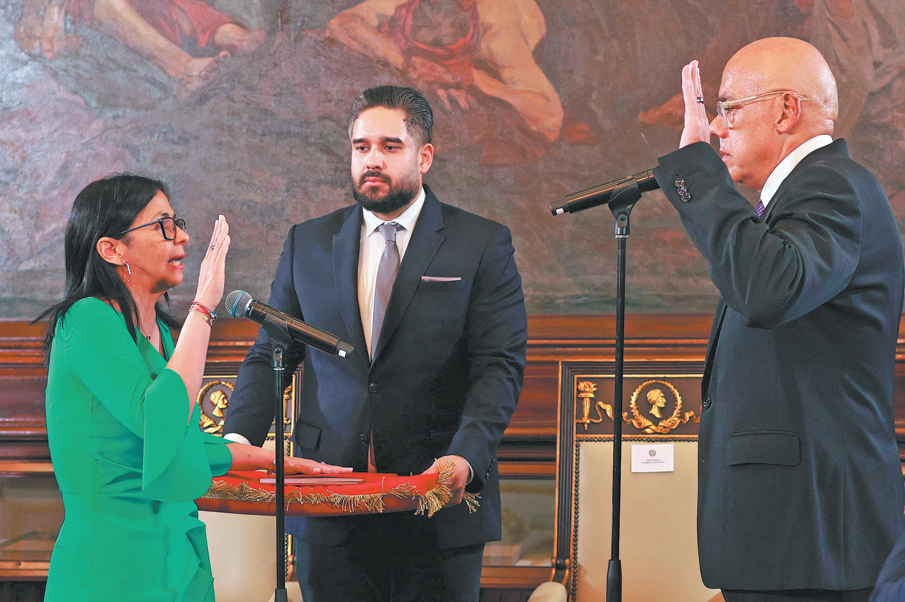
          Rodriguez, previously vice-president of Venezuela, was sworn in on Monday as the acting president of the country, after President Nicolas Maduro was taken by force during a US military operation against the South American nation, Xinhua News Agency reported.

          "China respects Venezuela's sovereignty and independence, and respects the arrangements made by the Venezuelan government in accordance with the country's constitution and laws," Foreign Ministry spokeswoman Mao Ning told a daily news conference in Beijing on Tuesday.

          When asked if China will call for sanctions against the US over the matter in Venezuela, Mao said, "We support the (United Nations) Security Council in fulfilling its primary responsibility to champion international peace and security."

          "As a permanent member of the Security Council, the US has disregarded the serious concerns of the international community and trampled upon Venezuela's sovereignty, security and legitimate rights and interests. China firmly opposes this," she said.

          16:24 2026-01-06
          Latin America confronts the US doctrine of force
          By Isaura Diez
          This photo taken with a mobile phone shows people protesting outside a courthouse in New York, the United States, on Jan 5, 2026. [Photo/Xinhua]

          The United States military operation against Venezuela marks a divergence from the international system that emerged after WWII, exposing the erosion of the principles of sovereignty, legality, and multilateralism.

          The attack not only redefines the internal situation of Venezuela, but also sends a warning to all of Latin America and the Caribbean that the use of direct intervention as a tool to subvert governments that are not "aligned" with Washington has returned.

          The bombings of Caracas and the abduction of President Nicolas Maduro and his wife constitute the first military actions in the region since the approval of the controversial new national security strategy, which reinterprets and updates a doctrine more than 200 years old (the 1823 Monroe Doctrine) and the concept of "America for Americans".

          This development has already had a profoundly negative impact on relations between Washington and Latin America and the Caribbean — heirs to a long history of US aggression, coups d'état, and military operations.

          The prevailing perception in the region is that any government could be next, and in fact, direct threats have already been made against Colombia, Mexico, and Cuba.

          What Washington has designed — with Secretary of State Marco Rubio as one of its main architects — is for South America and the Caribbean to be dominated by neocolonial rule.

          This also unfolds amid deep regional fragmentation, with the rise of right wing forces and clear US interference in the internal affairs of several nations.
          The inability of Latin America and the Caribbean to articulate a strategy, establish points of convergence and coordination, and build a unified long-term vision — despite ideological differences among their respective governments — buries any possibility of confronting the aspirations of the new US security doctrine as a bloc.

          This aggression constitutes a serious precedent for the continuity of international relations based on the rules established after WWII.

          The United States — possessing one of the most powerful armies in the world, with extensive military deployments and bases across the globe — has already demonstrated the capacity to carry out surgical operations that avoid a large-scale invasion, but effectively decapitate a system of government.

          Although the world recognizes that the US attack on Venezuela violated international law, multilateral bodies such as the United Nations lack the ability to restrain Washington, as previously demonstrated by its failure to intervene in Gaza.

          One objective of the attack was to eliminate Venezuela's influence as a regional actor opposed to the United States, as well as sabotage its deepening ties with Russia and China. However, the main goal undoubtedly lies in the US oil industry's interests in the resources of the South American giant.

          President Donald Trump admitted as much at a press conference following the attack, stating that major US companies will invest millions to recover Venezuela's oil industry — which he said should have always remained in the hands of the United States.

          Additionally, there are domestic political considerations, as President Trump — now midway through his term — needs a political win in the context of his campaign's promises to crackdown on drugs and immigration.

          The government of the newly appointed acting president Delcy Rodríguez (formerly executive vice president) will face strong external and internal pressures that will sustain economic and social instability in the coming days.

          On one hand, the United Socialist Party of Venezuela has a broad base of popular support demanding the release of President Nicolas Maduro. On the other, Trump has already threatened a second attack if US demands are not met and has announced that the military deployment in the Caribbean will be maintained.

          According to the White House, plans are underway to "run Venezuela" until "conditions are ripe" to establish a new government, which, notably, does not include the Venezuelan opposition, discredited by Trump himself.

          In reality, it seems unlikely that Washington can run Venezuela without the cooperation of the Venezuelan government, without occupying the territory, without reducing the multisectoral reach of armed forces loyal to Chavismo, and ultimately without eliminating a popular movement that has governed for more than 20 years.

          The military aggression against Venezuela reveals a broader dynamic of geopolitical reconfiguration in which force once again prevails over law, and security is used as a pretext for intervention.

          In the context of regional fragmentation and weakened multilateralism, Latin America and the Caribbean face the historic challenge of preventing this episode from becoming the norm.

          The response — or the absence of one — will shape not only Venezuela's future, but also sets a precedent for the entire international system, increasingly marked by inequality and uncertainty.

          Isaura Diez is the chief correspondent of the Latin American News Agency Prensa Latina, China Bureau. 

          The views don't necessarily reflect those of China Daily.

          If you have a specific expertise, or would like to share your thought about our stories, then send us your writings at opinion@chinadaily.com.cn, and comment@chinadaily.com.cn.

          11:27 2026-01-06
          American justice as 'supreme international crime'
          By Dan Steinbock
          A person demonstrates near the Miraflores Palace in Caracas, the capital of Venezuela, on Jan 3, 2026. [Photo/Xinhua]

          On Saturday, the Trump administration forcibly seized the incumbent president of Venezuela. It is its latest violation, a "supreme international crime" as Nuremberg prosecutors would put it.

          In a military operation, Venezuela's President Maduro was forcibly seized and transported to New York to face charges in a federal court. Reportedly, the US Army's elite Delta Force carried out a large-scale military strike and raid on Caracas, the capital of Venezuela, in the early hours of Jan 3, 2026.

          It was no minor event. The US military's operation was months in-the-making and involved more than 150 aircraft and drones, integrated space and cyber effects, multiple intelligence agencies and law enforcement personnel, according to Chairman of the Joint Chiefs of Staff Gen. Dan Caine.

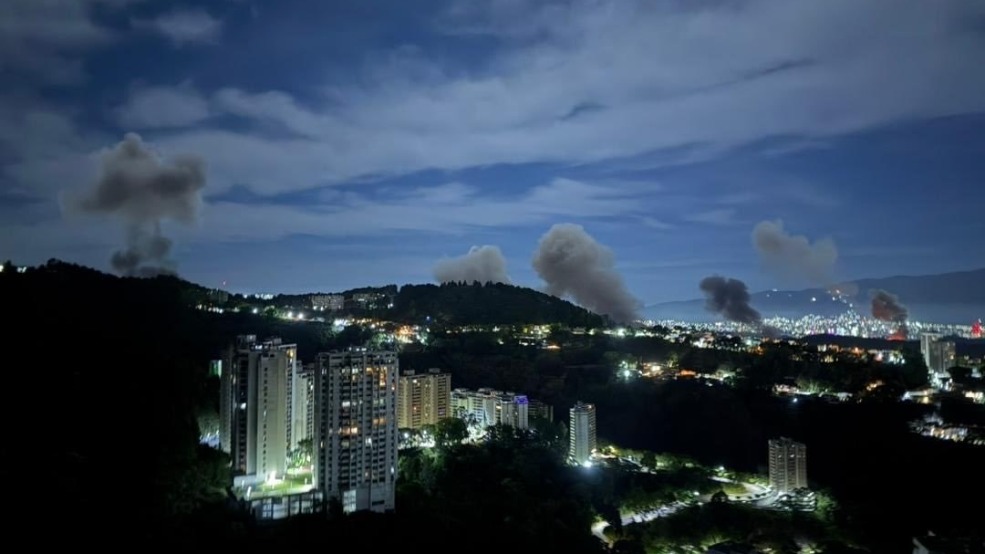
          The operation involved multiple explosions and low-flying aircraft. The Venezuelan government described it an "imperialist attack." US forces located Maduro and his wife, Cilia Flores, in a heavily guarded residence within the Fort Tiuna military installation, and captured them from their bedroom.

          US President Donald Trump announced that Maduro and his wife were taken by helicopter to the USS Iwo Jima warship and transported to New York. Meanwhile, the US Department of Justice unsealed an indictment against Maduro and his wife on four serious charges, including conspiracy in narco-terrorism and cocaine importation, possession of machine-guns and destructive devices, and conspiracy to possess machine-guns and destructive devices against the US.

          The US has for years considered Maduro an illegitimate leader and had offered a $50 million reward for information leading to his arrest. Maduro has consistently denied all allegations, calling the charges a US conspiracy to justify regime change.

          A grave violation of rules-based international law

          The US capture of Venezuelan President Nicolas Maduro and the associated military operation were widely condemned by legal experts and several nations as a violation of international law, specifically the UN Charter, which prohibits the use of force against the territorial integrity or political independence of another state.

          A unilateral military operation by one state to seize a sitting leader in another country is illegal. Critics of the US action, including the foreign ministries of China, France, Mexico, and Russia, have already cited violations of key UN Charter principles.

          Article 2(4) requires member states to refrain from the threat or use of force against the territorial integrity or political independence of any other state. Military force can generally only be used in self-defense (Article 51) or with authorization from the UN Security Council, neither of which occurred in this case.

          Nor was there any authorization by the Congress, which the Trump administration simply ignored.

          The capture is considered a grave violation of Venezuela's sovereignty, as it involved uninvited military action on Venezuelan soil.

          Undermining weak signs of recovery

          As a result of two decades of increasing economic coercion by the US government and the escalation of maximum pressure by the Trump administrations, Venezuela's economy is today highly fragile.

          There have been some promising signs, due to oil-driven growth and a slowdown in hyperinflation, thanks to the eased sanctions, mainly by the Biden administration.

          Nonetheless, Venezuela remains plagued by deep structural issues, extreme poverty, very low minimum wages, high inflation, and severe deterioration in services, as US economic pressure has overshadowed all stabilization efforts.

          Oil revenue that is crucial for recovery production remains far below past levels. Since Venezuelan economy heavily relies on oil, US sanctions have sought to undermine the efforts by the state oil company Petróleos de Venezuela SA (PDVSA) to fund most government revenue.

          The Maduro government implemented reforms (dollarization, private sector easing) slowed hyperinflation and fostered growth (5 percent in 2023).

          In view of the Trump administration, economic stabilization would reinforce the current status quo. Hence, the need for destabilization.

          It's about the control of oil and gas

          The oil sector's deterioration is the primary driver of the broader economic plunge in Venezuela, with exports dwindling despite vast potential.

          Thanks to the escalatory measures by the US, Venezuela's oil production has collapsed from over 3 million barrels per day (bpd) to around 1 million bpd or less, due to lack of investment and decaying infrastructure. Mismanagement in the sector is a reality, but it is hard to see how Venezuela could manage its oil amid continuous attacks by the world's greatest military power.

          By severely penalizing government revenue, these US efforts represent a long war against Venezuelan people and their living standards.

          The extraction of extra-heavy crude oil requires a higher level of technical expertise, which international oil companies possess but their involvement has been limited by international sanctions.

          Venezuela has the world's largest proven crude oil reserves with some 303 billion barrels, accounting for 17 percent of global reserves. Most of its proven oil reserves are extra-heavy crude oil from the Orinoco Belt.

          Yet, despite the sizeable reserves, Venezuela produced barely 0.8 percent of total global crude oil in 2023.

          Source: US EIA, author

          "We're going to have our very large United States oil companies, the biggest anywhere in the world, go in, spend billions of dollars, fix the badly broken infrastructure and start making money for the country," Trump said in a public address.

          The simple reality is, as Trump acknowledged, that the US will look to tap Venezuelan oil reserves.

          Future scenarios

          President Trump said in a press conference that the US would "run" Venezuela on a temporary basis during the transition, and "get the oil flowing." In reality, the power vacuum left by Maduro's capture creates several potential paths forward for Venezuela.

          Managed transition. According to Venezuela's constitution, Vice President Delcy Rodríguez, a key member of Maduro's United Socialist Party of Venezuela (PSUV), would assume power and call for new elections within 30 days. In the process, the Trump administration is likely to want the opposition candidate, such as Edmundo González, recognized as the legitimate winner of the contested 2024 election to take office. However, the key role in this scenario is predicated on the reactions of the socialist government and the military.

          Consolidation of pro-Maduro power. The pro-Maduro elite and military leaders, many of whom are under US sanctions thus facing potential prosecution, will seek to maintain control. In this scenario, a high-ranking military official or a civilian head from within the ruling socialist party could replace Maduro and ensure continuation of the current government and its control over the state and oil industry. It could result in new US attacks and repression in Venezuela.

          Internal conflict. The power vacuum could also lead to infighting among military factions or between different elite groups. The outcome could be widespread instability, popular unrest, and potentially an internal armed conflict involving pro-government armed groups and opposition forces, or even a full military takeover. These scenarios could instigate new US attacks.

          In this early stage, the Trump administration's goal has been to insulate Maduro from Venezuela and a murky judicial process that will destabilize Venezuela. The latter will then serve as a pretext for covert efforts to implant a pro-US leadership or to drive the country to a civil war.

          Although the US government has asserted that its actions are justified under domestic law and presidential authority, the overwhelming international legal opinion is that the use of military force to seize a leader on foreign territory constitutes an illegal "kidnapping" and a clear violation of international law and the UN Charter.

          International law vs imperial plunder

          Through the 20th century, the US has been heavily involved in numerous interventions and coups to influence or overthrow foreign governments, particularly in Latin America and the Middle East, usually for political or economic reasons. These actions, such as the 1953 Iranian coup d'état or interventions in various Latin American countries under the Roosevelt Corollary, often resulted in the removal or exile of the sitting leader.

          The dark history of external interventions, often involving subsequent terror and repression, insurgence and counter-insurgence and decades of instability, has featured repeated efforts at regime change or capturing specific individuals. These include the arrest of Manuel Noriega (Panama, 1989), targeted strikes and regime change attempts (Iraq, Libya and Yemen, 2000s and 2010s), the recent bombing of Iran, Nigeria and the logistical and financial support of Israel's bombing of and genocidal atrocities in Gaza.

          By contrast, international law is built on principles of sovereignty and non-interference, which make direct, peacetime attacks on foreign sovereigns highly controversial breaches of international peace.

          Until his death at the age of 103, Benjamin Ferencz, the last Nuremberg prosecutor, consistently argued that unauthorized US military actions, like the 2020 killing of the Iranian commander Qasem Soleimani and the Iraq War, violated international law.

          Ferencz believed that wars of aggression, as defined by the Nuremberg Principles, are the "supreme international crime," and leaders who initiate them should face international prosecution. In this view, the standards set at Nuremberg apply to all nations, including the US, and failure to apply them means that "law has lost its meaning."

          That's the crossroads where we stand today. A world where international law is devoid of meaning and a pretext for imperial plunder – and a world where international law ensures the continuance of human civilization.

          Dr. Dan Steinbock is an internationally recognized strategist of the multipolar world and the founder of Difference Group. He has served at the India, China and America Institute (USA), Shanghai Institutes for International Studies (China) and the EU Center (Singapore). 

          The original version was published by Informed Comment (US) on January 5, 2026.

          The views don't necessarily reflect those of China Daily.

          If you have a specific expertise, or would like to share your thought about our stories, then send us your writings at opinion@chinadaily.com.cn, and comment@chinadaily.com.cn.

          11:16 2026-01-06
          UN member states condemn US action in Venezuela
          By Zhao Huanxin in Washington
          Sun Lei, the charge d'affaires of China's Permanent Mission to the United Nations, addresses the Security Council Monday, Jan 5, 2026 at UN headquarters. [Photo/CFP]

          The United Nations Security Council's first meeting of 2026 heard a global chorus of UN member states strongly denounce the United States' strike in Venezuela as a grave violation of the UN Charter, though a US representative defended it as a "surgical law enforcement operation".

          At Monday's emergency session, Sun Lei, China's deputy permanent representative (chargé d'affaires) to the UN, urged Washington to heed the international community's "overwhelming voice," comply with international law and the UN Charter, halt actions that infringe other countries' sovereignty and security, stop toppling Venezuela's government, and return to dialogue and negotiations as the path to a political solution.

          Venezuelan President Nicolas Maduro, seized and brought to the US on Saturday following a large-scale US strike in the South American nation, pleaded not guilty in New York federal court to charges of narco-terrorism on Monday.

          Sun expressed China's "deep shock" and strong condemnation of what he called the "unilateral, illegal and bullying acts" of the United States, and called for the US to ensure the safety of Maduro and his wife, and to release them immediately.

          "The US has placed its own power above multilateralism and military actions above diplomatic efforts," Sun said, warning that such actions pose a grave threat to peace and security in Latin America and the Caribbean and even internationally.

          He said the US military strikes "wantonly trampled" upon Venezuela's sovereignty and violated core tenets of the UN Charter, including the principles of sovereign equality, non-interference in internal affairs, peaceful settlement of international disputes, and the prohibition of the use of force in international relations.

          "The lessons of history are a stark warning," Sun said, noting that military means are not the solution to international problems and that the indiscriminate use of force would only lead to greater crises.

          He cited past US actions, including bypassing the Security Council to launch military operations against Iraq, attacks on Iran's nuclear facilities, and the imposition of economic sanctions, military strikes and armed occupations in Latin America and the Caribbean.

          Those actions caused persistent conflict, instability and immense suffering for ordinary people. "Did these actions bring peace and stability? Did they bring development and prosperity?" he asked, saying the international community could see the answers clearly.

          The envoy reiterated that China firmly supports the Venezuelan government and people in safeguarding their sovereignty, security and legitimate rights and interests, and supports regional countries in upholding Latin America and the Caribbean as a zone of peace.

          He called on the United States to change course, cease bullying and coercive practices, and develop relations and cooperation with regional countries on the basis of mutual respect, equality and noninterference.

          Speaking to the UN meeting, US economist Jeffrey Sachs said that the US military action and ongoing pressure violate Article 2, Section 4 of the UN Charter, which prohibits the threat or use of force against the territorial integrity or political independence of any state.

          Sachs, president of the UN Sustainable Development Solutions Network and director of the Center for Sustainable Development at Columbia University, called these actions part of a long-standing US pattern of "covert regime change," citing a historical record of 70 such operations between 1947 and 1989 alone.

          "The United States shall immediately cease and desist from all explicit and implicit threats or uses of force against Venezuela," he said.

          Closing on a stark warning, Sachs said, "Peace, and the survival of humanity, depends on whether the United Nations Charter remains a living instrument of international law, or is allowed to wither into irrelevance."

          At the meeting, Russian UN ambassador Vassily Nebenzia also called for the immediate release of Maduro and his spouse.

          The Russian envoy called the US' military action in Venezuela a "crime cynically perpetrated" and a harbinger of a return to an era of "lawlessness", stressing that any conflicts must be resolved through dialogue as enshrined in the UN Charter.

          "We cannot allow the United States to proclaim itself as some kind of a supreme judge which alone bears the right to invade any country," he told the Council.

          The backers of the US military operation in Venezuela, primarily led by the United States and Argentina, framed the action as a law-enforcement/anti-narco-terrorism step and argued it could open a path to restoring democracy.

          But representatives of many countries pushed back by arguing that democracy cannot be delivered through force and coercion, and that any political outcome must be decided by Venezuelans through peaceful, lawful means.

          For instance, Colombia's UN envoy Zalabata Torres said "democracy cannot be promoted or defended through violence or coercion", and Venezuela deserves to live in peace, in democracy, prosperity and dignity with a government that is defined in sovereignty by no one else than the Venezuelan people and their institutions.

          Ambassador Hector Vasconcelos, Mexico's UN envoy, warned that "regime change by external actors and the application of extra-territorial measures" is contrary to international law, and historically, all they have done is exacerbate conflicts and weakened the social and political fabric of nations.

          Drawing on Chile's own history, Ambassador Paula Narvaez Ojeda, Chile's UN representative, noted that foreign interference previously caused extreme damage to the nation and stressed that democracy is best recovered through "the strength of organized citizens and through our institutions".

          Ambassador Hector Gomez Hernandez, representative of Spain to the UN, said that democracy "cannot be imposed by force" and added that "force never brings more democracy".

          Denmark struck a balancing tone, taking note of US statements that the operation aimed to combat drug trafficking, while stressing that such efforts "must be conducted in strict accordance with international law" and the UN Charter.

          Even as it said it does not recognize Maduro as Venezuela's legitimate president, Denmark emphasized Venezuelans' right to self-determination "without coercion, pressure or manipulation by external actors", adding that "Venezuela's future can be decided only by the Venezuelans."

          In his statement, Brazil's UN ambassador Sergio Franca Danese noted that international norms are "mandatory and universal" and do not allow for exceptions based on ideological, geopolitical or economic interests, such as the "exploitation of natural or economic resources".

          The envoy dismissed the argument that "the end justifies the means," saying that such reasoning lacks legitimacy and grants the "strongest the right to define what is just or unjust" while imposing decisions on the weakest.

          Representatives from other countries also unanimously emphasized that the US military intervention constitutes a fundamental breach of the United Nations Charter and the principles of sovereign equality.

          France's representative pointed out that when a permanent member of the Security Council violates the UN Charter, it "chips away at the very foundation of the international order".

          Brazil said the bombings and Maduro's seizure "cross an unacceptable line" and rejected the intervention as a "flagrant violation" of the UN Charter and international law, while South Africa warned that "no nation can claim to be legally or morally superior" to another.

          Pakistan said unilateral military action "contravenes these sacrosanct principles", while the A3 group, consisting of the Democratic Republic of Congo, Somalia and Liberia, said full respect for states' sovereignty and territorial integrity under the UN Charter is an essential foundation for international cooperation and peaceful coexistence.

          10:49 2026-01-06
          Trump says no election in Venezuela within 30 days

          WASHINGTON -- US President Donald Trump said on Monday that Venezuela will not hold elections in the next 30 days.

          "We have to fix the country first. You can't have an election. There's no way the people could even vote," Trump said in an interview with NBC News.

          The remarks came two days after Venezuelan President Nicolas Maduro was taken from the capital of Caracas by US forces.

          Trump identified a number of his team members, including Secretary of State Marco Rubio, Defense Secretary Pete Hegseth, White House Deputy Chief of Staff Stephen Miller and Vice President JD Vance, who will help oversee US intervention in Venezuela.

          Trump added that his administration may subsidize efforts by US oil companies to invest in and rebuild Venezuela's energy infrastructure, noting that the process could be completed in less than 18 months.

          "I think we can do it in less time than that, but it'll be a lot of money," Trump said. "A tremendous amount of money will have to be spent and the oil companies will spend it, and then they'll get reimbursed by us or through revenue."

          Trump denied that the United States is at war with Venezuela. "We're at war with people that sell drugs. We're at war with people that empty their prisons into our country and empty their drug addicts and empty their mental institutions into our country," he said.

          Earlier on Monday, Maduro, who was arraigned in New York on charges including narco-terrorism conspiracy and conspiracy to import cocaine, pleaded not guilty, saying he remains the leader of his country even as Vice President Delcy Rodriguez was sworn in as acting president.

          Trump said Rodriguez has been cooperating with US officials.

          Trump said on Sunday night that the United States is "in charge" of Venezuela, and that in the short term, he needs Rodriguez to provide the United States with "total access," especially access to Venezuela's oil.

          Meanwhile, Rodriguez demanded the "immediate release" of Maduro and his wife Cilia Flores during a session of the National Defense Council broadcast by state television channel VTV, calling Maduro "the only president of Venezuela" while describing the US action in her country as "a savage attack."

          The international community has been deeply shocked by the Trump administration's raid on Maduro. Multiple countries, including China, Russia and Brazil, have issued statements strongly condemning the United States' blatant use of force against a sovereign state and actions against its president, which are widely believed to have violated international law.

          10:39 2026-01-06
          Maduro appears in US court public condemns illegal US actions
          By Shi Guang

          On Jan 5, Venezuelan President Nicolas Maduro appeared in a New York court for the first time after being taken into US custody. Protesters gathered outside, denouncing US interference in other countries' internal affairs.??

          10:28 2026-01-06
          Threat looms over Greenland, Colombia and Cuba
          A view of the borderline at Paraguachon after it reopened on Sunday. After several days of tension and uncertainty, regional authorities announced the reopening of the border crossing between Venezuela and Colombia at Paraguachon. This measure comes after the events following the capture of Venezuelan President Nicolas Maduro. LISMARI MACHADO/GETTY IMAGES

          WASHINGTON — A day after the US military operation in Venezuela, US President Donald Trump and his top diplomat on Sunday made some comments on Greenland, Colombia, and Cuba, triggering anger in these countries.

          The comments came from Trump and Secretary of State Marco Rubio after the United States forcibly seized Venezuela's President Nicolas Maduro.

          With thinly veiled threats, Trump is rattling hemispheric friends and foes alike, spurring a pointed question around the globe: Who's next?

          Trump told reporters as he flew back to Washington from his home in Florida: "We need Greenland from the standpoint of national security, and Denmark is not going to be able to do it."

          Asked during an interview with The Atlantic earlier on Sunday what the US-military action in Venezuela could portend for Greenland, Trump replied: "They are going to have to view it themselves. I really don't know."

          Trump, in his administration's National Security Strategy published last month, laid out restoring US' "preeminence in the Western Hemisphere" as a central guidepost for his second go-around in the White House.

          Saturday's dead-of-night operation by US forces in Caracas and Trump's comments on Sunday heightened concerns in Denmark, which has jurisdiction over the vast mineral-rich island of Greenland.

          Danish Prime Minister Mette Frederiksen said in a statement that Trump has "no right to annex" the territory. She also reminded Trump that Denmark already provides the US, a fellow member of NATO, broad access to Greenland through existing security agreements.

          "I would therefore strongly urge the US to stop threatening a historically close ally and another country and people who have made it very clear that they are not for sale," Frederiksen said.

          Denmark on Sunday also signed onto a European Union statement underscoring that "the right of the Venezuelan people to determine their future must be respected" as Trump has vowed to "run" Venezuela and pressed the acting president, Delcy Rodriguez, to get in line.

          Additionally, Trump issued a stark warning to Colombian President Gustavo Petro on Sunday night, saying Petro "is not going to be doing it for very long".

          When asked about the possibility of a US military operation against Colombia, Trump replied, "It sounds good to me."

          Colombia, which borders Venezuela, is "run by a sick man who likes making cocaine and selling it to the United States," Trump told reporters on Air Force One. "He (Petro) has cocaine mills and cocaine factories. He's not going to be doing it," said Trump, offering no evidence to substantiate the claim. Petro on Saturday called for an urgent meeting of the Organization of American States and the United Nations to address the US attack on Venezuela.

          Meanwhile, concerns simmered in Cuba, one of Venezuela's most important allies and trading partners, as Rubio issued a stern new warning to the Cuban government. US-Cuba relations have been hostile since the 1959 Cuban Revolution.

          Rubio, in an appearance on NBC's Meet the Press, said Cuban officials were with Maduro in Venezuela ahead of his capture.

          "It was Cubans that guarded Maduro," Rubio said.

          Trump said that "a lot" of Cuban guards tasked with protecting Maduro were killed in the operation. The Cuban government said in a statement read on state television on Sunday evening that 32 officers were killed in the US military operation.

          Trump also said the Cuban economy, battered by years of US embargo, is in tatters and will slide further now with the ouster of Maduro, who provided the Caribbean island with subsidized oil.

          "It's going down," Trump said of Cuba. "It's going down for the count."

          Cuban authorities called a rally in support of Venezuela's government and rallied against the US military operation, writing in a statement: "All the nations of the region must remain alert, because the threat hangs over all of us."

          AGENCIES - XINHUA

          10:27 2026-01-06
          Acting president seeks respectful ties with US
          Venezuela's Vice-President Delcy Rodriguez (center), who is also the acting president of the country, speaks during a council of ministers' meeting in Caracas on Sunday. MARCELO GARCIA/MIRAFLORES PRESS OFFICE/AFP

          CARACAS/NEW YORK — Venezuela's acting president on Sunday offered to collaborate with the United States on an agenda focused on "shared development" as US President Donald Trump demanded "full access" to the South American country's oil.

          In a statement posted on social media, Acting President Delcy Rodriguez said her government was prioritizing a move toward respectful relations with the United States, having earlier criticized the raid on Saturday as an "illegal grab" of the country's national resources.

          "We invite the US government to collaborate with us on an agenda of cooperation oriented toward shared development within the framework of international law to strengthen lasting community coexistence," Rodriguez said. "President Donald Trump, our peoples and our region deserve peace, and dialogue, not war."

          Rodriguez, who also serves as oil minister, has long been considered the most pragmatic member of Venezuelan President Nicolas Maduro's inner circle.

          Trump had urged Rodriguez to grant the United States "total access", especially to Venezuela's oil resources.

          "We need total access. We need access to the oil and to other things in their country that allow us to rebuild their country," Trump told reporters aboard Air Force One.

          Trump said he had not spoken directly with Rodriguez, but would do so "at the right time".

          Meanwhile, Trump claimed the US was "in charge" of Venezuela and "dealing with the people that just got sworn in".

          "Don't ask me who's in charge, because I'll give you an answer, and it'll be very controversial," Trump said. "It means we're in charge. We're in charge."

          Trump reiterated comments made earlier on Sunday in a phone interview with The Atlantic, warning that Rodriguez would face a fate worse than that of Maduro if she failed to "do the right thing".

          "She will face a situation probably worse than Maduro," Trump said.

          However, US Secretary of State Marco Rubio suggested on Sunday that the US would not take a dayto-day role in governing Venezuela, a turnaround after Trump announced earlier that the US would be running Venezuela.

          More nuanced take

          Rubio's statements seemed designed to temper concerns about whether the assertive US action might again produce a prolonged foreign intervention or failed attempt at nation-building.

          But Rubio offered a more nuanced take, saying the US would continue to enforce an oil quarantine that is already in place on sanctioned tankers and use that leverage as a means to press policy changes in Venezuela.

          "And so that's the sort of control the president is pointing to when he says that," Rubio said on CBS'Face the Nation.

          "We continue with that quarantine, and we expect to see that there will be changes, not just in the way the oil industry is run for the benefit of the people, but also so that they stop the drug trafficking."

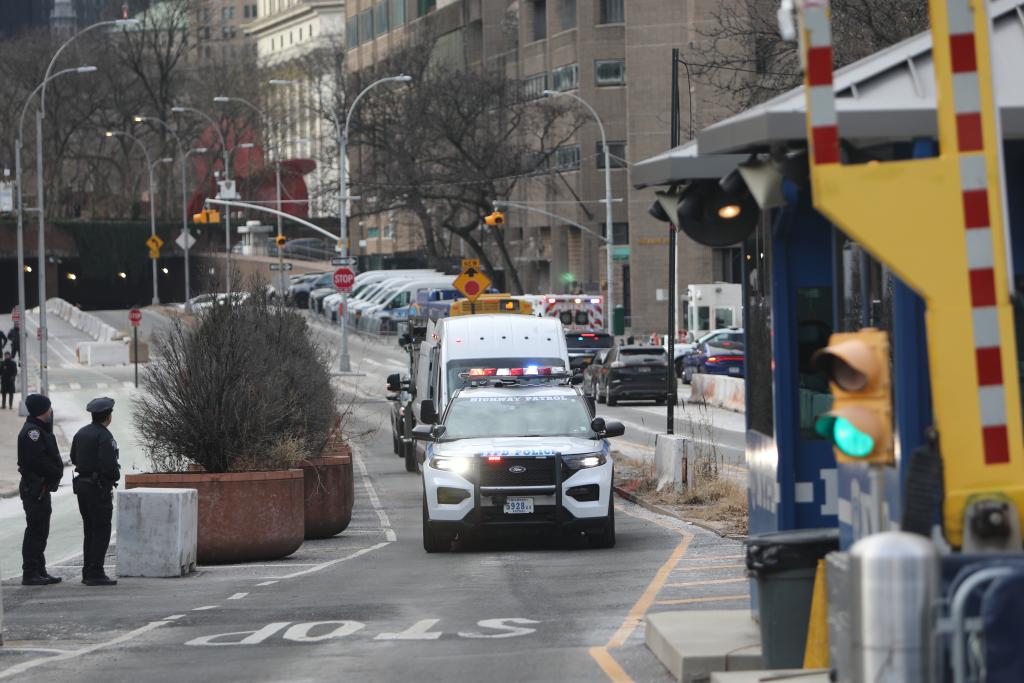
          In New York, Maduro arrived at federal courthouse on Monday to appear in court.

          Maduro, 63, faces charges that accuse him of providing support to major drug trafficking groups, such as the Sinaloa Cartel and the Tren de Aragua gang.

          Maduro has denied wrongdoing.

          Venezuela's government kept operating as usual over the weekend as ministers remained in their posts.

          The capital was unusually quiet on Sunday, with few vehicles moving around and convenience stores, gas stations and other businesses closed.

          Maduro's son, lawmaker Nicolas Ernesto Guerra, has not appeared in public since the attack.

          On Saturday, he posted on Instagram a government statement repudiating the capture of his father and stepmother.

          The country's incoming National Assembly is set to be sworn in at the legislative palace in Caracas. The unicameral assembly will remain under the control of the ruling party.

          In a related development, Switzerland has frozen any assets held in the country by Maduro and associates, the Federal Council said on Monday.

          The asset freeze does not affect members of the current Venezuelan government, the statement said.

          AGENCIES - XINHUA

          09:37 2026-01-06
          Venezuela not a major drug source, experts say
          By SHI GUANG in New York

          Experts have questioned whether the Latin American country is actually a major source of drugs in the United States.

          Jonathan Winer, a former senior US diplomat, told The New York Times that the cocaine moving through Venezuela likely accounts for less than 10 percent of the drug exported to the United States.

          Phil Gunson, senior analyst for the Andes Region at International Crisis Group, told PolitiFact that the US administration conflated several situations to conclude that a cartel runs Venezuela in order to justify US military action.

          There is no evidence to suggest that Venezuela's government is engaged in a war of terror against the US, or that it is using drugs and violent criminals to undermine the US, Gunson said.

          Venezuelan President Nicolas Maduro and his wife were forcibly captured by US military forces during a raid on Caracas early Saturday morning.

          The charges against them include narco-terrorism, cocaine importation and possession of machine guns and destructive devices.

          US authorities alleged that Maduro and his family helped cartels such as Tren de Aragua move as much as 250 metric tons of cocaine through Venezuela a year, according to the indictment, adding that the drugs were moved on fast vessels, fishing boats and container ships, or on planes from clandestine airstrips, the indictment says.

          Classified assessment

          However, according to a classified assessment from the National Intelligence Council released in April, no coordination between Tren de Aragua and the Venezuelan government was found, The Associated Press reported.

          The assessment drew from 18 agencies that comprise the intelligence community.

          It repeatedly stated that Tren de Aragua is not coordinated with or supported by Venezuela's president or senior officials in the government.

          While it found minimal contact between some members of the gang and low-level members of the government, there was a consensus that there was no coordination or direct role between the gang and the government, The Associated Press reported.

          According to The New York Times, Venezuela is not a major source of drugs in the US. It does not produce fentanyl or cocaine, narcotics experts said. "Venezuela is more of a transshipment point to Europe, and that doesn't necessarily make it our problem in exactly the same way," Annie Pforzheimer, a former senior US diplomat who specialized in counter-narcotics and Venezuela, told The New York Times.

          09:36 2026-01-06
          Military strike, capture of Maduro condemned
          By JAN YUMUL in Hong Kong
          Protesters shout slogans during a rally near the US embassy in Manila, Philippines, on Monday as they denounce the US after the government captured Venezuelan President Nicolas Maduro and his wife. AARON FAVILA/AP

          Asia-Pacific nations widely condemned the United States' forcible capture of Venezuelan President Nicolas Maduro and his wife Cilia Flores, saying the shocking move over the weekend undermines peace and stability in Latin America and beyond.

          Malaysian Prime Minister Anwar Ibrahim said in a post on X that he was following the developments in Venezuela with "grave concern", noting that Maduro and his wife were forcibly seized in a US military operation of "unusual scope and nature" and that such actions "constitute a clear violation of international law and amount to an unlawful use of force against a sovereign state".

          "President Maduro and his wife must be released without any undue delay", Anwar said, adding that history has shown that abrupt changes in leadership brought about through external force will bring more harm than good.

          The Democratic People's Republic of Korea strongly denounced the US action. A spokesperson from its Foreign Ministry said Washington "wildly violated the sovereignty of Venezuela" and the act shows "the rogue and brutal nature of the US".

          The Iranian foreign ministry said in a statement that it "strongly condemns the US military attack on Venezuela and the blatant violation of the country's national sovereignty and territorial integrity", and stressed that the attack must "be explicitly and immediately condemned by the UN and by all states that are committed to the rule of law, as well as to international peace and security".

          Singapore's foreign ministry said that while there were no Singaporeans e-registered with the ministry in Venezuela, it is "gravely concerned about the US intervention" on Saturday in the nation.

          "Singapore has consistently opposed actions contrary to international law by any parties, including foreign military intervention in any country. Singapore urges all parties to exercise restraint and hopes for a peaceful resolution to the situation in Venezuela in accordance with international law and the principles of the UN Charter," the ministry said in a statement.

          'Dangerous precedent'

          Among other Southeast Asian nations, Indonesia expressed grave concern "over any actions involving the use or threat of force, which risk setting a dangerous precedent in international relations and could undermine regional stability, peace, and the principles of sovereignty and diplomacy".

          A statement by the Department of Foreign Affairs of the Philippines said Manila views with concern the evolving events in Venezuela and "their consequential impact on peace and stability in the region and rules-based international order".

          Thailand's foreign ministry urged all parties involved to resolve the conflict peacefully with full respect for the UN Charter and international law.

          Elsewhere in the Asia-Pacific, Australian Prime Minister Anthony Albanese said his country has long held concerns about the situation in Venezuela, and urged all parties to support dialogue and diplomacy to secure regional stability and prevent escalation.

          New Zealand's Minister of Foreign Affairs Winston Peters echoed a similar view, saying his nation expects all parties "to act in accordance with international law". Meanwhile, he advised New Zealand nationals not to travel to Venezuela.

          India's Ministry of External Affairs said in a statement that recent developments in Venezuela are a matter of deep concern. "We are closely monitoring the evolving situation," it said.

          Arie Afriansyah, a professor in the Faculty of Law at the University of Indonesia, told China Daily that the US can be held accountable under international law.

          "But the questions are: which state is brave enough to start the process against the US, and which forum for this effort? The US will surely veto any effort at the UNSC," said Afriansyah, referring to the UN Security Council.

          09:27 2026-01-06
          Collapse of the rules-based order calls for a new multipolar world order
          By Maya Majueran
          WANG XIAOYING/CHINA DAILY

          The recent, deeply disturbing reports surrounding the forcible detention of Venezuela's president serve as a stark reminder of the widening gap between the rhetoric of a so-called "rules-based international order" and the realities of contemporary power politics.

          While global governance frameworks are routinely invoked to legitimize intervention, sanctions, and diplomatic pressure, their application remains selective and contingent. This asymmetry exposes the extent to which the rules-based order functions less as a neutral system of law and more as a flexible instrument of hierarchy — one that increasingly struggles to conceal its underlying coercive logic. Incidents such as these do not merely challenge international norms; they reveal how far norms have already eroded.

          This is not an anomaly, but part of a well-worn playbook: a decades-long pattern of unilateral interventions and coercive regime changes authored by the United States and its close circle of Western allies. From Cold War coups to 21st century wars, the justificatory language has shifted between containment, democracy promotion, humanitarianism, and counterterrorism — but the underlying logic has remained remarkably consistent. The outcomes are equally familiar: the erosion of national sovereignty, entrenched instability, humanitarian catastrophes, the extraction or appropriation of national resources, and a steady global loss of trust in the very principals these interventions claim to defend.

          This recurring pattern does more than condemn past actions; it offers a powerful indictment of the unipolar moment itself. The concentration of disproportionate power in the hands of a single state and its allies has not produced stability, restraint, or universal adherence to international law. Instead, it has generated a system in which the rules are applied selectively, and violations are normalized when committed by those at the apex of the global hierarchy.

          In this sense, unilateral intervention is not a failure of the unipolar order, but its most revealing feature. Therefore, it provides the strongest argument for why the international community must move beyond unipolarity and work toward a genuine multipolar world order — one in which power is more evenly distributed, sovereignty is meaningfully respected, and no single actor can unilaterally define legality, legitimacy, or justice on behalf of the rest of humanity.

          A world in which overwhelming power is concentrated on a single pole or even within a tightly aligned bipolar block creates a permissive environment in which the geopolitical interests of the few are laundered through claims of universal good. It sustains a system where "might makes right" is obscured by the rhetoric of shared values, and where the United Nations' foundational principle of the sovereign equality of states is reduced to a hollow promise for those far from the levers of power.

          The consequences are visible in the fractured states and refugee crises that now dot the global landscape as monuments to the failure of imposed solutions. This model of international relations is exhausted, morally bankrupt, and empirically disastrous. It is a recipe for perpetual conflict and resentment, not for lasting peace or shared prosperity.

          Yet an alternative vision is emerging. This vision is reflected in China's Global Governance Initiative and its complementary Global Security Initiative. Together, they propose a paradigm shift away from domination and toward dialogue, away from zero-sum confrontation and toward mutual security. At their core lies a renewed commitment to the fundamental principles of the UN Charter so often ignored by interventionist practices: the inviolable sovereignty of states and the imperative of non-interference in internal affairs. This framework asserts that stability and legitimacy must emerge organically from within societies themselves, rather than being imposed through external force or subversion.

          This is not an argument for isolationism, but for a more equitable and effective form of engagement. It calls for inclusive, reformed multilateralism where global challenges are addressed through deliberation in representative institutions rather than dictated by self-appointed coalitions. It emphasizes win-win cooperation, prioritizing shared development through connectivity, infrastructure, and economic integration, rather than enforcing political conditionalities or carving out spheres of influence. Unsurprisingly, this approach resonates deeply across the Global South, where many nations have grown weary of being treated as instruments rather than partners.

          The path forward is clear: the collapsing legacy of unilateral regime change demands a conscious choice for a different future. Supporting the transition to a multipolar world does not mean replacing one hegemon with another; it means cultivating a system with multiple centers of political, economic, and civilizational gravity. Such diffusion of power offers the most effective safeguard against the excesses of any single state and lays the foundation for a fairer, more representative international order in which all nations — regardless of size or power — have a meaningful voice.

          Ironically, it is precisely this pattern of coercive US behavior — selective legality, interventionism, and a blatant disregard for sovereignty — that continues to strengthen China's standing across the Global South. Each episode reinforces the perception that the existing order serves the interests of a few rather than the needs of the many. As a result, more countries are gravitating toward alternative frameworks that promise respect, equality, and development without domination. The accelerating shift toward multipolarity is therefore not driven by ideology alone, but by lived experience.

          A multipolar world order — one that serves all nations irrespective of size or power — is no longer an abstract aspiration. It is an emerging reality — shaped as much by the failures of unipolar conduct as by the growing demand across the Global South for a more just, inclusive, and balanced international system.

          Maya Majueran is the founding director of the Belt and Road Initiative Sri Lanka (BRISL), a pioneering organization dedicated to research, dialogue, and engagement on China's Belt and Road Initiative (BRI). 

          The views don't necessarily reflect those of China Daily.

          If you have a specific expertise, or would like to share your thought about our stories, then send us your writings at opinion@chinadaily.com.cn, and comment@chinadaily.com.cn.

          09:21 2026-01-06
          Operation Absolute Resolve really Operation Absolute Lawlessness!
          By LI YANG
          Protesters gather outside the federal courthouse in New York City on Jan 5, 2026 where Venezuelan President Nicolás Maduro and his wife made their first court appearance since being taken from their home. [Photo by Shi Guang/For chinadaily.com.cn]

          The abduction of Venezuelan President Nicolas Maduro and his wife Cilia Flores on Saturday, through the United States' "Operation Absolute Resolve", and their arraignment in New York on Monday on federal charges related to "drug trafficking" and working with gangs designated as "terrorist organizations" mark a dangerous escalation in Washington's long-running campaign against Venezuela. Whatever justifications the US administration trumps up for its acts, there is no disguising their nature: the extraterritorial abduction of a head of state and his spouse using military force.

          Such conduct is a flagrant violation of international law that the US claims to uphold. Speaking on Sunday, Chinese Foreign Minister Wang Yi made clear that China opposes the use of or threat of force to impose one country's will on another. "We never believe that any country can play the role of world policeman, nor do we agree that any country can claim itself to be an international judge," Wang said, adding that the sovereignty and security of all countries should be fully protected by international law.

          Beijing's stance was further underlined by a Chinese Foreign Ministry spokesperson, who stressed that the US moves are in clear violation of international law, the basic norms of international relations and the purposes and principles of the UN Charter.

          China has called on the US to ensure the personal safety of Maduro and his wife, to release them at once, to cease its attempts to topple the government of Venezuela, and to resolve issues through dialogue and negotiation. These are not abstract diplomatic phrases, but a sober reminder of the red lines of the international order.

          These remarks are given additional weight by the hollow ring of the counternarcotics justification the US administration is citing. US oil companies are going to take control of Venezuela's crude oil, according to US media reports, while policy discussions about US exploitation of Venezuela's vast oil reserves are underway in Washington.

          While taking questions on the US moves' influence on China-Venezuela cooperation at a news conference on Monday, the Chinese Foreign Ministry spokesperson stressed that bilateral cooperation is between sovereign states and protected by international law and the laws of both countries. Regardless of changes in Venezuela's political situation, China's willingness to deepen practical cooperation in various fields between the two countries will not change, and China's legitimate interests in Venezuela will continue to be protected by law, the spokesperson added.

          Likewise, openness, inclusiveness and win-win cooperation are the defining characteristics of China-Latin America cooperation. Latin American and Caribbean countries have the right to independently choose their development paths and partners.

          Spain and several Latin American countries have issued a joint communique condemning the US operation in Venezuela and urging the US administration to heed the voice of the international community.

          What the world has witnessed is a worrying signal that the US will do whatever it takes to seize the resources it covets. The White House is seeking to normalize actions that it would denounce as the actions of a dangerous "rogue state" if carried out by any other country. This double standard not only undermines the credibility of US claims to champion a "rules-based order" but also heralds instability, mistrust and future confrontations. No wonder after senior US officials again mentioned the US' longing for Greenland, the Danish government questioned the nature of their alliance.

          The international community should be clear-eyed about the implications of the US' lawlessness. Respect for sovereignty, opposition to the use of force and adherence to international law are not optional if the fragile balance on which global peace and security depend is to be maintained.

          Page 3 of 9
          Most Read Stories
          Copyright 1995 - . All rights reserved. The content (including but not limited to text, photo, multimedia information, etc) published in this site belongs to China Daily Information Co (CDIC). Without written authorization from CDIC, such content shall not be republished or used in any form. Note: Browsers with 1024*768 or higher resolution are suggested for this site.
          License for publishing multimedia online 0108263

          Registration Number: 130349
          FOLLOW US
          主站蜘蛛池模板: 最新成免费人久久精品| 日韩精品国产中文字幕| 精品久久久久久无码专区不卡| 国产无遮挡又黄又爽不要vip软件| 日韩不卡1卡2卡三卡网站| 亚洲第一视频在线观看| 男按摩师舌头伸进去了电影| 国产精品一二三入口播放| 无套内谢少妇毛片aaaa片免费| 欧美成人无码a区视频在线观看| 人妻少妇偷人精品一区| 久久99精品国产99久久6不卡| 精品亚洲精品日韩精品| 熟女一区| 欧美大胆老熟妇乱子伦视频| 国产超碰无码最新上传| 亚洲国产成人久久综合一区| av永久免费网站在线观看| 国产AV一区二区三区| 少妇爽到呻吟的视频| 亚洲精品区午夜亚洲精品区| 亚洲激情一区二区三区视频| 亚洲人妻一区二区精品| 日本韩国一区二区精品| 国产午夜精品福利免费看| 少妇高潮喷潮久久久影院| 人妻少妇不满足中文字幕| 国产激情艳情在线看视频| 亚洲aⅴ男人的天堂在线观看| 九九久久亚洲精品美国国内| 资源新版在线天堂偷自拍| 无码福利写真片视频在线播放| 国产丝袜在线精品丝袜| 国产精品店无码一区二区三区| 国产成人亚洲综合无码品善网 | 亚洲国产精品一区二区三| 一区二区三区av天堂| 超碰成人精品一区二区三| 五月婷婷久久中文字幕| 高清破外女出血AV毛片| 色吊丝二区三区中文写幕|