Nuclear Meltdown
Radiation fears hit Japanese food
By Wang Chenyan and Li Yao (China Daily)
Updated: 2011-03-25 06:41
 |
Large Medium Small |
|
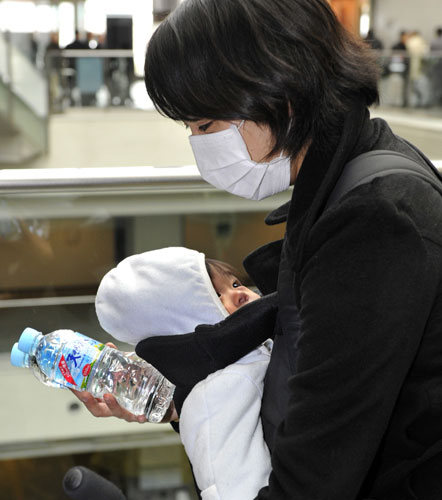 A mother holding her baby receives bottled water in Tokyo on Thursday. Officials warned on Wednesday that tap water in the Japanese capital contained radiaoactive iodine and was unsafe for infants to drink. [Photo/Agencies] |
BEIJING - Fears of radiation contamination from a crippled Japanese nuclear power plant have prompted governments around the world to either halt food imports from Japan, or step up tests, nearly two weeks after a devastating earthquake and tsunami.


Radiation has seeped into raw milk, seawater and 11 varieties of vegetables, including broccoli, cauliflower and turnips, grown in areas around the plant, according to media reports.
Foreign Ministry spokeswoman Jiang Yu said at a news conference on Thursday that the relevant authorities in China will continue to conduct radiation tests on food imports from Japan.
"We are monitoring the impact of the radiation and hope the Japanese government will take all measures to ease the situation," she said.
She was speaking as the United States and Australia halted imports of Japanese dairy products and other food from the region surrounding the nuclear plant. Hong Kong said it wanted Japan to conduct safety checks on meat, eggs and seafood, and Canada said it would upgrade controls on Japanese food imports.
Singapore has banned the sale of some foods from four Japanese prefectures, and the Philippines has banned chocolate imports from Japan amid contamination fears.
Concern has also spread to Europe. Officials in Iceland said they measured trace amounts of radioactive iodine in the air but assured residents it was "less than a millionth" of what was found in European countries in the aftermath of the 1986 Chernobyl disaster.
The European Union has urged member states to check Japanese food imports. The Food Administration of Sweden announced on Wednesday it would check products that may have been directly exposed to radioactive fallout or contaminated later during packaging and transportation.
But South Korea's agriculture ministry said on Thursday that it had no plans to ban produce from areas of Japan that have been affected by the nuclear accident, saying it had found no contamination in Japanese food imports so far.
"We are not considering banning (Japanese food) at this stage as we are conducting thorough tests," the ministry said in a statement.
Exposure to large amounts of radioactivity can cause nausea, vomiting, hair loss, diarrhea, hemorrhaging and death. It also causes DNA damage and raises the risk of cancer, particularly in young children.
"Food safety issues are an additional dimension of the emergency," said three UN agencies in a joint statement issued in Geneva, pledging they were "committed to mobilizing their knowledge and expertise" to help Japan.
Japan was taking the right action, said the International Atomic Energy Agency, the World Health Organization, and the Food and Agriculture Organization.
"Food monitoring is being implemented, measurements of radioactivity in food are taking place, and the results are being communicated publicly."
| 分享按鈕 |