Comments
  Print
Print  Mail
Mail  Large Medium Small
A 'nuclear-explosive' style diplomacy that shocked the world
On Jan 27, 1964, a simple joint communiqué that only consisted of two sentences announced the establishment of diplomatic relations between the PRC and France. The news was as a nuclear bomb to the international community.
On Oct 22, 1963, Charles de Gaulle's special envoy, the then President of French Ministers Council (Président du Conseil des Ministres) Edgar Darfur visited China with the mission to establish the diplomatic relations with the new China.
During Darfur's visit in Beijing and Shanghai, he had six talks with Premier Zhou Enlai and Vice Premier Chen Yi. Darfur said France was unwilling to take the initiative to break off diplomatic relations with Taiwan, and hoped to keep a low-level consul in Taiwan. But the Chinese side said that there was no room for negotiations on these issues. Finally, France recognized the PRC as the sole legitimate representative of the Chinese people and supported its rights in the United Nations. France also withdrew its representatives and institutions in Taiwan.
In 1963, de Gaulle approved the agreement signed in the negotiations. Both China and France simultaneously announced the establishment of diplomatic relations between the two countries in January 1964.
Western media at that time described the diplomatic relations as a "diplomatic nuclear explosion" on the international community.
First, the establishment of diplomatic relations between the two major countries - which belonged to different camps in the cold war- broke the bipolar pattern of US-Soviet hegemony.
Secondly, it opened a mode of direct dialogue between nations that was later followed by other countries.
Third, it met both countries' own strategic needs. De Gaulle's "triumvirate" was flatly rejected by the US and the UK so France needed to seek another way if it wanted to maintain its status as a major power. China in the east was its best choice. Concerning the young new China, on the one hand the country was suffering from its isolation from the US and the Europe, and on the other hand it was trying to resist the control of the Soviet Union. So France was a sally port for China to get rid of this unfavorable situation.
Bilateral relations were hit hard in the 1990s due to drastic changes in Europe.
The bipolar pattern collapsed after the Berlin Wall fell in 1990 and the Soviet Union's collapse in 1991. In this context, French leaders misjudged the international situation and acted in ways detrimental to Sino-French friendship.
Its first move was sanctions against China. Then France sold six frigates and 60 "Mirage 2000" fighters to Taiwan. These two pieces of arms sales seriously damaged China's sovereignty and national security.
France's acts meant bilateral relations fell apart. The Chinese government put forward the strongest protest and adopted a series of punitive measures. It demanded the French government close its consulate in Guangzhou within a month and revoked large-scale projects under negotiations, such as the Guangzhou Metro and the Daya Bay Nuclear Power Station. China strictly controlled the exchanges on the vice ministerial level and took the non-engagement policy against the companies that sold the arms to Taiwan.
This collapse of China-French relations lasted five years, and exchanges in various fields were frozen.
After the mid-1990s, China-French relations started to normalize again and quickly transformed into a honeymoon period.
Various exchanges have made remarkable progress.
A very important person was behind this is a Gaullist: Jacques Chirac. In 1993, as a candidate of the UMP (Union pour un Mouvement Populaire), he won the general election and became the French president. Chirac twice sent representatives to China, hoping to resume bilateral relations. It was in January 1994 that an agreement was reached. In the "112 communiqué," the French government promised not to involve any arms selling to Taiwan and clearly recognized that Taiwan is an inalienable part of China. Its later publication laid a new political foundation for the development of China-French relations.
In May 1997, during a state visit to China, President Chirac and then-Chinese President Jiang Zeming signed a joint statement announcing a comprehensive partnership between China and France and defined ambitious targets in political, economic and cultural cooperation. The move caused great worldwide repercussions. France once again won first prize in China's relations with the Western powers.
China-France relations were at their best in history during the 12 years of the Chirac presidency. From 2003 to 2005, China and France held the "Sino-French culture year" in turn. The two countries built a strategic partnership when President Hu Jintao visited France in 2004.

 Woman pulls a 2.5 ton car with her hair
 Fukushima starts year-long fuel removal
 Mermaids mesmerize visitors
 Bus overturns in Indonesia, killing 4 Chinese
 Russia mourns air crash victims
 5 dead as tornadoes ravage US Midwest
 Vintage cars concours kicks off in Kenya
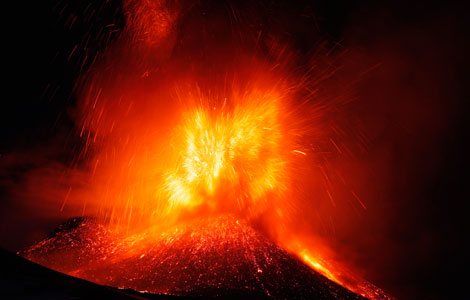 Volcano erupts on Italy's Mount Etna
Copyright 1995 - . All rights reserved. The content (including but not limited to text, photo, multimedia information, etc) published in this site belongs to China Daily Information Co (CDIC). Without written authorization from CDIC, such content shall not be republished or used in any form. Note: Browsers with 1024*768 or higher resolution are suggested for this site.
License for publishing multimedia online 0108263 Registration Number: 20100000002731