The Korean nuclear issue: Past, present, and future – A Chinese perspective


Editor's Note: Fu Ying, the chairperson of the Foreign Affairs Committee of China's National People's Congress, offers a Chinese perspective on the Korean nuclear issue, which has become the focus of attention in the Asia Pacific and the world.
 |
|
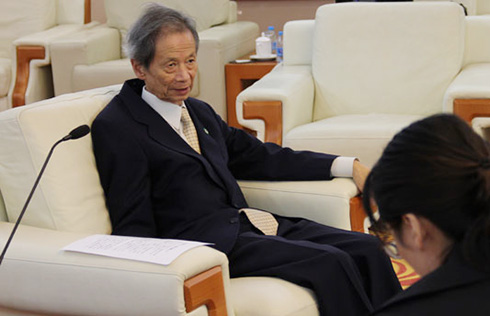
File photo of Fu Ying,the chairperson of the Foreign Affairs Committee of China's National People's Congress. [Photo/Xinhua] |
The Korean nuclear issue is the most complicated and uncertain factor for Northeast Asian security. It has now become the focus of attention in the Asia Pacific and even the world at large. Now, as the issue continues to heat up, one frequently raised question is: Why can't China take greater responsibility and make North Korea stop its nuclear weapons program?
China started to mediate on the Korean nuclear issue and host talks in 2003, at the United States' sincere request. As a developing country, China upholds its five principles of peaceful coexistence. On the Korean nuclear issue, which has a direct bearing over regional security, China's position is to strongly oppose nuclear proliferation. Upon taking up its role as a mediator, China firmly requested the Democratic People's Republic of Korea (DPRK, commonly referred to as North Korea) to stop its nuclear weapons development while requesting other concerned parties, especially the U.S., to address the DPRK's legitimate security concerns. But the deep mistrust between the U.S. and the DPRK made it very hard for any consensus or agreement made during the years of negotiations to be effectively implemented.
China had been working hard to play its role both as a mediator and a party to U.N. sanctions, but it did not have the leverage to force either the U.S. or the DPRK to assume their respective responsibilities. Without holding the key to the DPRK's security concerns, China has no leverage to convince this foreign nation to stop its nuclear program. The U.S., which the DPRK sees as the source of threats to its security, has been neither interested nor willing to consider responding to the DPRK's security concerns.
As the two sides reached an impasse, the DPRK took the opportunity to move forward with its program and, since 2005, has carried out five nuclear tests and numerous missile tests. In the meantime, the U.N. Security Council has stepped up sanctions, and the US and the Republic of Korea have been carrying out heightened military exercises to exert greater military pressure on the DPRK. Consequently, tensions are now running high and the channel for talks is closed, and the situation is increasingly dangerous.
On the international stage, the main players are states who enjoy sovereign rights endowed by the U.N. Charter and international law. Powerful states may have greater influence over the international situation, but they should also bear the consequences of what they say or do.
Smaller or weaker states may counter or respond to pres- sure from powerful states, but there is a price to pay for doing so. The international situation often evolves as the result of actions and counteractions by states over specific issues, whereby tension between states can rise and even intensify, leading the situation in an unexpected direction.
That is why China believes that peaceful negotiation is the "Pareto optimal" path. Although it may not meet the optimal demands of any party, it would bring maximal benefits to all parties with minimal cost. This would of course call for all par- ties, the U.S. included, to take their due responsibilities and make the necessary compromises. The reason that no results have been achieved to date is precisely because of the failure to implement negotiated agreements and the suspension of negotiations.
China remains committed to a nuclear-free Korean Peninsula. It has been and will continue to work to safeguard regional peace and stability. China stands for dialogue as the right route to address the Korean nuclear issue. North and South Korea are geographically connected and both are China's close neighbors; North Korea, in particular, shares 1,300 kilometers (808 miles) of common border with China. Any military conflict or disturbance in this region will endanger peace and stability, inflict huge damage to innocent people, and may even escalate tensions beyond control. The international community has witnessed enough bitter outcomes caused by the unwise use of military action over the past decades.
This article intends to revisit the recent history of the Korean nuclear issue, including how the Three-Party Talks evolved to Six-Party Talks and then broke down—a process in which I had been personally involved at its early stage. The goal is for readers to better understand the origin as well as the trajectory of multilateral efforts regarding the Korean nuclear issue: How did things reach this point? How and why were potential moments of successful resolution missed? Hopefully recounting this period of history can be of some guidance for making wiser choices in the future.
As the Chinese saying goes, "He who tied the bell should be the one who unties it." To open the rusty lock of the Korean nuclear issue, we should look for the right key.