Trump's blame for US factory closings a 'stretch'


Did China's entry into the World Trade Organization cause 60,000 factories in the United State to close?
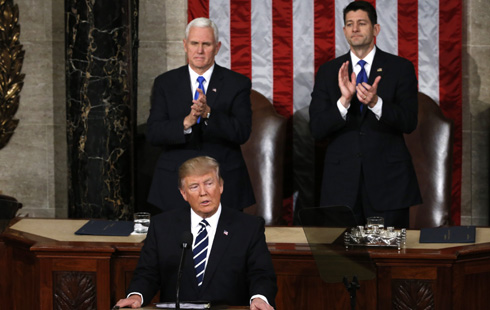
"We've lost more than one-fourth of our manufacturing jobs since NAFTA (North America Free Trade Agreement) was approved, and we've lost 60,000 factories since China joined the World Trade Organization in 2001," US President Donald Trump said Tuesday night in his first speech to a joint session of Congress.
That 60,000 number is accurate, but blaming China for the closings is, as one economist said, "a stretch''.--
While 60,000 factories were closed between 2002 and 2014, according to the US Census Bureau, China's entry into the WTO in 2001 isn't the reason, said Monica de Bolle, senior fellow at the Washington-based Peterson Institute for International Economics.
"The number is accurate, but attributing it to China is a stretch. There's nothing in the data that suggests it has anything to do with China," she said.
A steep decline in manufacturing jobs occurred after 9/11, rebounded, and then dropped dramatically again after the 2008 financial crisis. From 2009 to 2016, roughly 1 million jobs in manufacturing have been created. Trump's reference to a 25 percent loss in manufacturing jobs is correct, but there isn't a clear relationship to NAFTA or China's entrance into the WTO, de Bolle said.
"What seems to be happening is that there's more of a relationship to crises that hit the US economy, plus automation that has happened to manufacturing to a very large extent, and changes in the labor market structure in the US not related directly to automation, such as outsourcing of jobs," she said, "which have nothing to do with China, and which probably explain also the destruction of 60,000 firms in the manufacturing structure."
China's Foreign Ministry spokesman Geng Shuang said during a Wednesday press briefing that since joining the WTO, China has actively engaged in "international cooperation".
"This has boosted not only its own foreign trade, but also global trade, making important contribution to world economic growth and winning wide recognition and praise of the international community. China-US economic and trade cooperation is mutually beneficial in nature," he said.
Martin Baily, a trade economist at the Brookings Institute in Washington, said that much of the substantial decline in manufacturing jobs in the US after 2000 "does not mean that trade with NAFTA or trade with China are responsible."
Productivity increases and automation contributed to the decline, as did a slow growth in US demand for manufactured goods, he said.
"Our trade with Mexico has only a small deficit and we had a surplus with Canada in 2016. Manufacturing trade with China is very unbalanced, but that is not just China," Baily said.
A January report from the US-China Business Council stated that the US-China trade relationship today supports about 2.6 million jobs across a range of industries. US exports to China directly and indirectly created $165 billion in GDP in 2015 and supported 1.8 million new jobs, and combined with Chinese investment into the US the jobs total is 2.6 million. US-China trade ties generated 1.2 percent of US GDP in 2015, according to the report.
A June 2015 report on productivity growth in the US from 1998 to 2012 from the Center for Business and Economic Research at Ball State University said that 88 percent of job losses in manufacturing were due to technological changes like automation rather than international trade. Economists said that industrial output and productivity have increased despite fewer workers, according to the report.